Best B2B Mobile Phone Data Providers in 2026: Why Accuracy and Coverage Beat "Best Data" Claims

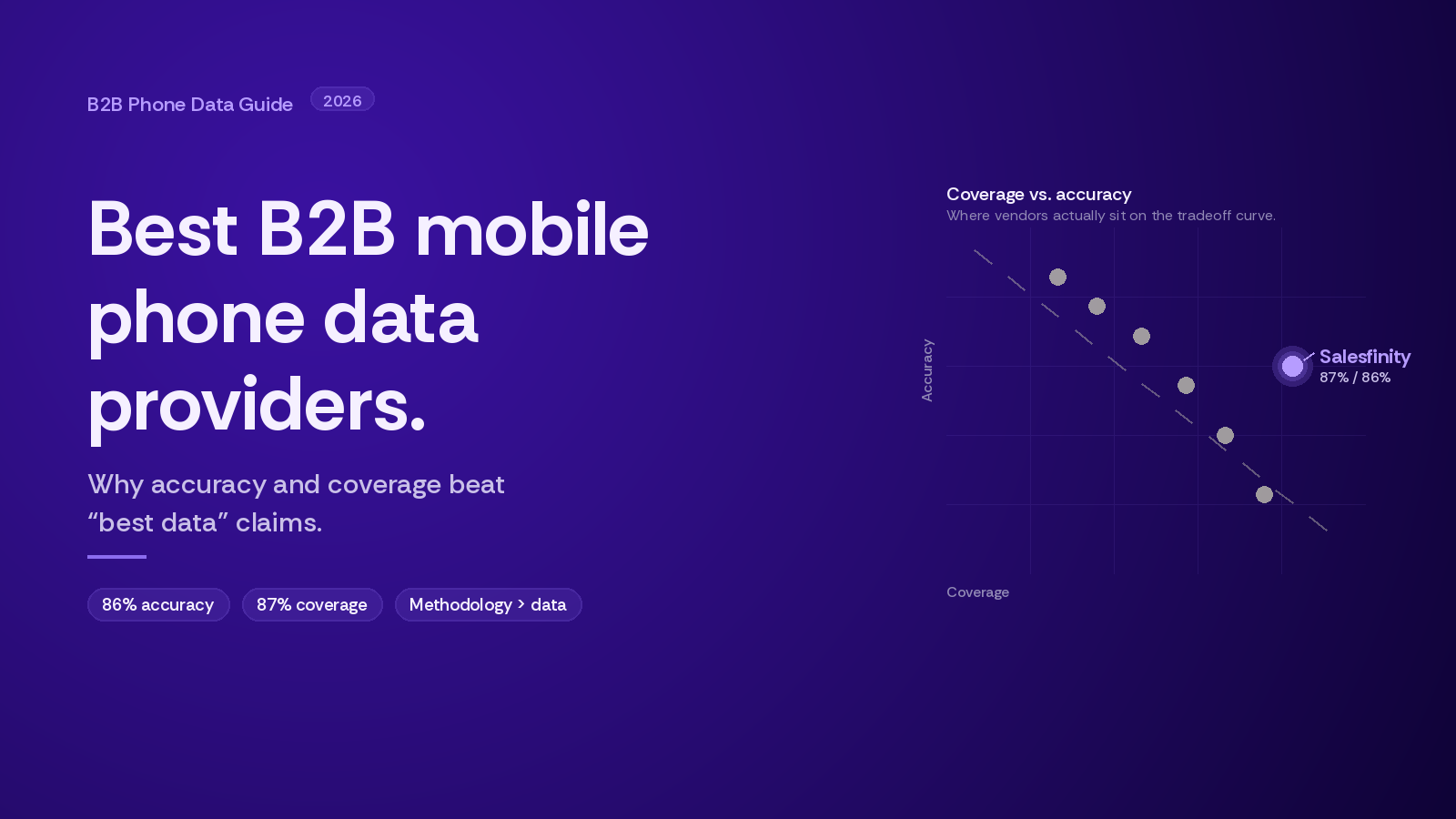
Quick answer: No B2B phone data vendor has access to secret data sources. Every vendor — including Salesfinity — pulls from the same pool of upstream providers. The difference between vendors is methodology: how they rank sources, how they validate accuracy, and whether their system learns from real dial outcomes. Salesfinity operates at 86% accuracy with 87% coverage — the highest accuracy ratio at scale-level coverage in the category.
Every dialer vendor claims to have "the best data." Most of those claims are nonsense, because of a basic fact most prospects don't know: there is no secret stash of phone numbers. Everyone — including us — pulls from the same pool of upstream data providers. The contact records you get from a major sales engagement platform, a parallel dialer, and a standalone enrichment tool are drawn from a small handful of underlying sources that all the vendors share.
So if everyone has access to the same data, why is the quality of what reaches your reps so different?
Because data is a commodity. Methodology isn't.
This post is about the methodology behind Salesfinity's B2B mobile phone data — why our 86%+ accuracy at industry-leading coverage outperforms the inflated numbers other vendors quote, and why our system structurally improves over time in a way most providers can't replicate.
What is B2B mobile phone data accuracy?
B2B mobile phone data accuracy is the percentage of phone numbers in a contact dataset that are correct, working, and reach the actual person they claim to belong to. Accuracy is one of two metrics that determine the quality of any phone data set; the other is coverage — the percentage of your target prospects the vendor can actually provide a number for.
These two metrics are in tension. You can artificially inflate one by sacrificing the other, which is exactly what most vendors do when they quote impressive accuracy numbers in marketing materials.
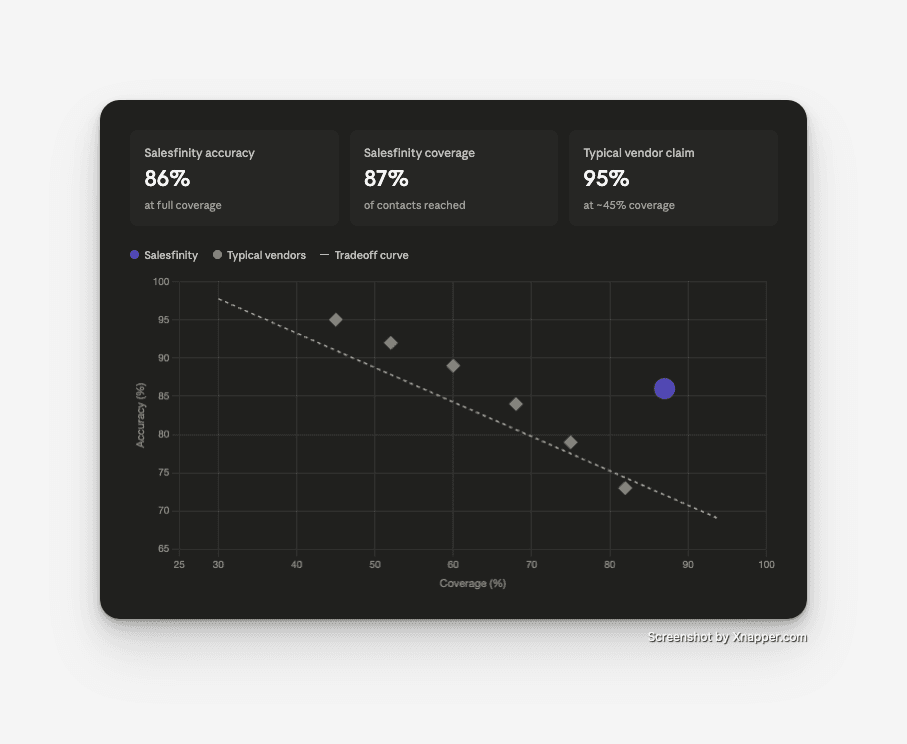
If a vendor tells you they have 95% accuracy, ask them about coverage. The math almost always reveals the same trick: they hit 95% accuracy by aggressively filtering out anything that isn't a high-confidence match — which means they're only delivering numbers for 40-50% of your contact list. The other half, your reps see "no number available" and the prospect doesn't get dialed.
You can technically push accuracy to 95%+ by throwing out enough of your database. Anyone can. The trade-off is that you're sending your reps half a contact list and pretending the missing half doesn't exist.
The real test is accuracy at scale-level coverage — what percentage of your contacts are reachable, and of the ones we provide, how many actually work.
Salesfinity currently runs at roughly 86% accuracy with 87% coverage. Both numbers are improving as our system matures. At the coverage level we operate at, that's the highest accuracy ratio in the category. Vendors that quote higher accuracy numbers are nearly always doing it by hiding their coverage.
Where does the difference between phone data vendors come from?
Methodology. Specifically, three things we do that almost no one else does.
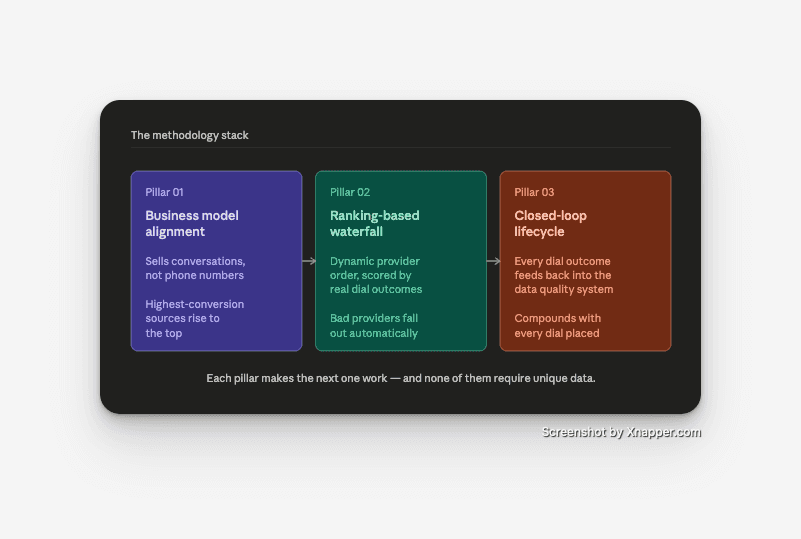
1. Our business model rewards conversations, not phone numbers sold
Most data providers are in the business of selling phone numbers. Their economic incentive is volume — the more numbers they push into customers' systems, the more they make. Whether those numbers actually connect a real conversation isn't their problem after the sale. There's no feedback loop that ties the data they sold to the outcome that data produced.
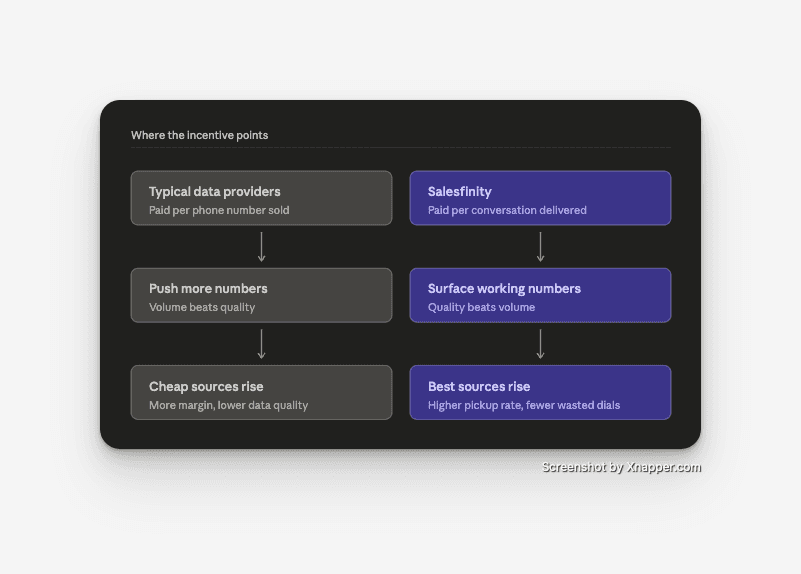
Salesfinity is in the business of selling conversations. Our customers don't care how many numbers we delivered to their dialer. They care how many of those numbers turned into a live conversation between an SDR and a prospect. That alignment changes every decision we make about data quality.
When a data provider's business model is "sell more numbers," it's economically rational to push lower-quality, higher-quantity sources to the top of their waterfall. When our business model is "deliver more conversations," it's economically rational to do the opposite — push the highest-conversion sources to the top, and aggressively penalize providers whose numbers don't actually connect.
The same data sources, pointed at different success metrics, produce different output.
2. A ranking-based waterfall, scored by real dial outcomes
Most enrichment systems use a fixed waterfall. Source A is checked first, then Source B, then Source C, in a predetermined order. The order is usually set once at integration time and rarely changes — and when it does change, it's typically because a salesperson at the data provider negotiated a better contract, not because of any signal about which provider is actually delivering better numbers.
Salesfinity's waterfall is dynamic and ranked by performance. Every phone number that flows through our platform is scored against the eventual outcome of the dial — did the call connect, did it ring out, did it hit a voicemail, was the number disconnected, did the wrong person answer. That outcome data feeds back into provider rankings continuously.
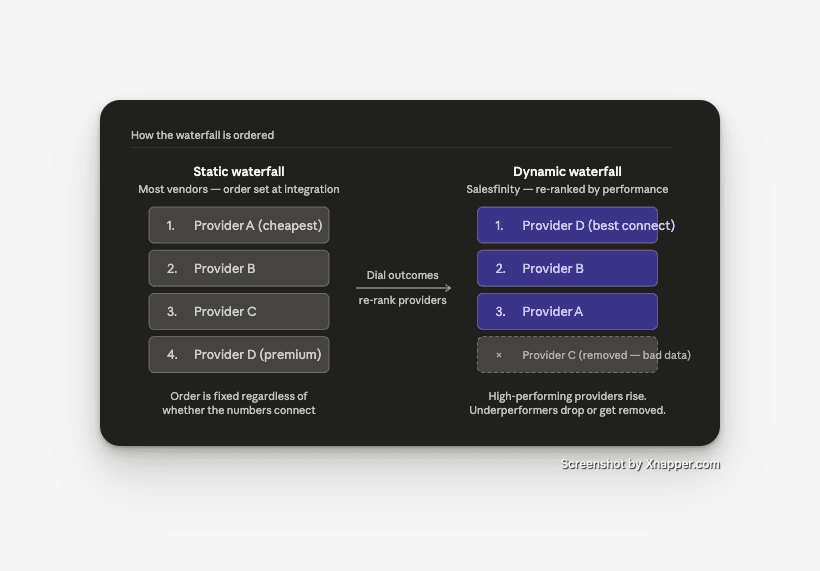
Providers that consistently deliver numbers that produce live conversations move up our waterfall. Providers that consistently deliver dead lines, voicemails, and wrong-number connects move down — and at the extreme, they get pulled out of the waterfall entirely.
Our customers benefit from the compounding effect: every dial they place across our platform makes the next dial slightly more likely to connect, because the system has learned which sources are working in real time. No data provider — including the ones we use upstream — has access to this signal, because they don't see what happens after the number is sold.
3. A self-aware, closed-loop system across the entire phone number lifecycle
This is the part that's structurally hardest for competitors to copy.
A typical data provider's relationship with a phone number ends at the point of sale. They generate the number, they sell it, they move on. They have no mechanism to learn whether the number worked, because they're not the ones placing the call.
Most dialers, on the other hand, have visibility into call outcomes — but they treat that as analytics for the customer, not as feedback to improve the underlying data. The dial happens, the disposition gets logged, the data quality stays static.
Salesfinity is built across the entire lifecycle:
We ingest data from multiple upstream providers
We rank those providers in real time based on observed outcomes
We surface the highest-ranked number to your rep
The rep dials, and we capture the outcome at the millisecond level
That outcome flows back into the ranking system, the enrichment waterfall, and the underlying data quality scores
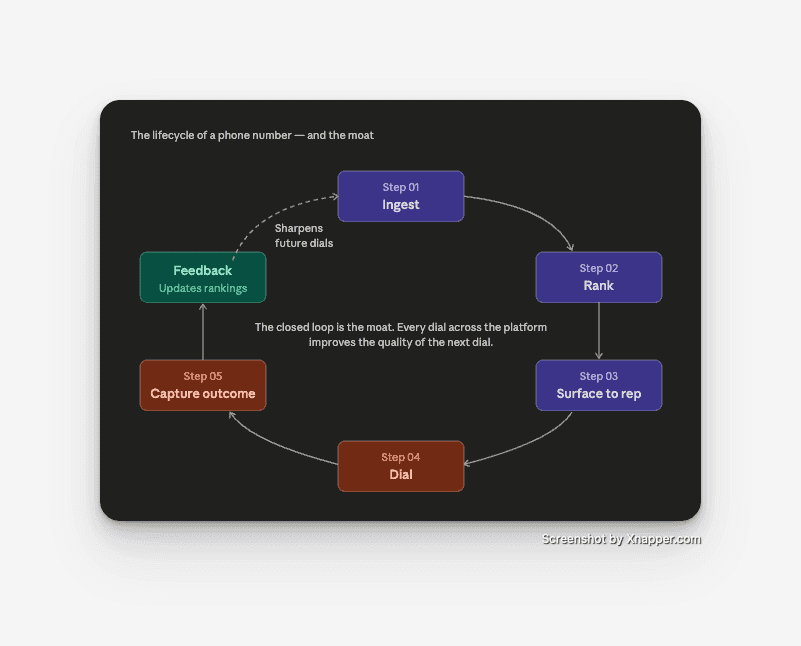
Every dial across our platform — millions of them — is improving the quality of the next dial. The data isn't static; it's a system that gets smarter every time it's used.
This is structurally different from the data provider model, where the data is delivered, billed, and forgotten. And it's structurally different from the dialer-only model, where outcomes are reported but never fed back into the data layer. The closed loop is the moat.
How to evaluate B2B phone data vendors
If you're evaluating phone data for an outbound team, here's what to actually ask vendors:
What's your accuracy at full coverage — not your cherry-picked accuracy after filtering down to high-confidence matches?
How does your enrichment waterfall change over time based on observed dial outcomes? If it's a fixed order, the system isn't learning.
Do call outcomes feed back into your data ranking system, or do you just sell numbers and move on?
Is your business model aligned with conversations or with volume? A provider that gets paid per number sold has different incentives than one that gets paid for a working number.
These questions matter more than any individual accuracy number a vendor quotes you in a marketing deck. The vendors with the best data aren't the ones with secret access to better sources — they're the ones with better methodology for separating signal from noise across millions of dials.
That's why Salesfinity has the best B2B mobile phone data in the industry. Not because we have data nobody else has access to. Because we've built the system that gets the most out of the data everyone has access to — and that system gets sharper every time your reps make a call.
Frequently asked questions
What is the most accurate B2B mobile phone data provider?
There is no single most accurate B2B mobile phone data provider, because accuracy is meaningless without coverage. A vendor claiming 95% accuracy at 45% coverage is delivering fewer reachable contacts than a vendor at 86% accuracy with 87% coverage. Salesfinity operates at 86% accuracy with 87% coverage — the highest accuracy ratio at scale-level coverage in the category.
What is a good accuracy rate for B2B phone data?
A good accuracy rate for B2B phone data is 85% or higher when measured at full coverage. Vendor-quoted accuracy rates above 90% almost always involve filtering down to a smaller, high-confidence subset of contacts — which sacrifices coverage. Always evaluate accuracy and coverage together, not in isolation.
What's the difference between accuracy and coverage in phone data?
Accuracy is the percentage of provided phone numbers that are correct and working. Coverage is the percentage of your target contact list that the vendor can provide phone numbers for. The two metrics are in tension: filtering out low-confidence records raises accuracy but lowers coverage. The right benchmark is accuracy at full coverage.
Do all phone data vendors use the same data sources?
Largely yes. Most B2B phone data vendors draw from the same handful of upstream data providers. The difference between vendors is methodology — how they rank sources, validate numbers, and learn from real dial outcomes. Vendors claiming proprietary or secret data sources are typically overstating; the real differentiator is how the data is processed and ranked.
What is a data enrichment waterfall?
A data enrichment waterfall is a sequence of data sources that a system queries in order to enrich a contact record. When the first source returns no result or a low-confidence result, the system moves to the next source, and so on. Most waterfalls use a fixed order set at integration time. Better systems rank sources dynamically based on observed performance — for example, Salesfinity's waterfall reorders sources based on real dial outcomes.
How does Salesfinity improve phone data quality over time?
Salesfinity captures the outcome of every dial — connect, voicemail, wrong number, disconnect — and feeds that outcome back into provider rankings. Sources that produce live conversations move up the waterfall. Sources that produce dead lines move down or are removed entirely. The data quality compounds: every dial across the platform improves the quality of the next dial.
Why is most B2B phone data inaccurate?
Most B2B phone data is inaccurate because data providers' business models reward volume, not working numbers. Once a provider sells a phone number, their relationship with that number ends — they have no feedback loop to learn whether the number worked. Without that closed loop, data quality stays static and decays as numbers age out, prospects change roles, and businesses move.
How can I tell if a phone data vendor's accuracy claims are real?
Ask three questions: (1) What's your accuracy at full coverage, not at the filtered subset? (2) How does your enrichment system learn from dial outcomes? (3) When was your accuracy last benchmarked, and against what methodology? Vendors with real accuracy will answer all three. Vendors quoting marketing-deck numbers will deflect on coverage and methodology.