Blog
Product updates and practical playbooks for modern teams
Stay updated on releases, learn best practices, and explore how partners and modern teams structure work.
Search...

·
Author
GTM Engineering for the Phones: Four Workflows You Can Build This Month
By Ben Holley, Head of GTM at Apero Advisors
Most GTM engineering content is about email because most GTM engineers don't know anything about picking up the phone.
Having been an SDR at multiple companies and having made thousands and thousands of cold calls in my life, I can confidently tell you that the phone is where some of the highest-leverage GTM engineering activities will ever occur. A call is the one touch that gets an answer in real time, and almost nobody builds systems around it. Reps still get a list, a dialer, and a hope.
Here are four workflows any team can stand up with a CRM, a dialer, and a handful of automations. Each one is written so you can build it in your own stack. Where it helps, I’ll show how it looks with Salesfinity — their REST API and Dial Links make the plumbing a lot less annoying than it used to be.
Workflow 1: Route every inbound lead to a rep’s phone in minutes
Anyone who raises their hand should be on a rep’s phone within minutes. And you should be able to prove it.
The build is five steps:
Someone submits a form or downloads an asset. The CRM creates or updates the contact.
A CRM workflow assigns an owner: round robin, territory, or the existing account owner.
That same workflow dumps the lead into the rep’s call queue and fires a Slack alert with a button.
Rep clicks the button. Dialer opens on that person. Rep makes the call.
CRM logs the call. A report measures the gap between submit and first dial.
Same pattern works for positive replies to cold email. Someone replies → email tool hits a webhook → CRM → same routing. Keep the routing logic in the CRM, not in the email tool, so every source of interest follows one set of rules. Otherwise you’ll have three “speed-to-lead” systems that all disagree with each other.
How this looks with Salesfinity
Two good ways to build step 3:
Dial Link. A Dial Link is just a URL that carries a person’s phone number and details. Click it, dialer opens on that person. Build it from CRM fields (phone, name, company, email) and put it behind the Slack button. Add
auto_dial=1if you want the call to start after a three-second countdown the rep can cancel. Include the email so Salesfinity can match them to the existing contact and pull call history. Their docs have ready-made link templates for HubSpot and Salesforce.API enrollment. Salesfinity’s REST API can add a contact to a sequence and set the owning rep in the same request, so the call task lands in that rep’s queue. Contact doesn’t exist yet? The request creates it.
The speed-to-lead report
Build one report: average minutes from form submission to first call, by rep. Subtract submission timestamp from the first logged call on the contact, average by owner. Salesfinity logs each call back to the contact in HubSpot and Salesforce, so the call timestamp is already sitting in the CRM. Everyone sets this up a little differently — in most CRMs it’s one calculated property and one dashboard tile. Put it where the whole team can see it. Everybody should know where they stand.
Workflow 2: Let signals decide who gets called today
A signal tells you who to call this week, so the rest of the list can wait. Pick the two or three events that actually precede a purchase of what you sell. Common ones: funding round, a hire for a role tied to your problem, a champion changing jobs.
The build:
A signal source (data provider, Clay table, job-board scraper, whatever) detects the event.
A webhook writes it to the CRM as two fields: signal text + signal date.
A CRM workflow creates a call task for the owning rep, with the signal in the task description.
Signals expire. After N days the task drops out of the queue, because a funding round from three months ago is not a reason to call anymore.
The point of step 3: the reason to call travels with the lead. Rep opens the task and sees why this person is here today. Not “here’s another name from the scrape.”
How this looks with Salesfinity
The API can create a one-off call task for a contact — or up to 500 at once — with due date, priority, assignee, subject, and note in the request. Put the signal in the subject or note and the rep sees it when the task comes up.
Salesfinity’s assistant, Ari, can also build signal-based account lists (e.g. companies hiring for a given role) and watch a list for job changes on a weekly routine, so you can start without wiring the whole signal source yourself. Nice if you don’t want to invent Clay Day One.
Workflow 3: Put a few lines of research in front of the rep
Give every call a short, researched context field that shows up while the phone rings.
First, a rule: build your call lists from people who share the same problem, so one pitch works for the whole list. The context field is not there so you can rewrite your opening every time. That’s how you get reps reading a novel while the line’s connecting.
It’s there for what happens after the first 30 seconds. Once the conversation is live, a funding round, a hiring push, or a new product launch helps the rep steer toward the problem that actually matters to this account. That’s what turns more conversations into meetings.
What belongs in the field depends on your business. Examples to react to, not a template:
Sell to manufacturers → show their open roles.
Sell to fintech → show the verticals they’re certified to work in.
Sell to funded startups → show the round size and date.
Keep it to two or three short lines. A rep will not read a paragraph while a call connects. If they say they will, they’re lying.
The build:
Define the two or three facts that change how your best reps run a call.
Enrich each account for those facts (data tool or a small research agent) and write the result into a single CRM field.
Sync that field to the dialer so it displays on the call.
How this looks with Salesfinity
Contacts added through the API can carry up to 100 custom fields each, which also work as merge fields in sequence templates. The API can attach a note to a person. Dial Links accept a
notesparameter of up to 2,000 characters shown with the contact. Any of these can carry your two or three lines. Don’t use all 2,000. Please.Workflow 4: Turn call outcomes into data that fixes the list
Every dial should make your next list better. Most teams lose that value because call outcomes sit in free-text notes — or never reach the CRM in a form a workflow can actually use.
Salesfinity already lets reps pick a disposition when they log a call, and that maps back to HubSpot / Salesforce. Good. Still: a lot of teams want the categorization done from the recording itself, not from a tired rep clicking the least-wrong dropdown after their fifth parallel session.
The build I'd actually propose:
Standardize the dispositions you care about so each outcome means one thing: connected, voicemail, wrong number, bad data, call back, not interested, meeting set — whatever your motion needs.
When a call completes, grab the recording (and transcript if you have it). Salesfinity's call log exposes a
recording_url; you can also hook aCALL_LOGGEDwebhook so you don't have to poll.Run an agent that listens to / reads the call and picks a disposition from your fixed list — deterministic enough that "wrong number" and "not interested" don't get confused.
Write that disposition back onto the CRM call object (HubSpot call engagement outcome / Salesforce task or call), plus any contact flags your workflows need (bad data → re-enrich, call back → follow-up task, not interested → suppress for N days).
One honesty note from the docs: Salesfinity's public REST API is read-only on call logs and dispositions. You list dispositions, you read call history, you get webhooks — you don't PATCH a Salesfinity call to change the outcome after the fact. So the writable "call object" for automation is the one in your CRM, which is also where your speed-to-lead and list-hygiene workflows should live anyway.
Once a week, review connect rate and meetings booked by list and by rep. Retire the lists that dial well but never convert. Without disposition data you can trust, you cannot tell a bad list from a bad pitch from a bad rep. You'll just have opinions in standup.
How this looks with Salesfinity
Native path: rep logs a disposition in the dialer → Salesfinity creates a HubSpot call engagement (or Salesforce completed task) with the mapped outcome, notes, and recording link. Your CRM workflows fire from there.
Agentic path: subscribe to
CALL_LOGGED(or poll call logs), pullrecording_url, categorize with your agent, then update the HubSpot/Salesforce call engagement disposition and any contact fields. Use Salesfinity's disposition list as the vocabulary so your agent's labels stay aligned with what reps see in the dialer. Enrichment endpoints can still look up a fresh phone or email from LinkedIn when the agent flags bad data — without waiting for someone to "get to it."What to build first
Build in this order:
Inbound routing (Workflow 1). Fastest to ship, and the speed-to-lead report gives you a baseline on day one.
Disposition workflows (Workflow 4). Clean outcomes make every later report trustworthy. Skip this and you’re decorating fiction.
Call context (Workflow 3). Needs enrichment you can only tune once real calls are running.
Signals (Workflow 2). Needs a signal source and some tuning, so it comes last.
Test each workflow on a single record before you roll it out to the team. Most of the failures are small and stupid: a phone number that loses its country code, a routing rule that skips a territory, a field that never syncs. Fix those before you declare victory.
Want help building this?
Salesfinity gives you the dialer, the API, and the CRM sync. The workflows above are the glue between them.
If you want a hand building that glue, Apero Advisors implements Salesfinity with these workflows already in place. You don’t have to hire us. But if you do, we already know where the weird edge cases live.
Read more

·
Author
What's new: a faster Salesfinity sidebar, built for the keyboard
Updated October 6, 2026
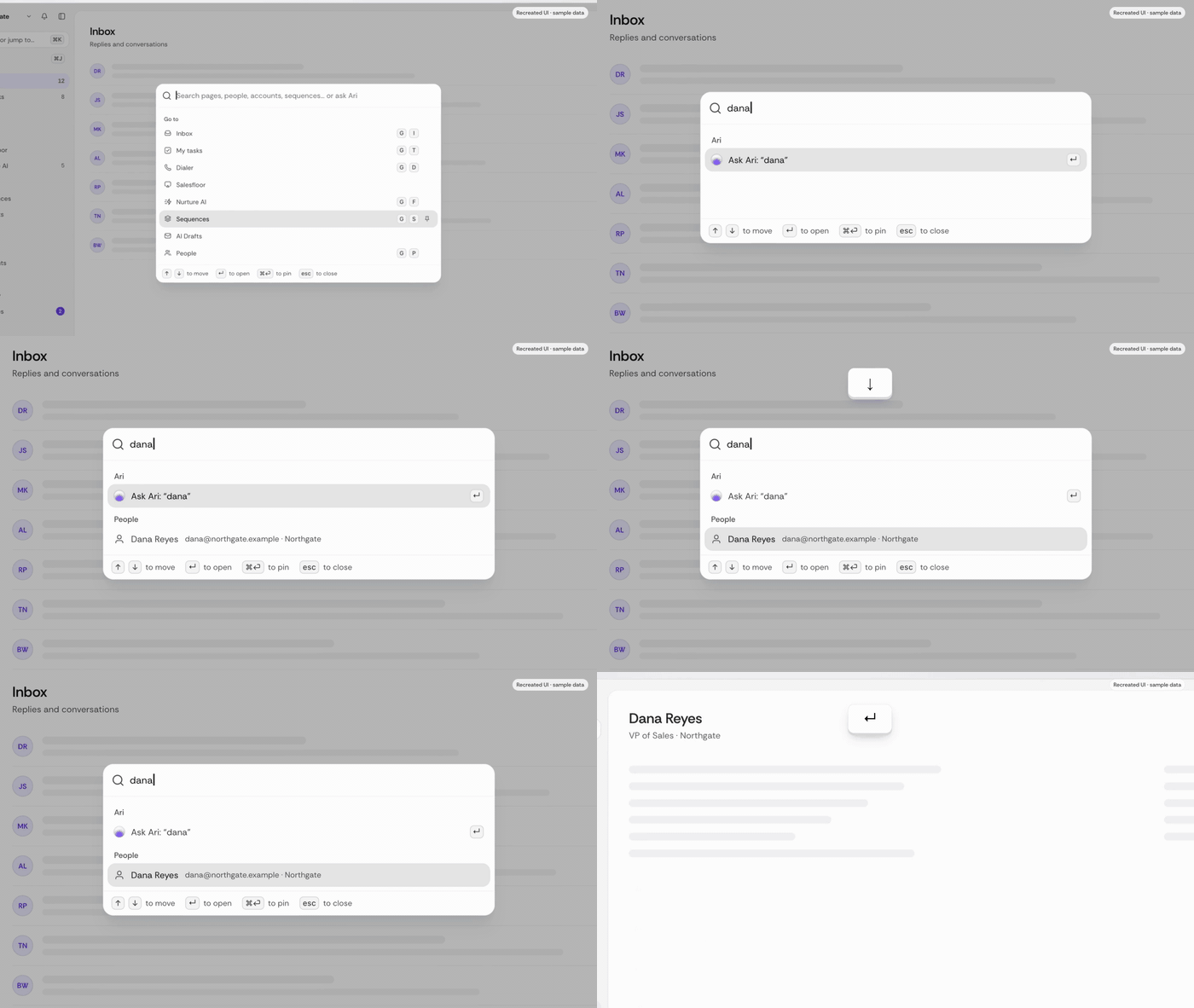
The new Salesfinity sidebar puts everything one keystroke away. Press Cmd+K (Ctrl+K on Windows) to search pages, people, accounts and more, pin what you use every day, and jump anywhere with G-then-a-letter shortcuts. Less time hunting through menus, more time on the phone.
Why did we rebuild the sidebar?
Every click spent looking for a page is a click not spent on a call. As Salesfinity grew from a dialer into a place where reps call, write, research and track their work, the old menu got long. Finding the right page meant scanning and scrolling.
So we rebuilt navigation around three ideas:
Built for speed. The pages you open ten times a day should be one keystroke away.
Keyboard first. Search, jump, pin and collapse without touching the mouse.
Grouped like the work. Calling, outreach, records, Ari and insights each get their own section, so the layout matches how a sales day actually flows.
It is all part of the same goal: build pipeline at superhuman speed.
How is the sidebar organized now?
At the top is your personal group: Inbox and My tasks. Below that, pages are grouped by the job they do:
Calling: Dialer, Salesfloor, Nurture AI
Outreach: Sequences, AI Drafts
Records: People, Accounts
Ari: Activity, Routines, Goals
Insights: Analytics (with its reports, like Call history and Scorecards, right in the sidebar) and AI Training
Settings and Help & support sit at the bottom. Each person only sees what their plan and team allow, so nobody scrolls past pages they can't open. Some pages, like Sequences, are in early access and show up only for teams that have them.
Can I find anything without clicking through menus?
Yes. Press Cmd+K (Ctrl+K on Windows) or click Search at the top of the sidebar. One box searches:
Pages and Analytics reports
Settings tabs (Account, Team, People, Connections, Ari)
Saved views
People and accounts
Sequences, routines and goals
Results only include things you have access to. Use the arrow keys to move, Enter to open and Esc to close. If you have Ari, you can type a question and send it straight to Ari from the same box.
How do I keep my most-used pages close?
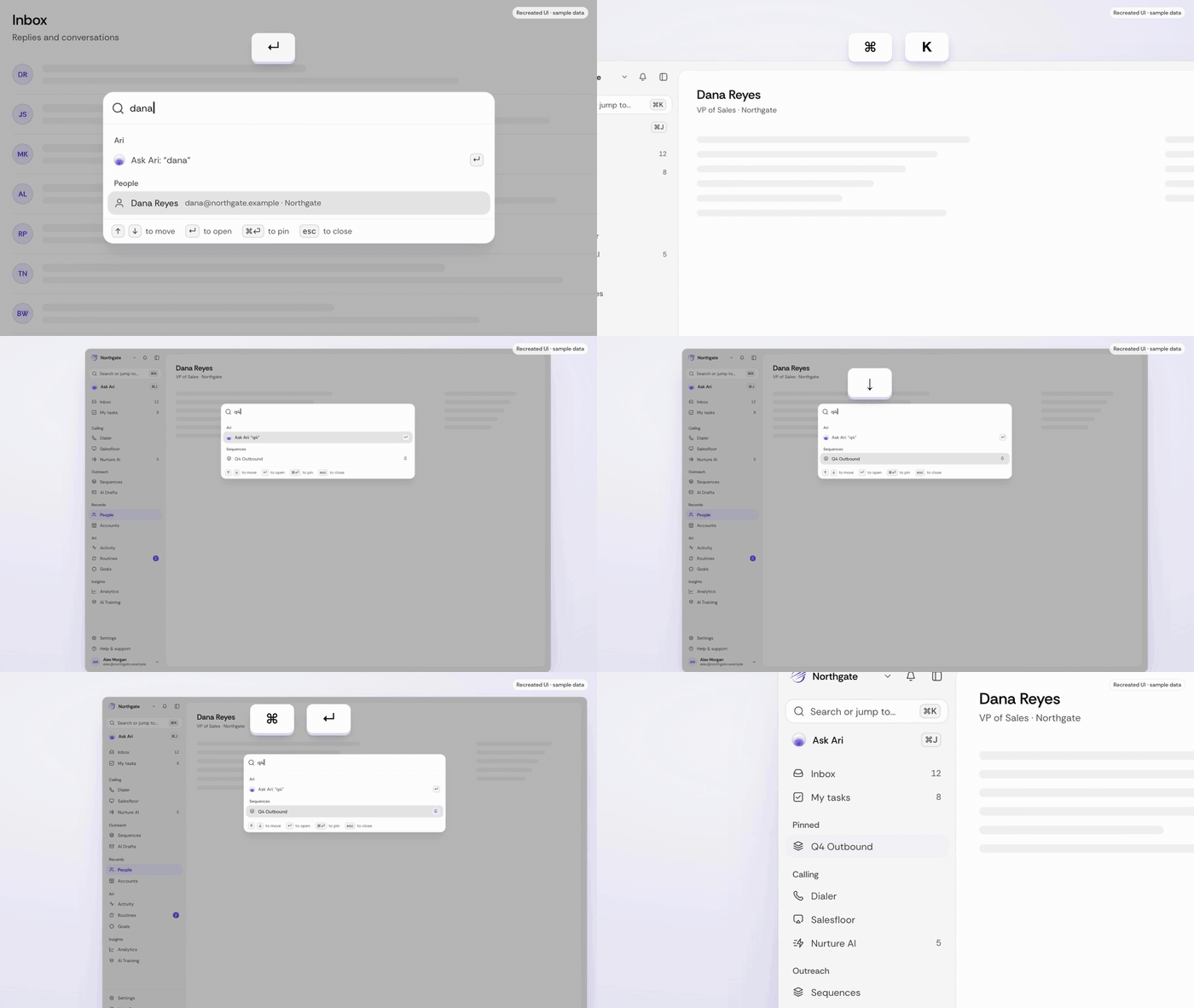
Pin them. Highlight anything in search and press Cmd+Enter (Ctrl+Enter on Windows) to pin it, or press it again to unpin. You can also click the + next to Pinned, which opens search so you can pick what to add.
You can pin up to 30 items: pages, saved People and Accounts views, sequences, routines and goals. Drag a pin to reorder it, or click the x to remove it. A rep working one sequence all week can pin it once and stop searching for it.
Can I ask Ari from anywhere?
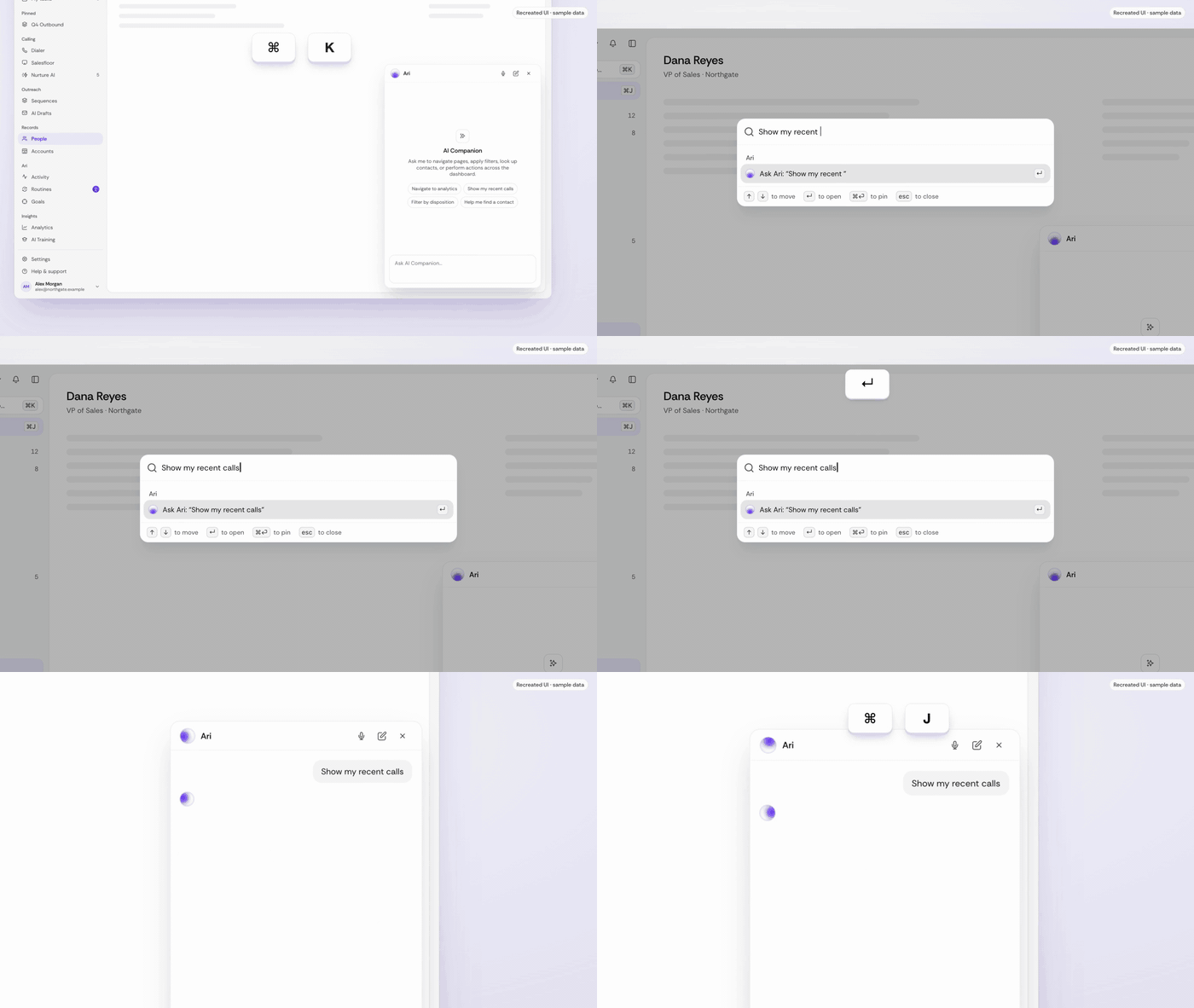
Yes, if your plan includes Ari. Press Cmd+J (Ctrl+J on Windows) or click Ask Ari in the sidebar to open it from any page. You can also type a question into Cmd+K search and choose to send it to Ari. Ari is available on Enterprise and Enterprise+ plans; if your plan doesn't include it, you won't see the button or the shortcut.
Can I make the sidebar fit how I work?
Yes, in a few ways:
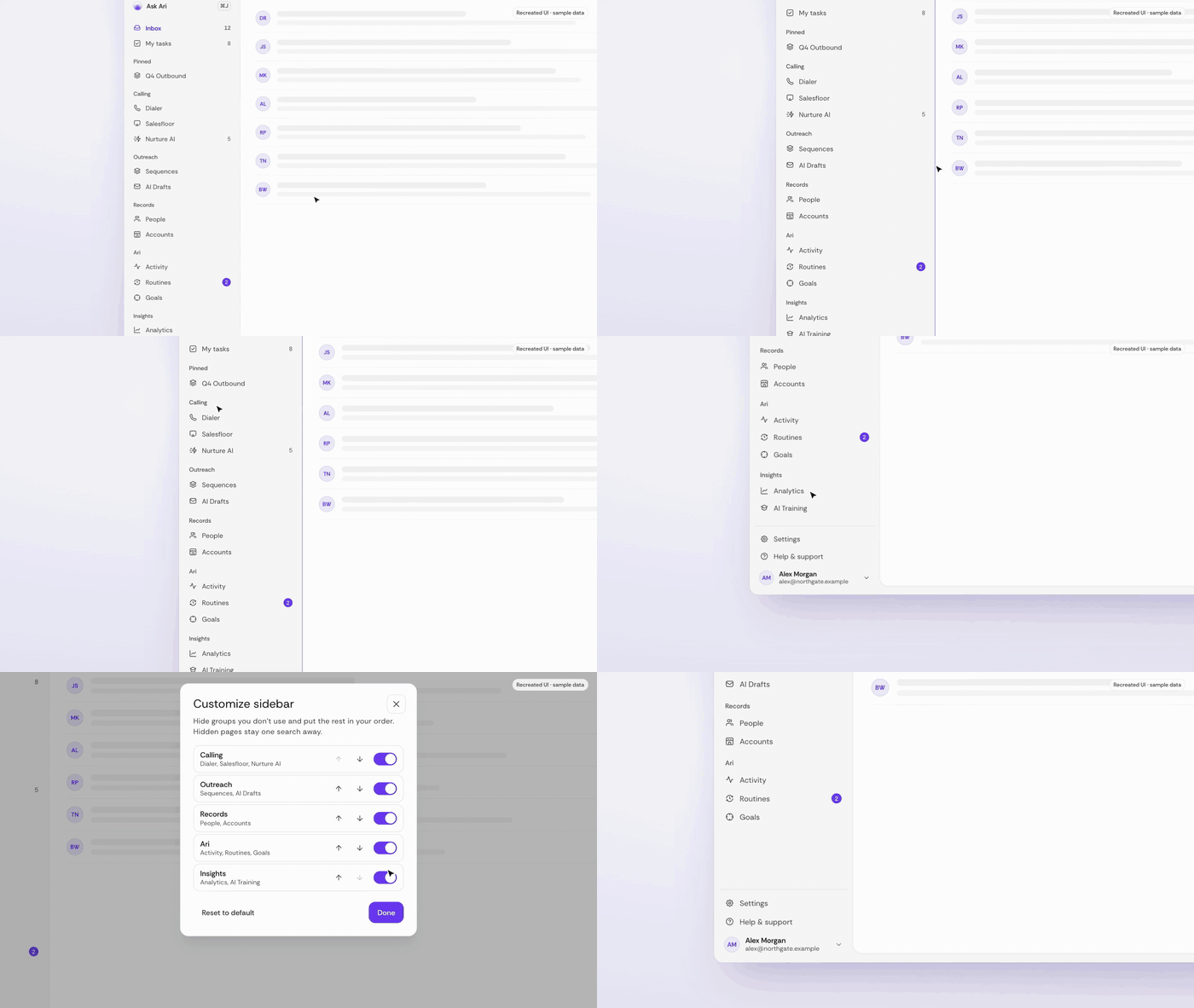
Customize sidebar. Open your profile menu and choose Customize sidebar. Move groups up or down and hide the ones you don't use. Changes save right away, and Reset to default puts everything back.
Collapse it. Press [ to shrink the sidebar to a slim icon rail, and press it again to bring it back.
Resize it. Drag the sidebar's edge to make it wider or narrower.
Fold groups. Click a group's title to fold it away until you need it.
What are the go-to shortcuts?
Press G, then a letter, to jump straight to a page. For example, G then D opens the Dialer. Shortcuts only work for pages you can open. Inside Sequencer and Contacts, those pages' own shortcuts take priority, so nothing you already know changes.
Press ? to see the shortcuts for your account. On pages with their own shortcuts, like Inbox, Sequences and People, ? shows that page's list instead.
Keyboard shortcuts cheat sheet
Action
Mac
Windows
Search or jump to anything
Cmd+K
Ctrl+K
Ask Ari (plans with Ari)
Cmd+J
Ctrl+J
Pin or unpin the highlighted search result
Cmd+Enter
Ctrl+Enter
Move through search results
Up / Down arrows
Up / Down arrows
Open a search result
Enter
Enter
Close search
Esc
Esc
Collapse or expand the sidebar
[
[
Show all shortcuts
?
?
Go to Inbox / My tasks
G then I / G then T
G then I / G then T
Go to Dialer / Nurture AI
G then D / G then F
G then D / G then F
Go to Sequences
G then S
G then S
Go to People / Accounts
G then P / G then A
G then P / G then A
Go to Routines / Goals
G then R / G then O
G then R / G then O
Go to Analytics
G then N
G then N
Go to Settings
G then ,
G then ,
How do I get started in 30 seconds?
Press Cmd+K (Ctrl+K) and type the name of a page, sequence or saved view you open every day.
Press Cmd+Enter (Ctrl+Enter) to pin it. Repeat for two or three favorites.
Press G then D to jump to the Dialer and start calling.
Press ? whenever you forget a shortcut.
That's it. The sidebar remembers your pins and group order, so it is ready the next time you sign in.
FAQ
Do I need to turn the new sidebar on?
No. It is live for everyone in Salesfinity today. Your pages are all still there, now grouped by the work they support.
Why don't I see some pages in my sidebar?
Each person only sees the pages their plan and team allow. Some pages, like Sequences, are in early access. If you think something is missing, ask your Salesfinity admin.
How many items can I pin?
Up to 30. You can pin pages, saved views, sequences, routines and goals. Drag pins to reorder them.
Does Cmd+J work on every plan?
No. Cmd+J opens Ari, which is available on Enterprise and Enterprise+ plans. On other plans, Cmd+K search and all the other shortcuts still work.
Can I hide groups I never use?
Yes. Open your profile menu, choose Customize sidebar, and switch off any group. You can also reorder groups there, or reset to the default layout.
Read more

·
Author
Salesfinity vs Nooks Sequencer: AI, Deliverability, API and MCP Compared (2026)
The short version: Salesfinity's AI Sequencer and Nooks AI Sequencing both put email and call steps in one sequence and sync activity to Salesforce and HubSpot. The biggest differences are in how much of the work is automated and how open each platform is. Salesfinity can AI-personalize automatic email steps, routes call steps straight into the parallel dialer, checks account-level rules before anyone is enrolled, and exposes the whole sequencer through 77 API operations, 11 webhooks and MCP. Its sending runs on Smartlead's cold-email infrastructure, with unlimited inboxes that one admin can set up and warm for the entire team, so new reps send from day one. Nooks limits AI writing to manual, rep-reviewed emails, and adds automated LinkedIn, SMS and WhatsApp steps, which Salesfinity deliberately leaves out because they put your accounts and your company at legal and platform risk.
This comparison uses Salesfinity's product and API documentation and Nooks' own public pages, help center and API reference, accessed October 1, 2026. Where Nooks doesn't publish something, we say so rather than guess.
Salesfinity vs Nooks sequencer at a glance
Feature
Salesfinity AI Sequencer
Nooks AI Sequencing
Steps in a sequence
Automatic email, manual email, call and task steps. LinkedIn, SMS and meetings as rep tasks, by design (see why below).
Email, call, SMS, LinkedIn (including automated connection requests), manual WhatsApp and tasks.
AI-written emails
Per-step AI personalization on automatic and manual email steps, with optional rep review.
AI drafts on manual email steps only. Nooks' API docs: "Nooks has no AI automatic email."
Call steps
Go straight into the rep's parallel-dialer list. Logging the call completes the step.
Call tasks. Parallel dialing works from the Dialer page; the Tasks page dials one at a time.
Account-level rules
Owner, open deal, opt-out, recent touch and active-in-another-sequence checks before enrollment, plus approvals. A meeting stops everyone at the account.
Not published.
Replies
Auto-sorted into 8 categories plus custom labels, AI-drafted replies, optional guarded auto-send, one unified inbox.
"Smart reply detection". A reply inbox is not documented.
Sending infrastructure
Built on Smartlead's cold-email infrastructure, with Salesfinity's AI, dialer and rules on top.
Sequencing launched in 2026. Sends through each rep's connected Gmail or Outlook.
Inboxes
Unlimited. One admin connects, imports and assigns inboxes for the whole team, or reps connect their own.
Each rep connects their own Gmail or Outlook. Up to 10 mailboxes per user.
New hires
Send from day one through the team's already-warmed inbox pool.
Connect a mailbox first. New mailboxes need warming before sending at volume.
Inbox rotation
Yes, across the mailbox pool and domains.
Yes, per-mailbox rotation toggle.
Warmup
Built in and on by default, with daily ramp-up.
Not published as a product feature (offered as part of migration).
Domain health
Per-mailbox SPF, DKIM, DMARC and MX health, daily caps per inbox.
Domain authentication, daily maximums, placement tests (details not published).
Suppression
Email, domain and phone. Bounces, unsubscribes and dialer do-not-call feed it automatically.
Bounce checks and unsubscribe blocking.
API
77 sequencer operations, including rules of engagement and suppression. Idempotency keys on writes.
Nooks Sequencing API (v0.1.0): sequences, steps, enrollments, tasks, emails, prospects, accounts.
Webhooks
11 signed sequencer events (enrolled, paused, finished, email sent, replied, bounced, opted out, tasks and approvals).
One documented event: call.logged.
MCP
Hosted MCP server with 114 tools, 77 of them for the sequencer: sequences, steps, enrollments and bulk runs, approvals, tasks, templates, suppression, rules of engagement and analytics.
Hosted MCP server (Nooks documents 37 to 46 tools) that can create and edit sequences and enroll prospects. Listed in Claude's connector directory.
CRM sync
Sequence emails and calls logged to Salesforce and HubSpot.
Activities logged as Salesforce and HubSpot tasks, plus custom sequence fields on Salesforce records.
Sequence steps and channels
Salesfinity sequences mix automatic email, manual email, call and task steps, with interval or date-based timing and sending windows that follow each prospect's time zone. Follow-ups reply in the same thread by default. LinkedIn touches, SMS reminders and meetings are tasks in the rep's task inbox rather than automated steps.
Nooks covers more channels inside the sequence itself. Its step types include automatic and manual email, calls, automatic and manual SMS, manual WhatsApp, and LinkedIn connection requests and messages, with the LinkedIn automation running through its Chrome extension and a connected LinkedIn account.
Why Salesfinity doesn't automate LinkedIn, SMS or WhatsApp
We left these out on purpose. Each one puts either your accounts or your company at risk:
LinkedIn: the LinkedIn User Agreement (section 8.2) prohibits using "bots or other unauthorized automated methods to access the Services, add or download contacts, send or redirect messages", and LinkedIn can restrict or suspend accounts that break it. A rep's LinkedIn profile is years of network. We don't think a sequence step is worth risking it.
SMS: in the US, the Telephone Consumer Protection Act requires prior express written consent before sending automated marketing texts to a cell phone. Statutory damages are $500 per message, or up to $1,500 if the violation is willful, so an automated SMS step to cold prospects can turn into a very expensive lawsuit. Other countries have similar consent rules.
WhatsApp: the WhatsApp Business Policy says businesses "may only contact people on WhatsApp if" the person gave them their number and opted in to messages. Cold prospects haven't, and WhatsApp can limit or ban accounts that violate the policy.
So in Salesfinity, LinkedIn touches, texts and WhatsApp messages are tasks a rep completes personally, where they belong, while email and calls are automated end to end.
AI writing and personalization
Automatic steps send personalized emails on their own; manual-only AI drafts wait for a rep.
This is the clearest split. In Salesfinity, any email step, automatic or manual, can carry AI personalization: the template stays yours, and the AI fills the parts that should change per prospect. Teams choose per step whether personalized emails send automatically or wait for the rep's review.
Nooks drafts AI emails from account and prospect signals, but only on manual email steps that a rep reviews. Its API reference says it directly: "Nooks has no AI automatic email." That keeps a human in the loop on every AI email, but it also means AI personalization only scales as far as your reps' review time.
Calls inside the sequence
Salesfinity started as a parallel dialer, and the sequencer is built around it. When a call step comes due, the prospect lands on the rep's sequence dial list, ready for a parallel-dialing session. Logging the outcome completes the step and moves the prospect forward, and a do-not-call disposition adds the number to the suppression list.
Nooks also has a strong dialer. Sequence call tasks can be parallel-dialed from its Dialer page; its Tasks page works through tasks one at a time.
Rules of engagement and account control
Every enrollment is checked against your rules first, and a booked meeting stops the rest of the account.
Before anyone is enrolled, Salesfinity checks the account: is another rep the CRM owner, is there an open deal, has the contact opted out, were they touched recently, are they already in another sequence? Each check can block, warn, skip a step, pause, or hold the enrollment for a manager's approval. When a meeting is booked or a positive reply comes in, everyone else at that company stops by default, so a prospect who just said yes doesn't get a cold email from a second rep.
Nooks mentions "rulesets" and conditional logic for LinkedIn steps, but account-level rules like these are not documented in its public help center.
Replies and the inbox
Replies are sorted into categories automatically, each with the next step applied and a draft ready.
Salesfinity reads every reply and sorts it automatically: interested, meeting request, not interested, out of office, wrong person, unsubscribe, auto-reply, plus any custom labels your team defines. Out-of-office replies pause the prospect, unsubscribes suppress them, and replies land in one unified inbox with an AI-drafted response ready. Auto-sending those drafts is off by default; when a team turns it on, it waits a set delay, needs high confidence and never auto-answers unsubscribes or wrong-person replies.
Nooks lists "Smart Reply Detection" and logs threaded replies to the CRM. It does not document a reply-categorization inbox for sequences.
Email infrastructure and deliverability
Both platforms send from real mailboxes and rotate across them. The differences are in who does the setup, how much the platform manages for you, and what sits underneath.
One admin imports and assigns inboxes for the whole team, so a new hire sends on day one instead of waiting for a new mailbox to warm up.
Built on proven infrastructure: Salesfinity's sending layer runs on Smartlead, a dedicated cold-email platform, and Salesfinity adds the AI, the parallel dialer, rules of engagement and reply handling on top. Nooks launched AI Sequencing in 2026; before that it was a dialer that plugged into other sequencers.
One admin sets up the whole team: in Salesfinity, an admin can bulk-import inboxes, put them in a shared pool and assign them to reps, with no limit on how many. Reps can still connect their own Google or SMTP/IMAP mailboxes if you allow it. In Nooks, each rep connects their own Gmail or Outlook mailboxes, up to 10 per user, which means every rep has to be walked through setup.
New hires send on day one: a brand-new mailbox typically needs three to four weeks of warmup before it can send at volume. In Salesfinity, a new rep without inboxes of their own sends from the team's already-warmed pool, so they can start sequencing right away. When every rep must connect and warm their own mailbox, a new hire waits.
Rotation and caps: Salesfinity rotates first emails across a shared or per-rep pool, keeps follow-ups in the same thread, and caps each inbox's daily volume. Nooks has a per-mailbox rotation toggle and daily maximums.
Warmup: Salesfinity warms up new mailboxes automatically, on by default, and ramps daily volume up gradually. Nooks does not document warmup as a product feature.
DNS health: Salesfinity checks SPF, DKIM, DMARC and MX for every mailbox and rates it Healthy, Needs work or Critical. Nooks has a domain authentication section.
Bounces and unsubscribes: in Salesfinity, a hard bounce or unsubscribe ends the prospect's sequence and adds them to a suppression list that also covers domains and phone numbers. Nooks runs bounce checks and blocks sends to unsubscribed prospects.
Tracking: both support custom tracking domains. On Nooks, open and click tracking and unsubscribe links stay off until a branded tracking domain is set up.
API and webhooks
Salesfinity's public API exposes 77 sequencer operations: sequences, steps, templates, enrollments, bulk enrollment runs of up to 5,000 people, tasks, suppression lists and rules of engagement. Write requests accept idempotency keys, so retries never double-enroll anyone. Eleven signed webhook events report enrollments, pauses, finishes, approvals, tasks, sent emails, replies, bounces and opt-outs as they happen.
Nooks publishes the Nooks Sequencing API (version 0.1.0) with OAuth apps and clear per-endpoint rate limits, covering sequences, steps, enrollments, tasks, one-off emails, prospects and accounts. Its only documented webhook today is call.logged, so reacting to replies or bounces in your own systems means polling.
MCP and AI agents
One request in an AI assistant builds and enrolls a sequence through Salesfinity's MCP tools, while webhooks report each event.
Both companies run a hosted MCP server, so Claude, Cursor and other MCP clients can work with sequences directly. Salesfinity's MCP server has 114 tools, and 77 of them cover the sequencer end to end: building, duplicating, enabling and analyzing sequences, editing and reordering steps, previewing and running enrollments of up to 5,000 people, approving or rejecting held enrollments, pausing, moving and reassigning prospects, working and bulk-snoozing tasks, managing templates and suppression lists, and editing rules of engagement. An AI assistant can also check account coverage before enrolling anyone and stop a whole account in one action. Ari, Salesfinity's AI employee, uses the same capabilities from Slack.
Nooks' MCP server can create sequences, add and edit steps, enroll and finish prospects and work tasks, and it is listed in Claude's connector directory. Its help center lists 46 tools in one article and 37 in another. Nooks says MCP access requires a Sequencing or Coaching seat, and its documented MCP tools and API don't include enrollment approvals, suppression lists or account-level rules.
CRM sync
Salesfinity logs sequence emails and calls to Salesforce and HubSpot, and can enroll straight from a HubSpot list, a Salesforce report or a rep's owned contacts. Nooks logs every activity as a CRM task and can stamp custom sequence fields such as current step and status on Salesforce records.
Pricing and packaging
Salesfinity includes the AI Sequencer in its Enterprise plans (2000 free emails per user/mo, then $0.02 per email, no seat pricing. Only pay for usage), alongside the parallel dialer. Nooks sells Sequencing as its own seat, paired with a weekly AI-credit plan (Basic, Pro or Max), on custom quotes.
Where Nooks is ahead today
Automated LinkedIn, SMS and WhatsApp steps. Salesfinity leaves these out on purpose: LinkedIn's terms prohibit automation, automated texts without consent can violate the TCPA, and WhatsApp requires opt-in.
Where Salesfinity is ahead today
AI personalization on automatic email steps, not just rep-reviewed drafts.
Call steps that feed the parallel dialer directly.
Account-level rules of engagement before enrollment, with approvals.
Unlimited inboxes that one admin sets up for the whole team, and new hires sending from day one.
Sending built on Smartlead's cold-email infrastructure, with built-in warmup, DNS health checks and an automatic suppression list.
Reply categorization with AI-drafted responses in one inbox.
A deeper API with 11 webhook events, and 77 MCP tools covering the whole sequencer, including approvals, suppression and rules of engagement.
See the full product on the AI Sequencer page, or compare the dialers in Salesfinity vs Nooks.
Frequently asked questions
Does Nooks have a sequencer?
Yes. Nooks launched AI Sequencing in early 2026. It supports email, call, SMS, LinkedIn, WhatsApp and task steps, with AI-drafted emails on manual steps.
Can Nooks send AI-written emails automatically?
No. Nooks' API documentation states that it "has no AI automatic email". AI drafts are supported only on manual email steps that a rep reviews. Salesfinity supports AI personalization on automatic email steps, with optional rep review.
Which has a better API for sequences?
Salesfinity exposes 77 sequencer API operations and 11 signed webhook events, including replies, bounces and opt-outs. Nooks' Sequencing API covers sequences, steps, enrollments and tasks, with one documented webhook event (call.logged).
Do both support MCP?
Yes. Both run hosted MCP servers that let AI assistants such as Claude build and manage sequences. Salesfinity's has 114 tools, 77 of them for the sequencer, including approvals, suppression lists and rules of engagement. Nooks documents 37 to 46 tools and limits MCP access to Sequencing or Coaching seats.
Does Salesfinity warm up mailboxes?
Yes. Warmup is built in and on by default for new mailboxes, with a gradual daily ramp-up, alongside SPF, DKIM, DMARC and MX health checks. Nooks does not document warmup as a product feature.
How many mailboxes can each rep use?
Salesfinity supports unlimited inboxes, and one admin can import and assign them for the whole team. Sends rotate across a shared or per-rep pool. Nooks allows up to 10 mailboxes per user, and each rep connects their own.
What email infrastructure does each use?
Salesfinity's sequencer sends through Smartlead's cold-email infrastructure, with Salesfinity's AI, dialer and rules of engagement on top. Nooks sends through each rep's connected Gmail or Outlook mailboxes. Nooks launched AI Sequencing in early 2026.
Can new reps start sending right away?
In Salesfinity, yes: a new rep can send from the team's already-warmed inbox pool on day one. A brand-new mailbox usually needs three to four weeks of warmup before it can send at volume, which is the wait a new rep faces when every rep must connect their own mailbox.
Can I automate LinkedIn steps?
Nooks offers automated LinkedIn connection requests and messages through its Chrome extension. Salesfinity keeps LinkedIn touches as tasks a rep completes personally, because the LinkedIn User Agreement prohibits bots and automated methods for adding contacts or sending messages, and LinkedIn can restrict accounts that break it.
Why doesn't Salesfinity send automated texts?
In the US, the Telephone Consumer Protection Act requires prior express written consent before sending automated marketing texts to a cell phone, with statutory damages of $500 to $1,500 per message. Cold prospects haven't given that consent, so Salesfinity keeps texting as a manual task. WhatsApp's Business Policy similarly requires opt-in before a business can message someone.
Nooks information comes from nooks.ai, support.nooks.ai and developer.nooks.in, accessed October 1, 2026. Product details change; check each vendor's current documentation before deciding.
Read more

·
Author
Introducing Salesfinity Anywhere: Dial, Enrich and Sequence From Any Tab
The short version: Salesfinity Anywhere is our new Chrome extension. It puts the Salesfinity dialer, SmartEnrich, the AI Sequencer and a LinkedIn inbox in a side panel next to whatever page you are on. Reps can call a number on any website, act on a Salesforce or HubSpot record, find a missing mobile number and clear their LinkedIn messages without switching back to the app.
Count the tabs: Salesfinity Anywhere in 25 seconds.
Why we built a Chrome extension
Reps don't work in one app. A normal outbound day moves between the CRM, prospect websites, LinkedIn and the dialer, and every hop is the same routine: copy, switch tabs, paste. Each one takes seconds. Across a day of calling, they add up to time that isn't spent talking to prospects.
Salesfinity Anywhere removes the hop. The work you would normally carry back into Salesfinity happens in a side panel, on the page you are already on.
Call any number on any page
Click a phone number on any website and Salesfinity offers to dial it. You can also highlight a number anywhere, right-click and choose Call with Salesfinity. Before it dials, the extension shows the number it found and the Salesfinity contact it matches, so you know who you are calling.
Calls go out through your Salesfinity phone numbers, and your do-not-call list still applies.
Call, email and sequence from Salesforce and HubSpot
Open a contact in Salesforce or HubSpot and a Salesfinity bar appears right below the record, with three actions:
Call the contact in one click.
Email them from your sequencer inbox, using your templates.
Sequence: add them to an AI Sequencer sequence without copying a single field.
Find a missing mobile number
If a record has no mobile number, SmartEnrich can find one from the side panel. It checks 7+ data providers and returns verified mobile numbers, ready to dial, with landlines filtered out. It uses your existing enrichment credits.
SmartEnrich works from the contact's LinkedIn profile. If the record doesn't have one yet, paste the LinkedIn URL once and Salesfinity remembers it for that contact.
Work LinkedIn like an inbox
On LinkedIn, the side panel opens the Salesfinity Inbox for your LinkedIn messages:
Color labels and auto-labeling rules
Snooze and follow-up reminders
Reusable snippets for the messages you send often
Private notes and pinned conversations
Scheduled messages, plus voice and video notes
Keyboard shortcuts and a command palette
How to install Salesfinity Anywhere
Open Salesfinity on the Chrome Web Store and click Add to Chrome.
Pin the extension to your Chrome toolbar.
Log in with your Salesfinity account.
Open a Salesforce or HubSpot record, a prospect's website or LinkedIn. The side panel is ready.
Install Salesfinity Anywhere
Frequently asked questions
What is Salesfinity Anywhere?
Salesfinity Anywhere is Salesfinity's Chrome extension. It adds a side panel to the browser so you can dial phone numbers on any web page, call, email and sequence contacts from Salesforce and HubSpot records, find mobile numbers with SmartEnrich and manage LinkedIn messages, without switching to the Salesfinity app.
Which CRMs does it work with?
Salesforce and HubSpot. The Salesfinity buttons appear directly below the contact record.
Can I dial a phone number on any website?
Yes. Click a phone number link on any page, or highlight a number, right-click and choose Call with Salesfinity. The call goes out through your Salesfinity phone numbers.
Does it respect my do-not-call list?
Yes. Calls placed from the extension go through the same Salesfinity dialer, so your do-not-call list applies to them.
Does finding a mobile number use credits?
Yes. SmartEnrich in the extension uses your existing Salesfinity enrichment credits.
Do I need a Salesfinity account?
Yes. The extension works with your Salesfinity account, phone numbers, sequences and enrichment credits. Log in once after installing it.
Which browser does it support?
Google Chrome. Install it from the Chrome Web Store.
Read more
·
Author
Best Auto Dialer for the UK Market (2026 Guide)
The short version: the best auto dialer for the UK market is a parallel dialer: it dials several numbers at once for one rep, connects the first person who answers within half a second, drops voicemails and dead numbers automatically, and logs every call to your CRM without the rep touching it. Salesfinity does exactly that with up to 5 lines per rep, a 400 ms median connect, UK (+44) caller IDs, live validation of UK mobile numbers before you dial, and native sync with Salesforce, HubSpot, Outreach, Salesloft, Apollo and 100+ other tools.
Updated 28 September 2026. Written for UK sales leaders and RevOps teams choosing an outbound dialer for B2B prospecting.
What is an auto dialer?
An auto dialer is software that places outbound calls from a list without a rep keying in each number, hands live answers to the rep, and handles everything else (voicemails, busy signals, disconnected numbers) on its own. The term covers four designs that behave very differently once a rep sits down to call.
Type
How it dials
Lines per rep
Best for
Preview dialer
Shows the record, rep clicks to dial one number
1
Account management, complex deals, low volume
Power (progressive) dialer
One number at a time, automatically, as soon as the rep is free
1
Steady SDR calling on lists with high answer rates
Parallel dialer
Several numbers at once for one rep; the first live answer connects, the rest are released
2 to 5
High-volume B2B prospecting where most dials go to voicemail
Predictive dialer
Dials ahead for a pool of agents using a model of when agents will free up
Shared pool
Large contact centres with dozens of agents on one queue
For a B2B sales team, the parallel dialer is the one that changes the maths. A rep on a power dialer spends most of the hour listening to ringing and voicemail greetings; a rep on a parallel dialer spends it talking, because the dialer absorbs the waiting.
Same list, one line vs five: the parallel dialer connects the first live answer and releases the other lines.
How does a parallel dialer work?
The rep opens a list from the CRM, a sequencer, a CSV or a Salesfinity contact list and picks how many lines to run.
The dialer calls several contacts at once. On Salesfinity that is up to 5 numbers simultaneously for one rep.
AI listens to the first moments of each answered call and classifies it as a live person or a recording. Voicemails and answering services are dropped or left a pre-recorded message; disconnected numbers are marked.
The first live person is connected to the rep in a fraction of a second, with the contact's record and call history on screen. The other lines are released.
The call is logged automatically. Disposition, recording and AI-written notes go to the CRM. The rep clicks once and the next batch dials.
The number that matters is how quickly the prospect hears a human after saying hello. Salesfinity's median is 400 milliseconds, which is why prospects do not experience the pause that gave older dialers a bad name.
How a parallel dialer works on a UK list: five lines at once, AI screens the answers, the rep hears a person in 400 ms, and the call logs to the CRM.
What should a UK sales team look for in an auto dialer?
UK caller IDs. A prospect in Manchester is far more likely to answer a +44 number than a +1 number. The dialer should provision UK numbers, rotate them, and watch their health.
Number validation before you dial. UK B2B lists are heavy on mobiles and on numbers that moved with their owner. Checking whether a number is live, what type it is and which carrier owns it, before it takes up a line, raises connect rates and stops reps redialling dead numbers.
Connect speed. Under half a second from answer to rep is the bar for a parallel dialer.
Native CRM and sequencer integration. Every dial, disposition, recording and note in Salesforce or HubSpot without rep effort, and call tasks from Outreach, Salesloft or Apollo pulled straight into the dialer.
An internal do-not-call list. When a rep marks a contact as do not call, that contact should be held from every future dial across the team, not just that rep's list.
Coaching and visibility. Call recording, AI scoring and a live floor view so managers can hear what UK prospects actually say back.
International reach. If the same team also calls Ireland, the rest of Europe or the US, one dialer should cover all of it.
Boss Mode checks line type, carrier and whether a UK number is live before it takes a line, while SmartGuard watches your +44 caller IDs.
How does Salesfinity work for UK sales teams?
Salesfinity is an AI parallel dialer used by B2B sales teams to hold more live conversations per hour without adding headcount. Here is how it maps to the seven requirements above.
Requirement
What Salesfinity does
UK caller IDs
Provisions UK (+44) numbers alongside US and Canadian local-presence numbers. SmartRotate rotates them automatically and SmartGuard monitors them for carrier flags, with automatic remediation when a number is flagged.
Number validation
Boss Mode validates every mobile number on a list against live carrier data before you dial. UK numbers are checked for line type, carrier and whether they are live; dead numbers are skipped and the best number for each person is dialled first.
Connect speed
400 milliseconds median from answer to rep, with AI answering-machine detection on every line.
CRM and sequencer integration
Two-way sync with Salesforce, HubSpot, Outreach, Salesloft, Apollo, Amplemarket, Lemlist, Attio and Gong, and 100+ integrations in total. Details below.
Internal do-not-call list
A contact a rep marks as do not call is held from every future dial across the team, and the disposition syncs to the CRM.
Coaching
Call recording, AI scoring on every call, and Salesfloor, a live view where managers listen in and coach mid-call.
International reach
Dials prospects in 120+ countries from the same list and the same rep seat.
On productivity, Salesfinity reports 10 to 15 live conversations per rep per hour on 5 lines and 5.2× more live conversations than a single-line power dialer. Treat those as US-measured figures; UK connect rates vary by sector and by how mobile-heavy your list is. Customers publicly report results such as 3,500 dials and 29 meetings in seven days (Qodo AI) and an 80% increase in demos (AutoRaptor).
An hour of calling: a single line spends most of it ringing; five lines spend it talking. Figures are Salesfinity-reported and US-measured.
Which CRMs and sales tools does Salesfinity integrate with?
The dialer sits on top of the system your team already works in, so reps never copy anything by hand.
Tool
What flows in
What flows back
Salesforce
Leads, contacts, list views and reports as dial lists; owner and account context on the call card
Call activity with disposition, duration, recording link and AI notes; task completion
HubSpot
Contacts and lists; company and deal context
Logged calls with outcome, notes and recording; contact property updates
Outreach, Salesloft, Apollo, Amplemarket, Lemlist
Due call steps pulled into the dialer as a working list
Step completed, outcome and notes written back so the sequence advances
Attio
People and company records as lists
Call activity and notes on the record
Gong
Recordings and transcripts for conversation intelligence
Every integration logs automatically: the rep sets a disposition at the end of the call and Salesfinity writes the call, the recording and the AI summary to the source system. See the AI Parallel Dialer page for the full integration list.
What else does the dialer do?
AI notes and summaries. Every call is transcribed and summarised into notes that land in the CRM; reps stop typing between calls.
Voicemail drop. Pre-recorded voicemails are left automatically when a call goes to a machine, so the rep is already on the next live answer.
Local presence. US and Canadian prospects see a matching local area code; UK prospects see a UK number.
Salesfloor. A virtual sales floor where reps run call blocks together, wins are visible to the team, and managers can listen in and whisper coaching mid-call.
AI coaching and call scoring. Every call is scored against a rubric your team configures, with coaching notes per rep.
Follow-ups and snoozes. "Call me next quarter" becomes a dated follow-up task instead of a lost lead.
Data enrichment. Missing mobile numbers and emails can be filled from inside the dialer before a list is worked.
Analytics. Dials, connects, conversations and meetings per rep, per list and per number, so you can see which lists and which caller IDs are performing.
How much does Salesfinity cost?
The self-serve Gold plan is $299 per user per month with unlimited dials, up to 5 parallel lines and 10 rotating caller IDs. Calling outside the US and Canada, including the UK, is included on the Enterprise Plus plan, which is quoted individually and billed annually. Prices are in US dollars; see the pricing page for current terms.
Frequently asked questions
What is the difference between a parallel dialer and a power dialer?
A power dialer calls one number at a time and the rep waits through every ring and voicemail. A parallel dialer calls several numbers at once for the same rep and connects only the first live answer, so the rep spends the hour in conversations rather than waiting. Salesfinity runs up to 5 lines per rep.
Is a parallel dialer the same as a predictive dialer?
No. A predictive dialer dials ahead for a pool of agents in a contact centre and decides who gets the call when someone answers. A parallel dialer dials for one rep and connects that rep to the first person who picks up. There is no queue and no hand-off.
How many lines should a UK rep use?
It depends on the answer rate of the list. Lists with many mobile numbers and high pick-up rates work well on 2 or 3 lines; lists where most dials go to voicemail benefit from 4 or 5. Reps can change the line count at any time.
Does Salesfinity provide UK phone numbers?
Yes. UK (+44) caller IDs are provisioned inside Salesfinity, rotate automatically, and are monitored for carrier flags. International calling outside the US and Canada is included on the Enterprise Plus plan.
Does it work with UK mobile numbers?
Yes. Boss Mode validates UK mobile numbers for line type, carrier and whether the number is live before dialling, so lines are not spent on dead numbers.
Which CRMs does Salesfinity integrate with?
Salesforce, HubSpot and Attio as CRMs; Outreach, Salesloft, Apollo, Amplemarket and Lemlist as sequencers; Gong for conversation intelligence; and 100+ other tools. Calls, dispositions, recordings and AI notes sync automatically.
Can a team outside the UK use Salesfinity to call UK prospects?
Yes. Salesfinity dials 120+ countries, and UK caller IDs can be assigned to reps wherever they sit, so a US or European team can run UK lists from the same seat.
Does Salesfinity record calls?
Yes. Recordings and transcripts are attached to the call in the CRM and used for AI notes, call scoring and coaching. Recording can be configured per team.
How long does setup take?
Most teams connect their CRM, import a list and place their first parallel calls the same day. Enterprise plans include white-glove onboarding and migration from an existing dialer.
Next step
If you run a UK B2B sales team and want to see parallel dialing on your own list, with UK caller IDs and your CRM connected, book a demo. Bring a list of 200 numbers and we will run it live.
Read more

·
Author
How to Get Past Call Screening on Cold Calls: What 2,468 Screened Calls Show
The short version: when a cold call hits call screening, like iPhone Call Screening, the first few words you say decide whether the owner picks up. Across 2,468 screened calls placed through Salesfinity, openers framed as a quick question turned into a live conversation 7.9% of the time, versus 4.2% for webinar invites. Length matters too, and not in a straight line: 1 to 5 words (6.8%) and 21+ words (6.5%) both beat the 13 to 20 word middle (4.1%). Naming your company or giving a reason for the call did not help on its own.
This study picks up where our 34,000-dial call screener study left off. That analysis showed call screeners cost you connects mostly on the first dial, and that screened prospects who pick up convert better. The next question is the practical one: what should you actually say to the screener?
The numbers at a glance
Metric
Result
Screened calls analyzed
2,468
Rep's name and reason relayed to the owner
84%
Owner accepted the call
7.8%
Became a live conversation
5.7%
Source: Salesfinity production data, September 14–22, 2026.
The takeaway from the top line: getting relayed is easy. Almost every rep who spoke to the screener had their intro passed along. The hard part is what happens next, when the prospect reads or hears your intro and decides in a second whether you're worth picking up for. That decision is where the opener matters.
What is call screening, and what happens to a cold call?
Call screening is a phone feature that answers calls from unknown numbers for the owner. On iPhone, Call Screening (expanded in iOS 26) asks the caller for their name and reason for calling, then shows the owner a live transcript so they can decide whether to pick up. Google's Call Screen does something similar on Android. For a cold caller, that means your first sentence is no longer heard by a person. It's read as a line of text, often at a glance, before anyone decides to answer.
Finding 1: How you frame the call matters more than what you pitch
Opener framing
Calls
Relayed
Accepted
Live connect
Quick question
190
89%
10.5%
7.9%
Callback
165
91%
9.1%
7.3%
Name only, no pitch
301
87%
9.6%
6.3%
Pitch with a reason
1,103
83%
7.3%
5.3%
Webinar invite
526
78%
6.1%
4.2%
Source: Salesfinity production data, September 14–22, 2026 · 2,468 screened calls.
The most common opener in the data, a pitch with a reason (1,103 calls), was also one of the weakest. Reps explained who they were and why they were calling, and the prospect declined. Openers that promised something small and specific, a quick question, did best. Webinar invites did worst on every measure: they were relayed least often, accepted least often, and connected least often.
Why? A screened call turns your opener into a notification. A notification that reads like a question feels like it needs an answer. One that reads like an invitation or a pitch can safely be ignored.
Finding 2: Go very short, or commit to a full explanation
Opener length
Calls
Relayed
Accepted
Live connect
1 to 5 words
454
88%
9.7%
6.8%
6 to 12 words
856
85%
8.2%
6.1%
13 to 20 words
776
79%
6.6%
4.1%
21+ words
382
87%
7.3%
6.5%
Source: Salesfinity production data, September 14–22, 2026 · 2,468 screened calls.
This is the finding most reps get wrong. The relationship between length and success is U-shaped, not a straight line. Very short intros (1 to 5 words) did best, and full explanations of 21 words or more held up well. The 13 to 20 word middle was the weak spot: long enough to sound like a pitch, too short to earn the pick-up with real substance.
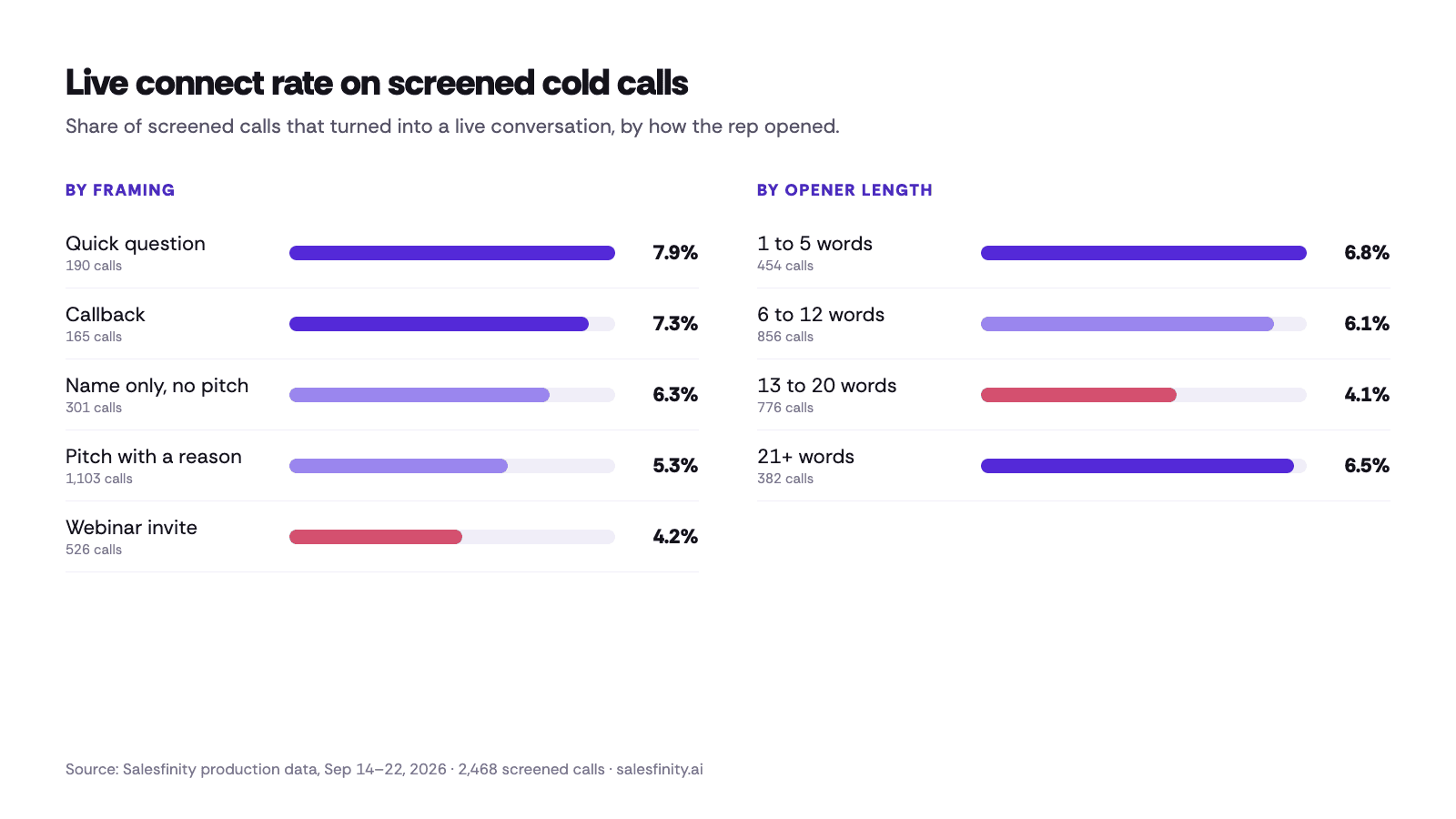
If your current intro is a single sentence with your name, company and a vague value statement, you are probably sitting right in that 13 to 20 word zone.
The openers that worked, and the ones that didn't
These are real openers from the data, machine-transcribed from the recordings, with company names removed. Individual openers are small samples, so read them as illustrations of the patterns above, not as scripts to copy.
Highest live connect rate
14.3%: “Taylor returning this call.”
13.5%: “Hey it's Dan, just had a quick customer question, thanks, it'll be brief.”
8.6%: “Hey this is James.”
Lowest live connect rate
3.0%: “Joe, responding to your application.”
0.0%: “Matthew, calling about effective top-of-funnel spend on your revenue.”
0.0%: “This is Pearson, my CEO wanted me to reach out to you.”
One caution on the top of that list. A callback opener works because it signals an existing conversation. Only use it when that's true: they called you, replied to an email, or asked you to follow up. Claiming a callback that never happened might get one pick-up, but it burns trust on the very first second of the relationship, and prospects remember.
How to get past call screening: a playbook for SDRs
Lead with a quick question. “It's Sam, quick question for Dana.” A question reads like something that needs an answer.
Keep it to 1 to 5 words when you can. “Hey, it's Sam.” Short intros did best in this data and leave the prospect curious enough to pick up.
If you explain, go all the way. Past 20 words, a specific reason held up: “Hi Dana, it's Sam at Salesfinity. I work with sales leaders at fintech companies on cold call connect rates and had a quick question about how your SDR team handles screened calls.”
Use a callback only when it's real. “Sam, following up on Dana's email from Tuesday” is honest and still signals an existing thread.
Drop the webinar invite and the 13 to 20 word pitch. Both underperformed across every stage of the funnel.
Keep calling screened numbers. Our 34,000-dial study found the connect gap for screened numbers mostly closes by the second dial, and screened prospects who do connect convert better.
How the data was collected
Dataset: 2,468 cold calls that reached a call screener, placed through Salesfinity between September 14 and 22, 2026.
Openers: what the rep said to the screener, taken from machine transcripts of the call recordings. Company names are removed from the examples.
Relayed: the rep's name and reason were passed on to the phone's owner. Accepted: the owner picked up. Live connect: the call became a live conversation with the owner.
Framing and length: each opener was grouped by how it was framed (quick question, callback, name only, pitch with a reason, webinar invite) and by word count.
Limits: nine days of data, and some groups are under 200 calls, so treat small differences as directional. The individual opener examples are especially small samples.
Every call in this dataset was placed and transcribed through Salesfinity's AI Parallel Dialer, which is what made it possible to see exactly what reps said to the screener and what happened next.
FAQ
How do you get past call screening on a cold call? Keep your intro short and framed as a quick question. In an analysis of 2,468 screened cold calls, quick-question openers reached a live conversation 7.9% of the time, versus 4.2% for webinar invites, and intros of 1 to 5 words (6.8%) beat intros of 13 to 20 words (4.1%).
What should I say when iPhone Call Screening answers? State your name and a short, honest reason, framed as a question: “It's Sam, quick question for Dana.” Avoid long pitch sentences and event or webinar invitations, which had the lowest connect rates in the data.
What is iOS 26 call screening? iOS 26 expanded iPhone Call Screening, which answers calls from unknown numbers, asks the caller for their name and reason, and shows the owner a live transcript before they decide whether to pick up. For cold callers, the first sentence becomes a text preview the prospect reads before answering.
Does saying your company name help get through call screening? Not on its own. In this dataset, naming the company or stating a reason for the call did not improve connect rates by itself. How the opener was framed and how long it was mattered more.
How long should a cold call opener be for a call screener? Either very short (1 to 5 words) or a full explanation of 21 words or more. The 13 to 20 word range had the lowest live connect rate, 4.1%.
Should I leave a callback-style message to a call screener? Only if there really is something to call back about. Callback openers connected at 7.3% in this data, but claiming a callback that never happened damages trust with the prospect from the first second.
How often do cold calls get screened? In our earlier analysis of 782,728 dials, about 2.5% were screened. Screened calls are a minority of dials, which is exactly why the opener matters so much on the ones that do hit a screener.
Should SDRs skip numbers with call screening? No. A separate 34,000-dial analysis found that screened numbers connect less often on the first dial, but the gap nearly disappears by the second, and screened contacts who connect give a positive response more often (30.9% vs 25.8%).
Read more
·
Author
GTM Engineering for the Phones: Four Workflows You Can Build This Month
By Ben Holley, Head of GTM at Apero Advisors
Most GTM engineering content is about email because most GTM engineers don't know anything about picking up the phone.
Having been an SDR at multiple companies and having made thousands and thousands of cold calls in my life, I can confidently tell you that the phone is where some of the highest-leverage GTM engineering activities will ever occur. A call is the one touch that gets an answer in real time, and almost nobody builds systems around it. Reps still get a list, a dialer, and a hope.
Here are four workflows any team can stand up with a CRM, a dialer, and a handful of automations. Each one is written so you can build it in your own stack. Where it helps, I’ll show how it looks with Salesfinity — their REST API and Dial Links make the plumbing a lot less annoying than it used to be.
Workflow 1: Route every inbound lead to a rep’s phone in minutes
Anyone who raises their hand should be on a rep’s phone within minutes. And you should be able to prove it.
The build is five steps:
Someone submits a form or downloads an asset. The CRM creates or updates the contact.
A CRM workflow assigns an owner: round robin, territory, or the existing account owner.
That same workflow dumps the lead into the rep’s call queue and fires a Slack alert with a button.
Rep clicks the button. Dialer opens on that person. Rep makes the call.
CRM logs the call. A report measures the gap between submit and first dial.
Same pattern works for positive replies to cold email. Someone replies → email tool hits a webhook → CRM → same routing. Keep the routing logic in the CRM, not in the email tool, so every source of interest follows one set of rules. Otherwise you’ll have three “speed-to-lead” systems that all disagree with each other.
How this looks with Salesfinity
Two good ways to build step 3:
Dial Link. A Dial Link is just a URL that carries a person’s phone number and details. Click it, dialer opens on that person. Build it from CRM fields (phone, name, company, email) and put it behind the Slack button. Add
auto_dial=1if you want the call to start after a three-second countdown the rep can cancel. Include the email so Salesfinity can match them to the existing contact and pull call history. Their docs have ready-made link templates for HubSpot and Salesforce.API enrollment. Salesfinity’s REST API can add a contact to a sequence and set the owning rep in the same request, so the call task lands in that rep’s queue. Contact doesn’t exist yet? The request creates it.
The speed-to-lead report
Build one report: average minutes from form submission to first call, by rep. Subtract submission timestamp from the first logged call on the contact, average by owner. Salesfinity logs each call back to the contact in HubSpot and Salesforce, so the call timestamp is already sitting in the CRM. Everyone sets this up a little differently — in most CRMs it’s one calculated property and one dashboard tile. Put it where the whole team can see it. Everybody should know where they stand.
Workflow 2: Let signals decide who gets called today
A signal tells you who to call this week, so the rest of the list can wait. Pick the two or three events that actually precede a purchase of what you sell. Common ones: funding round, a hire for a role tied to your problem, a champion changing jobs.
The build:
A signal source (data provider, Clay table, job-board scraper, whatever) detects the event.
A webhook writes it to the CRM as two fields: signal text + signal date.
A CRM workflow creates a call task for the owning rep, with the signal in the task description.
Signals expire. After N days the task drops out of the queue, because a funding round from three months ago is not a reason to call anymore.
The point of step 3: the reason to call travels with the lead. Rep opens the task and sees why this person is here today. Not “here’s another name from the scrape.”
How this looks with Salesfinity
The API can create a one-off call task for a contact — or up to 500 at once — with due date, priority, assignee, subject, and note in the request. Put the signal in the subject or note and the rep sees it when the task comes up.
Salesfinity’s assistant, Ari, can also build signal-based account lists (e.g. companies hiring for a given role) and watch a list for job changes on a weekly routine, so you can start without wiring the whole signal source yourself. Nice if you don’t want to invent Clay Day One.
Workflow 3: Put a few lines of research in front of the rep
Give every call a short, researched context field that shows up while the phone rings.
First, a rule: build your call lists from people who share the same problem, so one pitch works for the whole list. The context field is not there so you can rewrite your opening every time. That’s how you get reps reading a novel while the line’s connecting.
It’s there for what happens after the first 30 seconds. Once the conversation is live, a funding round, a hiring push, or a new product launch helps the rep steer toward the problem that actually matters to this account. That’s what turns more conversations into meetings.
What belongs in the field depends on your business. Examples to react to, not a template:
Sell to manufacturers → show their open roles.
Sell to fintech → show the verticals they’re certified to work in.
Sell to funded startups → show the round size and date.
Keep it to two or three short lines. A rep will not read a paragraph while a call connects. If they say they will, they’re lying.
The build:
Define the two or three facts that change how your best reps run a call.
Enrich each account for those facts (data tool or a small research agent) and write the result into a single CRM field.
Sync that field to the dialer so it displays on the call.
How this looks with Salesfinity
Contacts added through the API can carry up to 100 custom fields each, which also work as merge fields in sequence templates. The API can attach a note to a person. Dial Links accept a
notesparameter of up to 2,000 characters shown with the contact. Any of these can carry your two or three lines. Don’t use all 2,000. Please.Workflow 4: Turn call outcomes into data that fixes the list
Every dial should make your next list better. Most teams lose that value because call outcomes sit in free-text notes — or never reach the CRM in a form a workflow can actually use.
Salesfinity already lets reps pick a disposition when they log a call, and that maps back to HubSpot / Salesforce. Good. Still: a lot of teams want the categorization done from the recording itself, not from a tired rep clicking the least-wrong dropdown after their fifth parallel session.
The build I'd actually propose:
Standardize the dispositions you care about so each outcome means one thing: connected, voicemail, wrong number, bad data, call back, not interested, meeting set — whatever your motion needs.
When a call completes, grab the recording (and transcript if you have it). Salesfinity's call log exposes a
recording_url; you can also hook aCALL_LOGGEDwebhook so you don't have to poll.Run an agent that listens to / reads the call and picks a disposition from your fixed list — deterministic enough that "wrong number" and "not interested" don't get confused.
Write that disposition back onto the CRM call object (HubSpot call engagement outcome / Salesforce task or call), plus any contact flags your workflows need (bad data → re-enrich, call back → follow-up task, not interested → suppress for N days).
One honesty note from the docs: Salesfinity's public REST API is read-only on call logs and dispositions. You list dispositions, you read call history, you get webhooks — you don't PATCH a Salesfinity call to change the outcome after the fact. So the writable "call object" for automation is the one in your CRM, which is also where your speed-to-lead and list-hygiene workflows should live anyway.
Once a week, review connect rate and meetings booked by list and by rep. Retire the lists that dial well but never convert. Without disposition data you can trust, you cannot tell a bad list from a bad pitch from a bad rep. You'll just have opinions in standup.
How this looks with Salesfinity
Native path: rep logs a disposition in the dialer → Salesfinity creates a HubSpot call engagement (or Salesforce completed task) with the mapped outcome, notes, and recording link. Your CRM workflows fire from there.
Agentic path: subscribe to
CALL_LOGGED(or poll call logs), pullrecording_url, categorize with your agent, then update the HubSpot/Salesforce call engagement disposition and any contact fields. Use Salesfinity's disposition list as the vocabulary so your agent's labels stay aligned with what reps see in the dialer. Enrichment endpoints can still look up a fresh phone or email from LinkedIn when the agent flags bad data — without waiting for someone to "get to it."What to build first
Build in this order:
Inbound routing (Workflow 1). Fastest to ship, and the speed-to-lead report gives you a baseline on day one.
Disposition workflows (Workflow 4). Clean outcomes make every later report trustworthy. Skip this and you’re decorating fiction.
Call context (Workflow 3). Needs enrichment you can only tune once real calls are running.
Signals (Workflow 2). Needs a signal source and some tuning, so it comes last.
Test each workflow on a single record before you roll it out to the team. Most of the failures are small and stupid: a phone number that loses its country code, a routing rule that skips a territory, a field that never syncs. Fix those before you declare victory.
Want help building this?
Salesfinity gives you the dialer, the API, and the CRM sync. The workflows above are the glue between them.
If you want a hand building that glue, Apero Advisors implements Salesfinity with these workflows already in place. You don’t have to hire us. But if you do, we already know where the weird edge cases live.
Read more
·
Author
What's new: a faster Salesfinity sidebar, built for the keyboard
Updated October 6, 2026
The new Salesfinity sidebar puts everything one keystroke away. Press Cmd+K (Ctrl+K on Windows) to search pages, people, accounts and more, pin what you use every day, and jump anywhere with G-then-a-letter shortcuts. Less time hunting through menus, more time on the phone.
Why did we rebuild the sidebar?
Every click spent looking for a page is a click not spent on a call. As Salesfinity grew from a dialer into a place where reps call, write, research and track their work, the old menu got long. Finding the right page meant scanning and scrolling.
So we rebuilt navigation around three ideas:
Built for speed. The pages you open ten times a day should be one keystroke away.
Keyboard first. Search, jump, pin and collapse without touching the mouse.
Grouped like the work. Calling, outreach, records, Ari and insights each get their own section, so the layout matches how a sales day actually flows.
It is all part of the same goal: build pipeline at superhuman speed.
How is the sidebar organized now?
At the top is your personal group: Inbox and My tasks. Below that, pages are grouped by the job they do:
Calling: Dialer, Salesfloor, Nurture AI
Outreach: Sequences, AI Drafts
Records: People, Accounts
Ari: Activity, Routines, Goals
Insights: Analytics (with its reports, like Call history and Scorecards, right in the sidebar) and AI Training
Settings and Help & support sit at the bottom. Each person only sees what their plan and team allow, so nobody scrolls past pages they can't open. Some pages, like Sequences, are in early access and show up only for teams that have them.
Can I find anything without clicking through menus?
Yes. Press Cmd+K (Ctrl+K on Windows) or click Search at the top of the sidebar. One box searches:
Pages and Analytics reports
Settings tabs (Account, Team, People, Connections, Ari)
Saved views
People and accounts
Sequences, routines and goals
Results only include things you have access to. Use the arrow keys to move, Enter to open and Esc to close. If you have Ari, you can type a question and send it straight to Ari from the same box.
How do I keep my most-used pages close?
Pin them. Highlight anything in search and press Cmd+Enter (Ctrl+Enter on Windows) to pin it, or press it again to unpin. You can also click the + next to Pinned, which opens search so you can pick what to add.
You can pin up to 30 items: pages, saved People and Accounts views, sequences, routines and goals. Drag a pin to reorder it, or click the x to remove it. A rep working one sequence all week can pin it once and stop searching for it.
Can I ask Ari from anywhere?
Yes, if your plan includes Ari. Press Cmd+J (Ctrl+J on Windows) or click Ask Ari in the sidebar to open it from any page. You can also type a question into Cmd+K search and choose to send it to Ari. Ari is available on Enterprise and Enterprise+ plans; if your plan doesn't include it, you won't see the button or the shortcut.
Can I make the sidebar fit how I work?
Yes, in a few ways:
Customize sidebar. Open your profile menu and choose Customize sidebar. Move groups up or down and hide the ones you don't use. Changes save right away, and Reset to default puts everything back.
Collapse it. Press [ to shrink the sidebar to a slim icon rail, and press it again to bring it back.
Resize it. Drag the sidebar's edge to make it wider or narrower.
Fold groups. Click a group's title to fold it away until you need it.
What are the go-to shortcuts?
Press G, then a letter, to jump straight to a page. For example, G then D opens the Dialer. Shortcuts only work for pages you can open. Inside Sequencer and Contacts, those pages' own shortcuts take priority, so nothing you already know changes.
Press ? to see the shortcuts for your account. On pages with their own shortcuts, like Inbox, Sequences and People, ? shows that page's list instead.
Keyboard shortcuts cheat sheet
Action
Mac
Windows
Search or jump to anything
Cmd+K
Ctrl+K
Ask Ari (plans with Ari)
Cmd+J
Ctrl+J
Pin or unpin the highlighted search result
Cmd+Enter
Ctrl+Enter
Move through search results
Up / Down arrows
Up / Down arrows
Open a search result
Enter
Enter
Close search
Esc
Esc
Collapse or expand the sidebar
[
[
Show all shortcuts
?
?
Go to Inbox / My tasks
G then I / G then T
G then I / G then T
Go to Dialer / Nurture AI
G then D / G then F
G then D / G then F
Go to Sequences
G then S
G then S
Go to People / Accounts
G then P / G then A
G then P / G then A
Go to Routines / Goals
G then R / G then O
G then R / G then O
Go to Analytics
G then N
G then N
Go to Settings
G then ,
G then ,
How do I get started in 30 seconds?
Press Cmd+K (Ctrl+K) and type the name of a page, sequence or saved view you open every day.
Press Cmd+Enter (Ctrl+Enter) to pin it. Repeat for two or three favorites.
Press G then D to jump to the Dialer and start calling.
Press ? whenever you forget a shortcut.
That's it. The sidebar remembers your pins and group order, so it is ready the next time you sign in.
FAQ
Do I need to turn the new sidebar on?
No. It is live for everyone in Salesfinity today. Your pages are all still there, now grouped by the work they support.
Why don't I see some pages in my sidebar?
Each person only sees the pages their plan and team allow. Some pages, like Sequences, are in early access. If you think something is missing, ask your Salesfinity admin.
How many items can I pin?
Up to 30. You can pin pages, saved views, sequences, routines and goals. Drag pins to reorder them.
Does Cmd+J work on every plan?
No. Cmd+J opens Ari, which is available on Enterprise and Enterprise+ plans. On other plans, Cmd+K search and all the other shortcuts still work.
Can I hide groups I never use?
Yes. Open your profile menu, choose Customize sidebar, and switch off any group. You can also reorder groups there, or reset to the default layout.
Read more
·
Author
Salesfinity vs Nooks Sequencer: AI, Deliverability, API and MCP Compared (2026)
The short version: Salesfinity's AI Sequencer and Nooks AI Sequencing both put email and call steps in one sequence and sync activity to Salesforce and HubSpot. The biggest differences are in how much of the work is automated and how open each platform is. Salesfinity can AI-personalize automatic email steps, routes call steps straight into the parallel dialer, checks account-level rules before anyone is enrolled, and exposes the whole sequencer through 77 API operations, 11 webhooks and MCP. Its sending runs on Smartlead's cold-email infrastructure, with unlimited inboxes that one admin can set up and warm for the entire team, so new reps send from day one. Nooks limits AI writing to manual, rep-reviewed emails, and adds automated LinkedIn, SMS and WhatsApp steps, which Salesfinity deliberately leaves out because they put your accounts and your company at legal and platform risk.
This comparison uses Salesfinity's product and API documentation and Nooks' own public pages, help center and API reference, accessed October 1, 2026. Where Nooks doesn't publish something, we say so rather than guess.
Salesfinity vs Nooks sequencer at a glance
Feature
Salesfinity AI Sequencer
Nooks AI Sequencing
Steps in a sequence
Automatic email, manual email, call and task steps. LinkedIn, SMS and meetings as rep tasks, by design (see why below).
Email, call, SMS, LinkedIn (including automated connection requests), manual WhatsApp and tasks.
AI-written emails
Per-step AI personalization on automatic and manual email steps, with optional rep review.
AI drafts on manual email steps only. Nooks' API docs: "Nooks has no AI automatic email."
Call steps
Go straight into the rep's parallel-dialer list. Logging the call completes the step.
Call tasks. Parallel dialing works from the Dialer page; the Tasks page dials one at a time.
Account-level rules
Owner, open deal, opt-out, recent touch and active-in-another-sequence checks before enrollment, plus approvals. A meeting stops everyone at the account.
Not published.
Replies
Auto-sorted into 8 categories plus custom labels, AI-drafted replies, optional guarded auto-send, one unified inbox.
"Smart reply detection". A reply inbox is not documented.
Sending infrastructure
Built on Smartlead's cold-email infrastructure, with Salesfinity's AI, dialer and rules on top.
Sequencing launched in 2026. Sends through each rep's connected Gmail or Outlook.
Inboxes
Unlimited. One admin connects, imports and assigns inboxes for the whole team, or reps connect their own.
Each rep connects their own Gmail or Outlook. Up to 10 mailboxes per user.
New hires
Send from day one through the team's already-warmed inbox pool.
Connect a mailbox first. New mailboxes need warming before sending at volume.
Inbox rotation
Yes, across the mailbox pool and domains.
Yes, per-mailbox rotation toggle.
Warmup
Built in and on by default, with daily ramp-up.
Not published as a product feature (offered as part of migration).
Domain health
Per-mailbox SPF, DKIM, DMARC and MX health, daily caps per inbox.
Domain authentication, daily maximums, placement tests (details not published).
Suppression
Email, domain and phone. Bounces, unsubscribes and dialer do-not-call feed it automatically.
Bounce checks and unsubscribe blocking.
API
77 sequencer operations, including rules of engagement and suppression. Idempotency keys on writes.
Nooks Sequencing API (v0.1.0): sequences, steps, enrollments, tasks, emails, prospects, accounts.
Webhooks
11 signed sequencer events (enrolled, paused, finished, email sent, replied, bounced, opted out, tasks and approvals).
One documented event: call.logged.
MCP
Hosted MCP server with 114 tools, 77 of them for the sequencer: sequences, steps, enrollments and bulk runs, approvals, tasks, templates, suppression, rules of engagement and analytics.
Hosted MCP server (Nooks documents 37 to 46 tools) that can create and edit sequences and enroll prospects. Listed in Claude's connector directory.
CRM sync
Sequence emails and calls logged to Salesforce and HubSpot.
Activities logged as Salesforce and HubSpot tasks, plus custom sequence fields on Salesforce records.
Sequence steps and channels
Salesfinity sequences mix automatic email, manual email, call and task steps, with interval or date-based timing and sending windows that follow each prospect's time zone. Follow-ups reply in the same thread by default. LinkedIn touches, SMS reminders and meetings are tasks in the rep's task inbox rather than automated steps.
Nooks covers more channels inside the sequence itself. Its step types include automatic and manual email, calls, automatic and manual SMS, manual WhatsApp, and LinkedIn connection requests and messages, with the LinkedIn automation running through its Chrome extension and a connected LinkedIn account.
Why Salesfinity doesn't automate LinkedIn, SMS or WhatsApp
We left these out on purpose. Each one puts either your accounts or your company at risk:
LinkedIn: the LinkedIn User Agreement (section 8.2) prohibits using "bots or other unauthorized automated methods to access the Services, add or download contacts, send or redirect messages", and LinkedIn can restrict or suspend accounts that break it. A rep's LinkedIn profile is years of network. We don't think a sequence step is worth risking it.
SMS: in the US, the Telephone Consumer Protection Act requires prior express written consent before sending automated marketing texts to a cell phone. Statutory damages are $500 per message, or up to $1,500 if the violation is willful, so an automated SMS step to cold prospects can turn into a very expensive lawsuit. Other countries have similar consent rules.
WhatsApp: the WhatsApp Business Policy says businesses "may only contact people on WhatsApp if" the person gave them their number and opted in to messages. Cold prospects haven't, and WhatsApp can limit or ban accounts that violate the policy.
So in Salesfinity, LinkedIn touches, texts and WhatsApp messages are tasks a rep completes personally, where they belong, while email and calls are automated end to end.
AI writing and personalization
Automatic steps send personalized emails on their own; manual-only AI drafts wait for a rep.
This is the clearest split. In Salesfinity, any email step, automatic or manual, can carry AI personalization: the template stays yours, and the AI fills the parts that should change per prospect. Teams choose per step whether personalized emails send automatically or wait for the rep's review.
Nooks drafts AI emails from account and prospect signals, but only on manual email steps that a rep reviews. Its API reference says it directly: "Nooks has no AI automatic email." That keeps a human in the loop on every AI email, but it also means AI personalization only scales as far as your reps' review time.
Calls inside the sequence
Salesfinity started as a parallel dialer, and the sequencer is built around it. When a call step comes due, the prospect lands on the rep's sequence dial list, ready for a parallel-dialing session. Logging the outcome completes the step and moves the prospect forward, and a do-not-call disposition adds the number to the suppression list.
Nooks also has a strong dialer. Sequence call tasks can be parallel-dialed from its Dialer page; its Tasks page works through tasks one at a time.
Rules of engagement and account control
Every enrollment is checked against your rules first, and a booked meeting stops the rest of the account.
Before anyone is enrolled, Salesfinity checks the account: is another rep the CRM owner, is there an open deal, has the contact opted out, were they touched recently, are they already in another sequence? Each check can block, warn, skip a step, pause, or hold the enrollment for a manager's approval. When a meeting is booked or a positive reply comes in, everyone else at that company stops by default, so a prospect who just said yes doesn't get a cold email from a second rep.
Nooks mentions "rulesets" and conditional logic for LinkedIn steps, but account-level rules like these are not documented in its public help center.
Replies and the inbox
Replies are sorted into categories automatically, each with the next step applied and a draft ready.
Salesfinity reads every reply and sorts it automatically: interested, meeting request, not interested, out of office, wrong person, unsubscribe, auto-reply, plus any custom labels your team defines. Out-of-office replies pause the prospect, unsubscribes suppress them, and replies land in one unified inbox with an AI-drafted response ready. Auto-sending those drafts is off by default; when a team turns it on, it waits a set delay, needs high confidence and never auto-answers unsubscribes or wrong-person replies.
Nooks lists "Smart Reply Detection" and logs threaded replies to the CRM. It does not document a reply-categorization inbox for sequences.
Email infrastructure and deliverability
Both platforms send from real mailboxes and rotate across them. The differences are in who does the setup, how much the platform manages for you, and what sits underneath.
One admin imports and assigns inboxes for the whole team, so a new hire sends on day one instead of waiting for a new mailbox to warm up.
Built on proven infrastructure: Salesfinity's sending layer runs on Smartlead, a dedicated cold-email platform, and Salesfinity adds the AI, the parallel dialer, rules of engagement and reply handling on top. Nooks launched AI Sequencing in 2026; before that it was a dialer that plugged into other sequencers.
One admin sets up the whole team: in Salesfinity, an admin can bulk-import inboxes, put them in a shared pool and assign them to reps, with no limit on how many. Reps can still connect their own Google or SMTP/IMAP mailboxes if you allow it. In Nooks, each rep connects their own Gmail or Outlook mailboxes, up to 10 per user, which means every rep has to be walked through setup.
New hires send on day one: a brand-new mailbox typically needs three to four weeks of warmup before it can send at volume. In Salesfinity, a new rep without inboxes of their own sends from the team's already-warmed pool, so they can start sequencing right away. When every rep must connect and warm their own mailbox, a new hire waits.
Rotation and caps: Salesfinity rotates first emails across a shared or per-rep pool, keeps follow-ups in the same thread, and caps each inbox's daily volume. Nooks has a per-mailbox rotation toggle and daily maximums.
Warmup: Salesfinity warms up new mailboxes automatically, on by default, and ramps daily volume up gradually. Nooks does not document warmup as a product feature.
DNS health: Salesfinity checks SPF, DKIM, DMARC and MX for every mailbox and rates it Healthy, Needs work or Critical. Nooks has a domain authentication section.
Bounces and unsubscribes: in Salesfinity, a hard bounce or unsubscribe ends the prospect's sequence and adds them to a suppression list that also covers domains and phone numbers. Nooks runs bounce checks and blocks sends to unsubscribed prospects.
Tracking: both support custom tracking domains. On Nooks, open and click tracking and unsubscribe links stay off until a branded tracking domain is set up.
API and webhooks
Salesfinity's public API exposes 77 sequencer operations: sequences, steps, templates, enrollments, bulk enrollment runs of up to 5,000 people, tasks, suppression lists and rules of engagement. Write requests accept idempotency keys, so retries never double-enroll anyone. Eleven signed webhook events report enrollments, pauses, finishes, approvals, tasks, sent emails, replies, bounces and opt-outs as they happen.
Nooks publishes the Nooks Sequencing API (version 0.1.0) with OAuth apps and clear per-endpoint rate limits, covering sequences, steps, enrollments, tasks, one-off emails, prospects and accounts. Its only documented webhook today is call.logged, so reacting to replies or bounces in your own systems means polling.
MCP and AI agents
One request in an AI assistant builds and enrolls a sequence through Salesfinity's MCP tools, while webhooks report each event.
Both companies run a hosted MCP server, so Claude, Cursor and other MCP clients can work with sequences directly. Salesfinity's MCP server has 114 tools, and 77 of them cover the sequencer end to end: building, duplicating, enabling and analyzing sequences, editing and reordering steps, previewing and running enrollments of up to 5,000 people, approving or rejecting held enrollments, pausing, moving and reassigning prospects, working and bulk-snoozing tasks, managing templates and suppression lists, and editing rules of engagement. An AI assistant can also check account coverage before enrolling anyone and stop a whole account in one action. Ari, Salesfinity's AI employee, uses the same capabilities from Slack.
Nooks' MCP server can create sequences, add and edit steps, enroll and finish prospects and work tasks, and it is listed in Claude's connector directory. Its help center lists 46 tools in one article and 37 in another. Nooks says MCP access requires a Sequencing or Coaching seat, and its documented MCP tools and API don't include enrollment approvals, suppression lists or account-level rules.
CRM sync
Salesfinity logs sequence emails and calls to Salesforce and HubSpot, and can enroll straight from a HubSpot list, a Salesforce report or a rep's owned contacts. Nooks logs every activity as a CRM task and can stamp custom sequence fields such as current step and status on Salesforce records.
Pricing and packaging
Salesfinity includes the AI Sequencer in its Enterprise plans (2000 free emails per user/mo, then $0.02 per email, no seat pricing. Only pay for usage), alongside the parallel dialer. Nooks sells Sequencing as its own seat, paired with a weekly AI-credit plan (Basic, Pro or Max), on custom quotes.
Where Nooks is ahead today
Automated LinkedIn, SMS and WhatsApp steps. Salesfinity leaves these out on purpose: LinkedIn's terms prohibit automation, automated texts without consent can violate the TCPA, and WhatsApp requires opt-in.
Where Salesfinity is ahead today
AI personalization on automatic email steps, not just rep-reviewed drafts.
Call steps that feed the parallel dialer directly.
Account-level rules of engagement before enrollment, with approvals.
Unlimited inboxes that one admin sets up for the whole team, and new hires sending from day one.
Sending built on Smartlead's cold-email infrastructure, with built-in warmup, DNS health checks and an automatic suppression list.
Reply categorization with AI-drafted responses in one inbox.
A deeper API with 11 webhook events, and 77 MCP tools covering the whole sequencer, including approvals, suppression and rules of engagement.
See the full product on the AI Sequencer page, or compare the dialers in Salesfinity vs Nooks.
Frequently asked questions
Does Nooks have a sequencer?
Yes. Nooks launched AI Sequencing in early 2026. It supports email, call, SMS, LinkedIn, WhatsApp and task steps, with AI-drafted emails on manual steps.
Can Nooks send AI-written emails automatically?
No. Nooks' API documentation states that it "has no AI automatic email". AI drafts are supported only on manual email steps that a rep reviews. Salesfinity supports AI personalization on automatic email steps, with optional rep review.
Which has a better API for sequences?
Salesfinity exposes 77 sequencer API operations and 11 signed webhook events, including replies, bounces and opt-outs. Nooks' Sequencing API covers sequences, steps, enrollments and tasks, with one documented webhook event (call.logged).
Do both support MCP?
Yes. Both run hosted MCP servers that let AI assistants such as Claude build and manage sequences. Salesfinity's has 114 tools, 77 of them for the sequencer, including approvals, suppression lists and rules of engagement. Nooks documents 37 to 46 tools and limits MCP access to Sequencing or Coaching seats.
Does Salesfinity warm up mailboxes?
Yes. Warmup is built in and on by default for new mailboxes, with a gradual daily ramp-up, alongside SPF, DKIM, DMARC and MX health checks. Nooks does not document warmup as a product feature.
How many mailboxes can each rep use?
Salesfinity supports unlimited inboxes, and one admin can import and assign them for the whole team. Sends rotate across a shared or per-rep pool. Nooks allows up to 10 mailboxes per user, and each rep connects their own.
What email infrastructure does each use?
Salesfinity's sequencer sends through Smartlead's cold-email infrastructure, with Salesfinity's AI, dialer and rules of engagement on top. Nooks sends through each rep's connected Gmail or Outlook mailboxes. Nooks launched AI Sequencing in early 2026.
Can new reps start sending right away?
In Salesfinity, yes: a new rep can send from the team's already-warmed inbox pool on day one. A brand-new mailbox usually needs three to four weeks of warmup before it can send at volume, which is the wait a new rep faces when every rep must connect their own mailbox.
Can I automate LinkedIn steps?
Nooks offers automated LinkedIn connection requests and messages through its Chrome extension. Salesfinity keeps LinkedIn touches as tasks a rep completes personally, because the LinkedIn User Agreement prohibits bots and automated methods for adding contacts or sending messages, and LinkedIn can restrict accounts that break it.
Why doesn't Salesfinity send automated texts?
In the US, the Telephone Consumer Protection Act requires prior express written consent before sending automated marketing texts to a cell phone, with statutory damages of $500 to $1,500 per message. Cold prospects haven't given that consent, so Salesfinity keeps texting as a manual task. WhatsApp's Business Policy similarly requires opt-in before a business can message someone.
Nooks information comes from nooks.ai, support.nooks.ai and developer.nooks.in, accessed October 1, 2026. Product details change; check each vendor's current documentation before deciding.
Read more
·
Author
Introducing Salesfinity Anywhere: Dial, Enrich and Sequence From Any Tab
The short version: Salesfinity Anywhere is our new Chrome extension. It puts the Salesfinity dialer, SmartEnrich, the AI Sequencer and a LinkedIn inbox in a side panel next to whatever page you are on. Reps can call a number on any website, act on a Salesforce or HubSpot record, find a missing mobile number and clear their LinkedIn messages without switching back to the app.
Count the tabs: Salesfinity Anywhere in 25 seconds.
Why we built a Chrome extension
Reps don't work in one app. A normal outbound day moves between the CRM, prospect websites, LinkedIn and the dialer, and every hop is the same routine: copy, switch tabs, paste. Each one takes seconds. Across a day of calling, they add up to time that isn't spent talking to prospects.
Salesfinity Anywhere removes the hop. The work you would normally carry back into Salesfinity happens in a side panel, on the page you are already on.
Call any number on any page
Click a phone number on any website and Salesfinity offers to dial it. You can also highlight a number anywhere, right-click and choose Call with Salesfinity. Before it dials, the extension shows the number it found and the Salesfinity contact it matches, so you know who you are calling.
Calls go out through your Salesfinity phone numbers, and your do-not-call list still applies.
Call, email and sequence from Salesforce and HubSpot
Open a contact in Salesforce or HubSpot and a Salesfinity bar appears right below the record, with three actions:
Call the contact in one click.
Email them from your sequencer inbox, using your templates.
Sequence: add them to an AI Sequencer sequence without copying a single field.
Find a missing mobile number
If a record has no mobile number, SmartEnrich can find one from the side panel. It checks 7+ data providers and returns verified mobile numbers, ready to dial, with landlines filtered out. It uses your existing enrichment credits.
SmartEnrich works from the contact's LinkedIn profile. If the record doesn't have one yet, paste the LinkedIn URL once and Salesfinity remembers it for that contact.
Work LinkedIn like an inbox
On LinkedIn, the side panel opens the Salesfinity Inbox for your LinkedIn messages:
Color labels and auto-labeling rules
Snooze and follow-up reminders
Reusable snippets for the messages you send often
Private notes and pinned conversations
Scheduled messages, plus voice and video notes
Keyboard shortcuts and a command palette
How to install Salesfinity Anywhere
Open Salesfinity on the Chrome Web Store and click Add to Chrome.
Pin the extension to your Chrome toolbar.
Log in with your Salesfinity account.
Open a Salesforce or HubSpot record, a prospect's website or LinkedIn. The side panel is ready.
Install Salesfinity Anywhere
Frequently asked questions
What is Salesfinity Anywhere?
Salesfinity Anywhere is Salesfinity's Chrome extension. It adds a side panel to the browser so you can dial phone numbers on any web page, call, email and sequence contacts from Salesforce and HubSpot records, find mobile numbers with SmartEnrich and manage LinkedIn messages, without switching to the Salesfinity app.
Which CRMs does it work with?
Salesforce and HubSpot. The Salesfinity buttons appear directly below the contact record.
Can I dial a phone number on any website?
Yes. Click a phone number link on any page, or highlight a number, right-click and choose Call with Salesfinity. The call goes out through your Salesfinity phone numbers.
Does it respect my do-not-call list?
Yes. Calls placed from the extension go through the same Salesfinity dialer, so your do-not-call list applies to them.
Does finding a mobile number use credits?
Yes. SmartEnrich in the extension uses your existing Salesfinity enrichment credits.
Do I need a Salesfinity account?
Yes. The extension works with your Salesfinity account, phone numbers, sequences and enrichment credits. Log in once after installing it.
Which browser does it support?
Google Chrome. Install it from the Chrome Web Store.
Read more
·
Author
GTM Engineering for the Phones: Four Workflows You Can Build This Month
By Ben Holley, Head of GTM at Apero Advisors
Most GTM engineering content is about email because most GTM engineers don't know anything about picking up the phone.
Having been an SDR at multiple companies and having made thousands and thousands of cold calls in my life, I can confidently tell you that the phone is where some of the highest-leverage GTM engineering activities will ever occur. A call is the one touch that gets an answer in real time, and almost nobody builds systems around it. Reps still get a list, a dialer, and a hope.
Here are four workflows any team can stand up with a CRM, a dialer, and a handful of automations. Each one is written so you can build it in your own stack. Where it helps, I’ll show how it looks with Salesfinity — their REST API and Dial Links make the plumbing a lot less annoying than it used to be.
Workflow 1: Route every inbound lead to a rep’s phone in minutes
Anyone who raises their hand should be on a rep’s phone within minutes. And you should be able to prove it.
The build is five steps:
Someone submits a form or downloads an asset. The CRM creates or updates the contact.
A CRM workflow assigns an owner: round robin, territory, or the existing account owner.
That same workflow dumps the lead into the rep’s call queue and fires a Slack alert with a button.
Rep clicks the button. Dialer opens on that person. Rep makes the call.
CRM logs the call. A report measures the gap between submit and first dial.
Same pattern works for positive replies to cold email. Someone replies → email tool hits a webhook → CRM → same routing. Keep the routing logic in the CRM, not in the email tool, so every source of interest follows one set of rules. Otherwise you’ll have three “speed-to-lead” systems that all disagree with each other.
How this looks with Salesfinity
Two good ways to build step 3:
Dial Link. A Dial Link is just a URL that carries a person’s phone number and details. Click it, dialer opens on that person. Build it from CRM fields (phone, name, company, email) and put it behind the Slack button. Add
auto_dial=1if you want the call to start after a three-second countdown the rep can cancel. Include the email so Salesfinity can match them to the existing contact and pull call history. Their docs have ready-made link templates for HubSpot and Salesforce.API enrollment. Salesfinity’s REST API can add a contact to a sequence and set the owning rep in the same request, so the call task lands in that rep’s queue. Contact doesn’t exist yet? The request creates it.
The speed-to-lead report
Build one report: average minutes from form submission to first call, by rep. Subtract submission timestamp from the first logged call on the contact, average by owner. Salesfinity logs each call back to the contact in HubSpot and Salesforce, so the call timestamp is already sitting in the CRM. Everyone sets this up a little differently — in most CRMs it’s one calculated property and one dashboard tile. Put it where the whole team can see it. Everybody should know where they stand.
Workflow 2: Let signals decide who gets called today
A signal tells you who to call this week, so the rest of the list can wait. Pick the two or three events that actually precede a purchase of what you sell. Common ones: funding round, a hire for a role tied to your problem, a champion changing jobs.
The build:
A signal source (data provider, Clay table, job-board scraper, whatever) detects the event.
A webhook writes it to the CRM as two fields: signal text + signal date.
A CRM workflow creates a call task for the owning rep, with the signal in the task description.
Signals expire. After N days the task drops out of the queue, because a funding round from three months ago is not a reason to call anymore.
The point of step 3: the reason to call travels with the lead. Rep opens the task and sees why this person is here today. Not “here’s another name from the scrape.”
How this looks with Salesfinity
The API can create a one-off call task for a contact — or up to 500 at once — with due date, priority, assignee, subject, and note in the request. Put the signal in the subject or note and the rep sees it when the task comes up.
Salesfinity’s assistant, Ari, can also build signal-based account lists (e.g. companies hiring for a given role) and watch a list for job changes on a weekly routine, so you can start without wiring the whole signal source yourself. Nice if you don’t want to invent Clay Day One.
Workflow 3: Put a few lines of research in front of the rep
Give every call a short, researched context field that shows up while the phone rings.
First, a rule: build your call lists from people who share the same problem, so one pitch works for the whole list. The context field is not there so you can rewrite your opening every time. That’s how you get reps reading a novel while the line’s connecting.
It’s there for what happens after the first 30 seconds. Once the conversation is live, a funding round, a hiring push, or a new product launch helps the rep steer toward the problem that actually matters to this account. That’s what turns more conversations into meetings.
What belongs in the field depends on your business. Examples to react to, not a template:
Sell to manufacturers → show their open roles.
Sell to fintech → show the verticals they’re certified to work in.
Sell to funded startups → show the round size and date.
Keep it to two or three short lines. A rep will not read a paragraph while a call connects. If they say they will, they’re lying.
The build:
Define the two or three facts that change how your best reps run a call.
Enrich each account for those facts (data tool or a small research agent) and write the result into a single CRM field.
Sync that field to the dialer so it displays on the call.
How this looks with Salesfinity
Contacts added through the API can carry up to 100 custom fields each, which also work as merge fields in sequence templates. The API can attach a note to a person. Dial Links accept a
notesparameter of up to 2,000 characters shown with the contact. Any of these can carry your two or three lines. Don’t use all 2,000. Please.Workflow 4: Turn call outcomes into data that fixes the list
Every dial should make your next list better. Most teams lose that value because call outcomes sit in free-text notes — or never reach the CRM in a form a workflow can actually use.
Salesfinity already lets reps pick a disposition when they log a call, and that maps back to HubSpot / Salesforce. Good. Still: a lot of teams want the categorization done from the recording itself, not from a tired rep clicking the least-wrong dropdown after their fifth parallel session.
The build I'd actually propose:
Standardize the dispositions you care about so each outcome means one thing: connected, voicemail, wrong number, bad data, call back, not interested, meeting set — whatever your motion needs.
When a call completes, grab the recording (and transcript if you have it). Salesfinity's call log exposes a
recording_url; you can also hook aCALL_LOGGEDwebhook so you don't have to poll.Run an agent that listens to / reads the call and picks a disposition from your fixed list — deterministic enough that "wrong number" and "not interested" don't get confused.
Write that disposition back onto the CRM call object (HubSpot call engagement outcome / Salesforce task or call), plus any contact flags your workflows need (bad data → re-enrich, call back → follow-up task, not interested → suppress for N days).
One honesty note from the docs: Salesfinity's public REST API is read-only on call logs and dispositions. You list dispositions, you read call history, you get webhooks — you don't PATCH a Salesfinity call to change the outcome after the fact. So the writable "call object" for automation is the one in your CRM, which is also where your speed-to-lead and list-hygiene workflows should live anyway.
Once a week, review connect rate and meetings booked by list and by rep. Retire the lists that dial well but never convert. Without disposition data you can trust, you cannot tell a bad list from a bad pitch from a bad rep. You'll just have opinions in standup.
How this looks with Salesfinity
Native path: rep logs a disposition in the dialer → Salesfinity creates a HubSpot call engagement (or Salesforce completed task) with the mapped outcome, notes, and recording link. Your CRM workflows fire from there.
Agentic path: subscribe to
CALL_LOGGED(or poll call logs), pullrecording_url, categorize with your agent, then update the HubSpot/Salesforce call engagement disposition and any contact fields. Use Salesfinity's disposition list as the vocabulary so your agent's labels stay aligned with what reps see in the dialer. Enrichment endpoints can still look up a fresh phone or email from LinkedIn when the agent flags bad data — without waiting for someone to "get to it."What to build first
Build in this order:
Inbound routing (Workflow 1). Fastest to ship, and the speed-to-lead report gives you a baseline on day one.
Disposition workflows (Workflow 4). Clean outcomes make every later report trustworthy. Skip this and you’re decorating fiction.
Call context (Workflow 3). Needs enrichment you can only tune once real calls are running.
Signals (Workflow 2). Needs a signal source and some tuning, so it comes last.
Test each workflow on a single record before you roll it out to the team. Most of the failures are small and stupid: a phone number that loses its country code, a routing rule that skips a territory, a field that never syncs. Fix those before you declare victory.
Want help building this?
Salesfinity gives you the dialer, the API, and the CRM sync. The workflows above are the glue between them.
If you want a hand building that glue, Apero Advisors implements Salesfinity with these workflows already in place. You don’t have to hire us. But if you do, we already know where the weird edge cases live.
Read more
·
Author
What's new: a faster Salesfinity sidebar, built for the keyboard
Updated October 6, 2026
The new Salesfinity sidebar puts everything one keystroke away. Press Cmd+K (Ctrl+K on Windows) to search pages, people, accounts and more, pin what you use every day, and jump anywhere with G-then-a-letter shortcuts. Less time hunting through menus, more time on the phone.
Why did we rebuild the sidebar?
Every click spent looking for a page is a click not spent on a call. As Salesfinity grew from a dialer into a place where reps call, write, research and track their work, the old menu got long. Finding the right page meant scanning and scrolling.
So we rebuilt navigation around three ideas:
Built for speed. The pages you open ten times a day should be one keystroke away.
Keyboard first. Search, jump, pin and collapse without touching the mouse.
Grouped like the work. Calling, outreach, records, Ari and insights each get their own section, so the layout matches how a sales day actually flows.
It is all part of the same goal: build pipeline at superhuman speed.
How is the sidebar organized now?
At the top is your personal group: Inbox and My tasks. Below that, pages are grouped by the job they do:
Calling: Dialer, Salesfloor, Nurture AI
Outreach: Sequences, AI Drafts
Records: People, Accounts
Ari: Activity, Routines, Goals
Insights: Analytics (with its reports, like Call history and Scorecards, right in the sidebar) and AI Training
Settings and Help & support sit at the bottom. Each person only sees what their plan and team allow, so nobody scrolls past pages they can't open. Some pages, like Sequences, are in early access and show up only for teams that have them.
Can I find anything without clicking through menus?
Yes. Press Cmd+K (Ctrl+K on Windows) or click Search at the top of the sidebar. One box searches:
Pages and Analytics reports
Settings tabs (Account, Team, People, Connections, Ari)
Saved views
People and accounts
Sequences, routines and goals
Results only include things you have access to. Use the arrow keys to move, Enter to open and Esc to close. If you have Ari, you can type a question and send it straight to Ari from the same box.
How do I keep my most-used pages close?
Pin them. Highlight anything in search and press Cmd+Enter (Ctrl+Enter on Windows) to pin it, or press it again to unpin. You can also click the + next to Pinned, which opens search so you can pick what to add.
You can pin up to 30 items: pages, saved People and Accounts views, sequences, routines and goals. Drag a pin to reorder it, or click the x to remove it. A rep working one sequence all week can pin it once and stop searching for it.
Can I ask Ari from anywhere?
Yes, if your plan includes Ari. Press Cmd+J (Ctrl+J on Windows) or click Ask Ari in the sidebar to open it from any page. You can also type a question into Cmd+K search and choose to send it to Ari. Ari is available on Enterprise and Enterprise+ plans; if your plan doesn't include it, you won't see the button or the shortcut.
Can I make the sidebar fit how I work?
Yes, in a few ways:
Customize sidebar. Open your profile menu and choose Customize sidebar. Move groups up or down and hide the ones you don't use. Changes save right away, and Reset to default puts everything back.
Collapse it. Press [ to shrink the sidebar to a slim icon rail, and press it again to bring it back.
Resize it. Drag the sidebar's edge to make it wider or narrower.
Fold groups. Click a group's title to fold it away until you need it.
What are the go-to shortcuts?
Press G, then a letter, to jump straight to a page. For example, G then D opens the Dialer. Shortcuts only work for pages you can open. Inside Sequencer and Contacts, those pages' own shortcuts take priority, so nothing you already know changes.
Press ? to see the shortcuts for your account. On pages with their own shortcuts, like Inbox, Sequences and People, ? shows that page's list instead.
Keyboard shortcuts cheat sheet
Action
Mac
Windows
Search or jump to anything
Cmd+K
Ctrl+K
Ask Ari (plans with Ari)
Cmd+J
Ctrl+J
Pin or unpin the highlighted search result
Cmd+Enter
Ctrl+Enter
Move through search results
Up / Down arrows
Up / Down arrows
Open a search result
Enter
Enter
Close search
Esc
Esc
Collapse or expand the sidebar
[
[
Show all shortcuts
?
?
Go to Inbox / My tasks
G then I / G then T
G then I / G then T
Go to Dialer / Nurture AI
G then D / G then F
G then D / G then F
Go to Sequences
G then S
G then S
Go to People / Accounts
G then P / G then A
G then P / G then A
Go to Routines / Goals
G then R / G then O
G then R / G then O
Go to Analytics
G then N
G then N
Go to Settings
G then ,
G then ,
How do I get started in 30 seconds?
Press Cmd+K (Ctrl+K) and type the name of a page, sequence or saved view you open every day.
Press Cmd+Enter (Ctrl+Enter) to pin it. Repeat for two or three favorites.
Press G then D to jump to the Dialer and start calling.
Press ? whenever you forget a shortcut.
That's it. The sidebar remembers your pins and group order, so it is ready the next time you sign in.
FAQ
Do I need to turn the new sidebar on?
No. It is live for everyone in Salesfinity today. Your pages are all still there, now grouped by the work they support.
Why don't I see some pages in my sidebar?
Each person only sees the pages their plan and team allow. Some pages, like Sequences, are in early access. If you think something is missing, ask your Salesfinity admin.
How many items can I pin?
Up to 30. You can pin pages, saved views, sequences, routines and goals. Drag pins to reorder them.
Does Cmd+J work on every plan?
No. Cmd+J opens Ari, which is available on Enterprise and Enterprise+ plans. On other plans, Cmd+K search and all the other shortcuts still work.
Can I hide groups I never use?
Yes. Open your profile menu, choose Customize sidebar, and switch off any group. You can also reorder groups there, or reset to the default layout.
Read more
·
Author
Salesfinity vs Nooks Sequencer: AI, Deliverability, API and MCP Compared (2026)
The short version: Salesfinity's AI Sequencer and Nooks AI Sequencing both put email and call steps in one sequence and sync activity to Salesforce and HubSpot. The biggest differences are in how much of the work is automated and how open each platform is. Salesfinity can AI-personalize automatic email steps, routes call steps straight into the parallel dialer, checks account-level rules before anyone is enrolled, and exposes the whole sequencer through 77 API operations, 11 webhooks and MCP. Its sending runs on Smartlead's cold-email infrastructure, with unlimited inboxes that one admin can set up and warm for the entire team, so new reps send from day one. Nooks limits AI writing to manual, rep-reviewed emails, and adds automated LinkedIn, SMS and WhatsApp steps, which Salesfinity deliberately leaves out because they put your accounts and your company at legal and platform risk.
This comparison uses Salesfinity's product and API documentation and Nooks' own public pages, help center and API reference, accessed October 1, 2026. Where Nooks doesn't publish something, we say so rather than guess.
Salesfinity vs Nooks sequencer at a glance
Feature
Salesfinity AI Sequencer
Nooks AI Sequencing
Steps in a sequence
Automatic email, manual email, call and task steps. LinkedIn, SMS and meetings as rep tasks, by design (see why below).
Email, call, SMS, LinkedIn (including automated connection requests), manual WhatsApp and tasks.
AI-written emails
Per-step AI personalization on automatic and manual email steps, with optional rep review.
AI drafts on manual email steps only. Nooks' API docs: "Nooks has no AI automatic email."
Call steps
Go straight into the rep's parallel-dialer list. Logging the call completes the step.
Call tasks. Parallel dialing works from the Dialer page; the Tasks page dials one at a time.
Account-level rules
Owner, open deal, opt-out, recent touch and active-in-another-sequence checks before enrollment, plus approvals. A meeting stops everyone at the account.
Not published.
Replies
Auto-sorted into 8 categories plus custom labels, AI-drafted replies, optional guarded auto-send, one unified inbox.
"Smart reply detection". A reply inbox is not documented.
Sending infrastructure
Built on Smartlead's cold-email infrastructure, with Salesfinity's AI, dialer and rules on top.
Sequencing launched in 2026. Sends through each rep's connected Gmail or Outlook.
Inboxes
Unlimited. One admin connects, imports and assigns inboxes for the whole team, or reps connect their own.
Each rep connects their own Gmail or Outlook. Up to 10 mailboxes per user.
New hires
Send from day one through the team's already-warmed inbox pool.
Connect a mailbox first. New mailboxes need warming before sending at volume.
Inbox rotation
Yes, across the mailbox pool and domains.
Yes, per-mailbox rotation toggle.
Warmup
Built in and on by default, with daily ramp-up.
Not published as a product feature (offered as part of migration).
Domain health
Per-mailbox SPF, DKIM, DMARC and MX health, daily caps per inbox.
Domain authentication, daily maximums, placement tests (details not published).
Suppression
Email, domain and phone. Bounces, unsubscribes and dialer do-not-call feed it automatically.
Bounce checks and unsubscribe blocking.
API
77 sequencer operations, including rules of engagement and suppression. Idempotency keys on writes.
Nooks Sequencing API (v0.1.0): sequences, steps, enrollments, tasks, emails, prospects, accounts.
Webhooks
11 signed sequencer events (enrolled, paused, finished, email sent, replied, bounced, opted out, tasks and approvals).
One documented event: call.logged.
MCP
Hosted MCP server with 114 tools, 77 of them for the sequencer: sequences, steps, enrollments and bulk runs, approvals, tasks, templates, suppression, rules of engagement and analytics.
Hosted MCP server (Nooks documents 37 to 46 tools) that can create and edit sequences and enroll prospects. Listed in Claude's connector directory.
CRM sync
Sequence emails and calls logged to Salesforce and HubSpot.
Activities logged as Salesforce and HubSpot tasks, plus custom sequence fields on Salesforce records.
Sequence steps and channels
Salesfinity sequences mix automatic email, manual email, call and task steps, with interval or date-based timing and sending windows that follow each prospect's time zone. Follow-ups reply in the same thread by default. LinkedIn touches, SMS reminders and meetings are tasks in the rep's task inbox rather than automated steps.
Nooks covers more channels inside the sequence itself. Its step types include automatic and manual email, calls, automatic and manual SMS, manual WhatsApp, and LinkedIn connection requests and messages, with the LinkedIn automation running through its Chrome extension and a connected LinkedIn account.
Why Salesfinity doesn't automate LinkedIn, SMS or WhatsApp
We left these out on purpose. Each one puts either your accounts or your company at risk:
LinkedIn: the LinkedIn User Agreement (section 8.2) prohibits using "bots or other unauthorized automated methods to access the Services, add or download contacts, send or redirect messages", and LinkedIn can restrict or suspend accounts that break it. A rep's LinkedIn profile is years of network. We don't think a sequence step is worth risking it.
SMS: in the US, the Telephone Consumer Protection Act requires prior express written consent before sending automated marketing texts to a cell phone. Statutory damages are $500 per message, or up to $1,500 if the violation is willful, so an automated SMS step to cold prospects can turn into a very expensive lawsuit. Other countries have similar consent rules.
WhatsApp: the WhatsApp Business Policy says businesses "may only contact people on WhatsApp if" the person gave them their number and opted in to messages. Cold prospects haven't, and WhatsApp can limit or ban accounts that violate the policy.
So in Salesfinity, LinkedIn touches, texts and WhatsApp messages are tasks a rep completes personally, where they belong, while email and calls are automated end to end.
AI writing and personalization
Automatic steps send personalized emails on their own; manual-only AI drafts wait for a rep.
This is the clearest split. In Salesfinity, any email step, automatic or manual, can carry AI personalization: the template stays yours, and the AI fills the parts that should change per prospect. Teams choose per step whether personalized emails send automatically or wait for the rep's review.
Nooks drafts AI emails from account and prospect signals, but only on manual email steps that a rep reviews. Its API reference says it directly: "Nooks has no AI automatic email." That keeps a human in the loop on every AI email, but it also means AI personalization only scales as far as your reps' review time.
Calls inside the sequence
Salesfinity started as a parallel dialer, and the sequencer is built around it. When a call step comes due, the prospect lands on the rep's sequence dial list, ready for a parallel-dialing session. Logging the outcome completes the step and moves the prospect forward, and a do-not-call disposition adds the number to the suppression list.
Nooks also has a strong dialer. Sequence call tasks can be parallel-dialed from its Dialer page; its Tasks page works through tasks one at a time.
Rules of engagement and account control
Every enrollment is checked against your rules first, and a booked meeting stops the rest of the account.
Before anyone is enrolled, Salesfinity checks the account: is another rep the CRM owner, is there an open deal, has the contact opted out, were they touched recently, are they already in another sequence? Each check can block, warn, skip a step, pause, or hold the enrollment for a manager's approval. When a meeting is booked or a positive reply comes in, everyone else at that company stops by default, so a prospect who just said yes doesn't get a cold email from a second rep.
Nooks mentions "rulesets" and conditional logic for LinkedIn steps, but account-level rules like these are not documented in its public help center.
Replies and the inbox
Replies are sorted into categories automatically, each with the next step applied and a draft ready.
Salesfinity reads every reply and sorts it automatically: interested, meeting request, not interested, out of office, wrong person, unsubscribe, auto-reply, plus any custom labels your team defines. Out-of-office replies pause the prospect, unsubscribes suppress them, and replies land in one unified inbox with an AI-drafted response ready. Auto-sending those drafts is off by default; when a team turns it on, it waits a set delay, needs high confidence and never auto-answers unsubscribes or wrong-person replies.
Nooks lists "Smart Reply Detection" and logs threaded replies to the CRM. It does not document a reply-categorization inbox for sequences.
Email infrastructure and deliverability
Both platforms send from real mailboxes and rotate across them. The differences are in who does the setup, how much the platform manages for you, and what sits underneath.
One admin imports and assigns inboxes for the whole team, so a new hire sends on day one instead of waiting for a new mailbox to warm up.
Built on proven infrastructure: Salesfinity's sending layer runs on Smartlead, a dedicated cold-email platform, and Salesfinity adds the AI, the parallel dialer, rules of engagement and reply handling on top. Nooks launched AI Sequencing in 2026; before that it was a dialer that plugged into other sequencers.
One admin sets up the whole team: in Salesfinity, an admin can bulk-import inboxes, put them in a shared pool and assign them to reps, with no limit on how many. Reps can still connect their own Google or SMTP/IMAP mailboxes if you allow it. In Nooks, each rep connects their own Gmail or Outlook mailboxes, up to 10 per user, which means every rep has to be walked through setup.
New hires send on day one: a brand-new mailbox typically needs three to four weeks of warmup before it can send at volume. In Salesfinity, a new rep without inboxes of their own sends from the team's already-warmed pool, so they can start sequencing right away. When every rep must connect and warm their own mailbox, a new hire waits.
Rotation and caps: Salesfinity rotates first emails across a shared or per-rep pool, keeps follow-ups in the same thread, and caps each inbox's daily volume. Nooks has a per-mailbox rotation toggle and daily maximums.
Warmup: Salesfinity warms up new mailboxes automatically, on by default, and ramps daily volume up gradually. Nooks does not document warmup as a product feature.
DNS health: Salesfinity checks SPF, DKIM, DMARC and MX for every mailbox and rates it Healthy, Needs work or Critical. Nooks has a domain authentication section.
Bounces and unsubscribes: in Salesfinity, a hard bounce or unsubscribe ends the prospect's sequence and adds them to a suppression list that also covers domains and phone numbers. Nooks runs bounce checks and blocks sends to unsubscribed prospects.
Tracking: both support custom tracking domains. On Nooks, open and click tracking and unsubscribe links stay off until a branded tracking domain is set up.
API and webhooks
Salesfinity's public API exposes 77 sequencer operations: sequences, steps, templates, enrollments, bulk enrollment runs of up to 5,000 people, tasks, suppression lists and rules of engagement. Write requests accept idempotency keys, so retries never double-enroll anyone. Eleven signed webhook events report enrollments, pauses, finishes, approvals, tasks, sent emails, replies, bounces and opt-outs as they happen.
Nooks publishes the Nooks Sequencing API (version 0.1.0) with OAuth apps and clear per-endpoint rate limits, covering sequences, steps, enrollments, tasks, one-off emails, prospects and accounts. Its only documented webhook today is call.logged, so reacting to replies or bounces in your own systems means polling.
MCP and AI agents
One request in an AI assistant builds and enrolls a sequence through Salesfinity's MCP tools, while webhooks report each event.
Both companies run a hosted MCP server, so Claude, Cursor and other MCP clients can work with sequences directly. Salesfinity's MCP server has 114 tools, and 77 of them cover the sequencer end to end: building, duplicating, enabling and analyzing sequences, editing and reordering steps, previewing and running enrollments of up to 5,000 people, approving or rejecting held enrollments, pausing, moving and reassigning prospects, working and bulk-snoozing tasks, managing templates and suppression lists, and editing rules of engagement. An AI assistant can also check account coverage before enrolling anyone and stop a whole account in one action. Ari, Salesfinity's AI employee, uses the same capabilities from Slack.
Nooks' MCP server can create sequences, add and edit steps, enroll and finish prospects and work tasks, and it is listed in Claude's connector directory. Its help center lists 46 tools in one article and 37 in another. Nooks says MCP access requires a Sequencing or Coaching seat, and its documented MCP tools and API don't include enrollment approvals, suppression lists or account-level rules.
CRM sync
Salesfinity logs sequence emails and calls to Salesforce and HubSpot, and can enroll straight from a HubSpot list, a Salesforce report or a rep's owned contacts. Nooks logs every activity as a CRM task and can stamp custom sequence fields such as current step and status on Salesforce records.
Pricing and packaging
Salesfinity includes the AI Sequencer in its Enterprise plans (2000 free emails per user/mo, then $0.02 per email, no seat pricing. Only pay for usage), alongside the parallel dialer. Nooks sells Sequencing as its own seat, paired with a weekly AI-credit plan (Basic, Pro or Max), on custom quotes.
Where Nooks is ahead today
Automated LinkedIn, SMS and WhatsApp steps. Salesfinity leaves these out on purpose: LinkedIn's terms prohibit automation, automated texts without consent can violate the TCPA, and WhatsApp requires opt-in.
Where Salesfinity is ahead today
AI personalization on automatic email steps, not just rep-reviewed drafts.
Call steps that feed the parallel dialer directly.
Account-level rules of engagement before enrollment, with approvals.
Unlimited inboxes that one admin sets up for the whole team, and new hires sending from day one.
Sending built on Smartlead's cold-email infrastructure, with built-in warmup, DNS health checks and an automatic suppression list.
Reply categorization with AI-drafted responses in one inbox.
A deeper API with 11 webhook events, and 77 MCP tools covering the whole sequencer, including approvals, suppression and rules of engagement.
See the full product on the AI Sequencer page, or compare the dialers in Salesfinity vs Nooks.
Frequently asked questions
Does Nooks have a sequencer?
Yes. Nooks launched AI Sequencing in early 2026. It supports email, call, SMS, LinkedIn, WhatsApp and task steps, with AI-drafted emails on manual steps.
Can Nooks send AI-written emails automatically?
No. Nooks' API documentation states that it "has no AI automatic email". AI drafts are supported only on manual email steps that a rep reviews. Salesfinity supports AI personalization on automatic email steps, with optional rep review.
Which has a better API for sequences?
Salesfinity exposes 77 sequencer API operations and 11 signed webhook events, including replies, bounces and opt-outs. Nooks' Sequencing API covers sequences, steps, enrollments and tasks, with one documented webhook event (call.logged).
Do both support MCP?
Yes. Both run hosted MCP servers that let AI assistants such as Claude build and manage sequences. Salesfinity's has 114 tools, 77 of them for the sequencer, including approvals, suppression lists and rules of engagement. Nooks documents 37 to 46 tools and limits MCP access to Sequencing or Coaching seats.
Does Salesfinity warm up mailboxes?
Yes. Warmup is built in and on by default for new mailboxes, with a gradual daily ramp-up, alongside SPF, DKIM, DMARC and MX health checks. Nooks does not document warmup as a product feature.
How many mailboxes can each rep use?
Salesfinity supports unlimited inboxes, and one admin can import and assign them for the whole team. Sends rotate across a shared or per-rep pool. Nooks allows up to 10 mailboxes per user, and each rep connects their own.
What email infrastructure does each use?
Salesfinity's sequencer sends through Smartlead's cold-email infrastructure, with Salesfinity's AI, dialer and rules of engagement on top. Nooks sends through each rep's connected Gmail or Outlook mailboxes. Nooks launched AI Sequencing in early 2026.
Can new reps start sending right away?
In Salesfinity, yes: a new rep can send from the team's already-warmed inbox pool on day one. A brand-new mailbox usually needs three to four weeks of warmup before it can send at volume, which is the wait a new rep faces when every rep must connect their own mailbox.
Can I automate LinkedIn steps?
Nooks offers automated LinkedIn connection requests and messages through its Chrome extension. Salesfinity keeps LinkedIn touches as tasks a rep completes personally, because the LinkedIn User Agreement prohibits bots and automated methods for adding contacts or sending messages, and LinkedIn can restrict accounts that break it.
Why doesn't Salesfinity send automated texts?
In the US, the Telephone Consumer Protection Act requires prior express written consent before sending automated marketing texts to a cell phone, with statutory damages of $500 to $1,500 per message. Cold prospects haven't given that consent, so Salesfinity keeps texting as a manual task. WhatsApp's Business Policy similarly requires opt-in before a business can message someone.
Nooks information comes from nooks.ai, support.nooks.ai and developer.nooks.in, accessed October 1, 2026. Product details change; check each vendor's current documentation before deciding.
Read more