Introducing the GTM Operating System


The GTM Operating System: Why Sales Reps Shouldn't Need Ten Logins
The average sales rep starts their day by signing into ten different apps.
Salesforce or HubSpot for the CRM. Outreach or Salesloft for sequences. Gong or Chorus to review yesterday's calls. Calendly for booking. Apollo or Clay for enrichment. Slack for the team. Gmail or Outlook for inbox. LinkedIn Sales Navigator. A dialer. A note-taker.
By 9:15am, they've spent more time logging in than talking to prospects.
This is the state of go-to-market in 2026. And it's the problem we're solving.
Today, Salesfinity integrates with 1,000+ apps — every CRM, sequencer, calendar, conversation intelligence platform, recruiting system, analytics tool, HR platform, and inbox a modern revenue org runs on. Greenhouse. Ashby. Lever. Gong. Chorus. Outreach. Salesloft. Apollo. Clay. Calendly. Cal.com. HubSpot. Salesforce. Gmail. Outlook. Slack. Mixpanel. PostHog. Pendo.
But integrations aren't the story. They're the foundation.
The story is what we're building on top of them: the Go-to-Market Operating System.
Sales reps became human APIs. That has to end.
Somewhere between 2015 and 2025, the SDR job description quietly changed. The role used to be: research accounts, call prospects, book meetings.
The new role is: be a human API.
Pull a list from Apollo. Push it to Outreach. Sync activity back to Salesforce. Cross-reference with Gong call data. Check LinkedIn Sales Navigator for triggers. Update the CRM. Log the call. Tag the disposition. Move the contact to the next sequence step. Schedule the follow-up in Calendly. Send the recap in Gmail. Notify AE in Slack.
None of that is selling. All of it is plumbing.
The math is brutal. A new SDR hire spends their first two to three weeks learning software before they place a single cold call. By the time they're productive, 30% of the new hire class has already churned out. The ones who stay spend 3-4 hours a day on data entry and tool-switching.
This isn't a training problem. It isn't a discipline problem. It's an architecture problem. We built a sales tech stack that requires humans to act as the integration layer between systems that should talk to each other.
And now there's a better integration layer: AI agents.
The shift: agents run the stack, reps run the conversation
Here's what's true in 2026 that wasn't true in 2022:
AI agents can navigate Salesforce, draft an email in Gmail, pull a contact from Apollo, check Greenhouse for the hiring manager, log a disposition in HubSpot, and queue the follow-up in Outreach — autonomously, in seconds, with structured outputs and audit trails.
The bottleneck is no longer "can the model do it." The bottleneck is "does the model have access to the apps."
That's why integrations matter. Not because reps need 1,000 SaaS logos in a settings page, but because agents need 1,000 doors to walk through.
Once agents have the keys to the stack, the rep's job collapses back to what it should always have been: have great conversations with prospects.
That's the inversion. For a decade, the sales tech industry told reps: here are 12 tools, become an expert in all of them. The Go-to-Market Operating System tells reps: here is one place to work. Agents handle the rest.
What a GTM Operating System actually is
An operating system has three properties that distinguish it from an application.
1. It's where you live. You don't open Windows to do a task and then close it. You open Windows and do everything inside it. Salesfinity reps already spend 3+ hours per day on our platform — more than they spend in their CRM, sequencer, or inbox. That's not because we asked them to. It's because the conversation layer is the work.
2. It abstracts the hardware. Windows doesn't ask you which graphics card you have. It just renders the pixel. The GTM Operating System doesn't ask the rep which CRM, sequencer, dialer, or scheduler the company runs. It just executes the workflow — across Salesforce or HubSpot, Outreach or Salesloft, Gong or Chorus, Calendly or Cal.com — and writes the result back wherever it belongs.
3. It's the substrate other things are built on. The GTM OS is where AI agents do their work. Where call intelligence flows. Where pipeline gets built. Where data gets enriched, deduped, scored, and routed. Where new sales motions get prototyped without a six-month RevOps project.
That's the category. Not "AI dialer." Not "sales engagement platform." Not "conversation intelligence." Those are features of the operating system, the way email is a feature of macOS.
The three layers of the GTM OS
Here's how we think about the architecture.
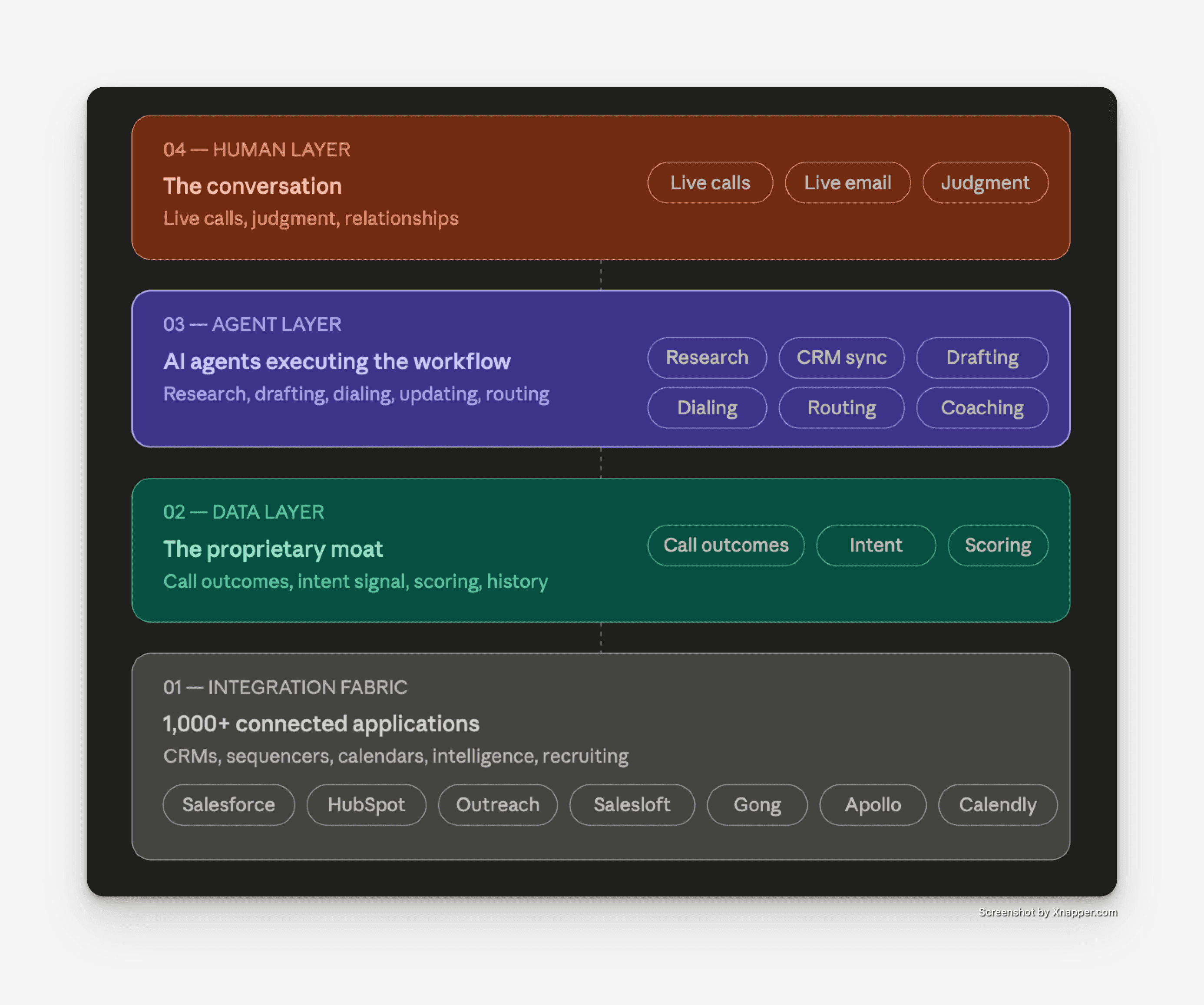
Layer 1: The Integration Fabric. 1,000+ connections to the apps your GTM team already uses. Greenhouse and Ashby for hiring signals. Lever for talent pipeline data. Gong and Chorus for call intelligence. Outreach, Salesloft, and Apollo for engagement. HubSpot and Salesforce for record-of-truth. Calendly and Cal.com for scheduling. Mixpanel, PostHog, and Pendo for product signal. Gmail and Outlook for inbox. Slack and Microsoft Teams for internal comms. The fabric is wide because the modern GTM team is wide.
Layer 2: The Agent Layer. AI agents that read, write, and reason across the fabric. They draft, they dial, they update, they research, they coach. They don't replace the rep — they replace the plumbing the rep used to do.
Layer 3: The Conversation Layer. This is where the human lives. Live calls, live emails, live decisions. High-leverage human work, with the agent layer handling everything around it.
When you stack those three layers, you stop being a sales tool and you start being the place where go-to-market happens.
Why this is a category, not a feature
Every category-defining company starts with a wedge product and earns the right to expand. Salesforce was a contact database. AWS was object storage. Shopify was a theme on top of a payment processor.
Salesfinity's wedge was the parallel dialer — and we built the most-loved one in the market. 300+ customers, thousands of SDRs, millions of dials of training data, the highest connect rates in the industry.
But the dialer was always the door. The category is the room behind it.
The GTM Operating System is what the room becomes when you put 1,000 integrations, autonomous agents, and the rep's primary workspace under one roof. It's a different kind of company than a point solution.
What's next
Today's announcement — 1,000+ integrations live — is the foundation being poured. The walls go up next. So do the agents that live inside them.
If you're a revenue leader who's tired of paying for ten tools, training reps on twelve, and watching half your team's day evaporate into context-switching: this is the direction we're building.
If you're a rep who got into sales to talk to people, not to be a human API: this is the operating system we're building for you.
More soon.
FAQ
What is a Go-to-Market Operating System? A Go-to-Market Operating System (GTM OS) is the unified platform where revenue teams do all of their work — calls, emails, research, pipeline updates, and AI agent workflows — replacing the fragmented stack of 10+ point tools that SDRs and AEs currently context-switch between. Salesfinity is building the category-defining GTM OS, with 1,000+ integrations across CRMs, sequencers, calendars, conversation intelligence, recruiting, and analytics platforms.
How is a GTM Operating System different from a sales engagement platform? A sales engagement platform like Outreach or Salesloft is one application a rep logs into among many. A GTM Operating System is the workspace itself — the layer where every other tool is accessed, automated, and orchestrated by AI agents. Sales engagement is a feature of the GTM OS, the way email is a feature of an operating system.
Which apps does Salesfinity integrate with? Salesfinity now integrates with 1,000+ applications, including Salesforce, HubSpot, Outreach, Salesloft, Apollo, Clay, Gong, Chorus, Greenhouse, Ashby, Lever, Calendly, Cal.com, Gmail, Outlook, Slack, Microsoft Teams, Mixpanel, PostHog, Pendo, and LinkedIn Sales Navigator — covering CRMs, sequencers, conversation intelligence, recruiting, scheduling, communication, and analytics categories.
Will AI agents replace SDRs? No. AI agents replace the plumbing SDRs do — list pulls, CRM updates, data syncing, sequence routing, follow-up scheduling. The human SDR keeps the high-leverage work: live conversations, judgment calls, and relationship building. The GTM OS thesis is that reps should spend 100% of their time on conversations and 0% being a human API between systems.
How much time do reps actually spend on Salesfinity? Salesfinity reps currently spend 3+ hours per day on the platform — more than they spend in their CRM, their sequencer, or their inbox. That's the operating-system signal: the place where the work actually happens.