Why Connect Rates Are Low (And How to Actually Fix Them): A Manual for SDR Teams


TL;DR — Low connect rates aren't a dialer problem. They're a data problem wearing a dialer's costume. About 30% of any list you buy is bad numbers, another 30–40% is people who never pick up phones, leaving 20–30% as actual phone-reachable prospects. Most teams respond by dialing harder — switching to a parallel dialer, hiring more SDRs, raising activity quotas. None of that fixes the underlying issue. The real fix is a system: verify the list, continuously re-enrich the bad numbers, and manage caller ID hygiene automatically. This post walks through how to think about the problem, what to look for in a dialer, and what "good" actually looks like.
If you manage an outbound team, you've had this meeting:
Pipeline is light. You pull up the team's connect rate. It's around 2%. You ask why. Someone says the dialer is broken. Someone else blames the data provider. A third person says reps need to be coached harder. Everyone has a theory. Nobody has evidence. You leave the meeting having approved a budget increase for a different dialer, or another data tool, or a quota increase, and you'll be back in the same meeting in 90 days.
This is the core problem with how most SDR organizations approach connect rates: it gets treated as a vague performance issue, not a system. So nobody can investigate it, nobody can fix it, and the cycle repeats.
This post is the manual we wished existed when we started thinking about this problem from first principles. It's written for SDR managers, VPs of Sales, and RevOps leaders who are tired of guessing. By the end, you'll have a framework for diagnosing where your connect rate problem actually lives, and a checklist of what to demand from any dialer you're evaluating.
Let's start with the math.
What's actually inside a typical contact list
Every conversation about connect rates has to start here, because this is the thing that determines 50%+ of the outcome. If you don't fix this, nothing else you do matters.
Buy a list from any major data provider — and it doesn't really matter which one, the expensive ones aren't materially different from the cheap ones — and here's roughly what you're getting:
20–30% bad numbers. Voids, disconnects, unreachable lines, toll-free routings, switchboard numbers that don't reach anyone in particular, numbers that ring forever and go nowhere.
30–40% non-phone leads. Real people, real numbers, but the phone is not their channel. They respond to email, to LinkedIn, to events, to door-to-door — but they will never answer an unknown number. That's not a list problem, it's a buyer-behavior reality.
20–30% phone-reachable. Real people, real numbers, who actually answer phones. These are your real prospects.
The remaining ~15% sits in a borderline zone — numbers that connect intermittently, gatekeepers, voicemail-only routings, mobile numbers shared between household members.
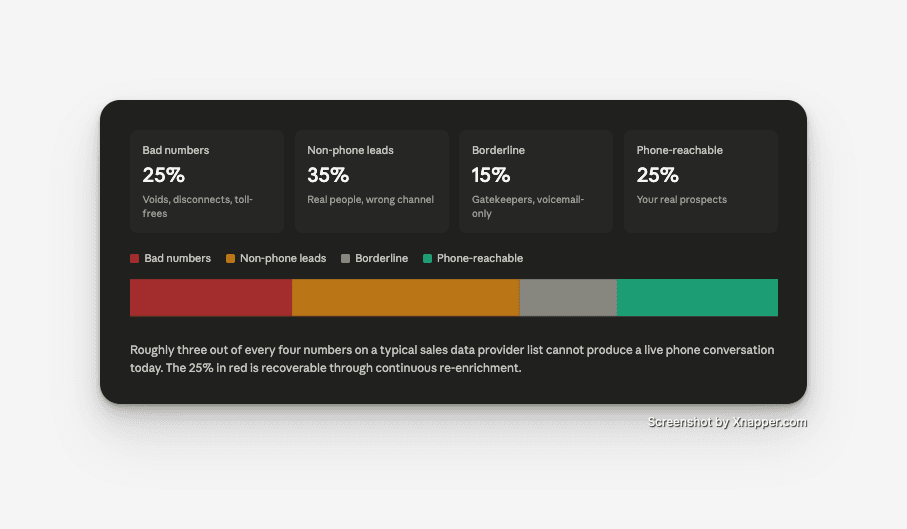
That's the playing field. Three out of every four numbers your reps dial are not going to produce a conversation. Not because your reps are bad. Not because your dialer is broken. Because the underlying input is broken.
The hidden cost of dialing into a bad list
Here's the part most teams don't sit with long enough.
SDRs are not paid to make dials. They're paid to have conversations. Every minute a rep spends listening to a number ring out, navigating an IVR for a disconnected line, leaving a voicemail at a toll-free routing — that minute is a net negative. It costs the company salary. It costs the rep morale. It costs the pipeline a conversation that didn't happen.
Run the math on a 20-rep team:
20 reps × 100 dials/day × 75% bad-or-non-phone = 1,500 wasted dials/day
At 30 seconds of average wasted-dial time = 750 minutes/day = 12.5 rep-hours/day evaporated
Across 250 working days/year = 3,125 rep-hours/year on dials that mathematically can never produce conversations
That's roughly 1.5 full-time SDRs worth of payroll spent dialing numbers that were never going to ring.
This is what makes connect rate a finance problem, not a sales-ops problem.
Why "just dial more" doesn't fix it
When connect rates drop, the standard playbook is to dial more. Manual dialing doesn't scale, so teams move to power dialers (one line, automated dial-and-pause) and then to parallel dialers (multi-line, like Orum and Nooks). This produces a real, immediate lift — more dials per hour means more chances at the 25% of the list that's actually phone-reachable.
But it's masking, not solving. The underlying ratio doesn't change. You're still dialing 75% bad inputs, just faster. The team feels productive (dial counts go up). The metrics that matter (conversations per rep per hour, meetings booked, pipeline created) plateau within a quarter, because you've hit the natural ceiling of the list quality.
And there's a second-order cost most teams don't catch until it's too late: dialing harder into the same numbers from the same caller IDs gets those caller IDs flagged as spam. Now even your good prospects see "Spam Likely" on their screen and decline the call. You've made the connect rate problem worse by trying to brute-force it.
Parallel dialers are a tool. They are not a strategy. They belong inside a system that handles list quality and caller ID hygiene; on their own, they're a more efficient way to dial bad data.
The data quality flywheel nobody is building
Here's the insight that actually breaks the problem open.
That ~30% of bad numbers in your list — the voicemails, toll-frees, disconnects, dead lines — is not a fixed loss. It's recoverable.
If your dialer can identify a number as bad in real time (a number that didn't ring, a number that hit a recorded toll-free message, a number that voicemail-jailed on the first ring), and if you have a continuous enrichment process that automatically sources a replacement number from a different provider, then over time, those bad numbers turn into good numbers. The same contact, with a working phone, now reachable.
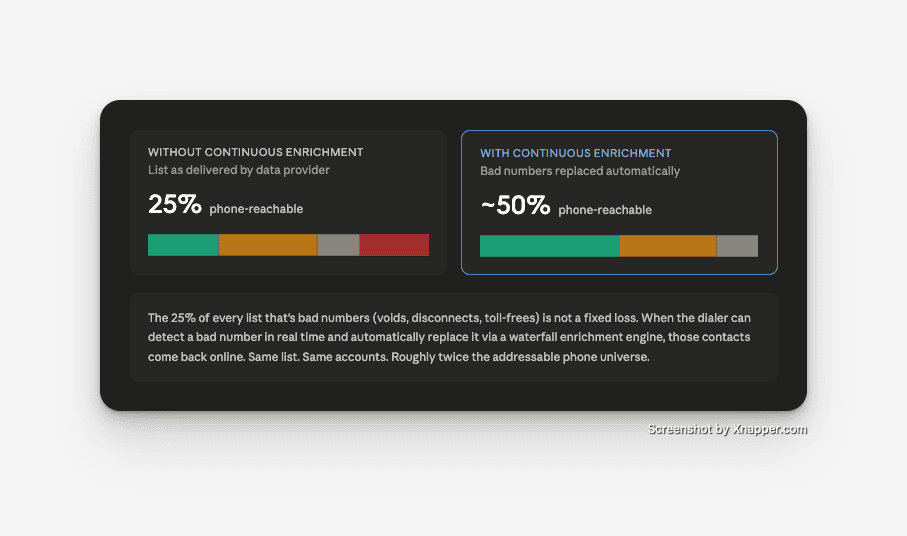
Run that math: a 100,000-contact list with ~25,000 phone-reachable today becomes ~50,000 phone-reachable over a few cycles of automated re-enrichment. Same list. Same accounts. Same ICP. Twice the addressable phone universe. Without buying any additional contacts.
Almost no SDR team is doing this. Most do enrichment as a one-time process at the moment of import — list comes in, gets enriched once, goes to the dialer, and any bad numbers that get discovered during dialing are silently absorbed as a tax. The team eats the loss. Nobody re-enriches.
This is the single highest-ROI workflow that most outbound orgs are not running. And it's specifically because the tools aren't set up to make it easy — data providers sell numbers but don't see the outcome of a dial, so they have no feedback loop to know which numbers are bad. Dialers see the dial outcome but historically don't have enrichment built in. The two systems are separate, and the gap between them is where the addressable market gets lost.
The other invisible drains on connect rate
Even if you fix the data quality problem, there are three more contributors to low connect rates that compound on top:
Wrong-person contacts. You called Bob, Bob picked up, but it turned out to be a different Bob — same name, wrong company, wrong title, wrong person. Or your list had Bob as the VP of Engineering, but Bob moved to a new company eight months ago and the number on file is now Andy's. Your data is stale. Most lists are.
Caller ID burn. A single phone number making hundreds of outbound dials per day across the same carrier networks gets algorithmically flagged. Carriers don't tell you they've flagged it — you just notice connect rates dropping on that specific number. By the time you investigate, it's been "Spam Likely" on prospects' screens for two weeks.
Local presence mismatch. Buyers screen unknown numbers aggressively. A number from an area code your prospect has never lived in is roughly half as likely to get answered as a number from their own area code. Local presence isn't a nice-to-have; it's a baseline.
Each of these is fixable, but only if the dialer is designed to fix them automatically. Asking SDRs to manage caller ID rotation and area code matching by hand is asking them to do RevOps work in the gaps between dials. They won't, and even if they did, they shouldn't — that's not what they're paid for.
What "good" actually looks like: the three-layer system
The right way to think about connect rate is as a system with three layers, each addressing a different failure mode. Any dialer evaluation should be a test of whether the dialer can do all three.
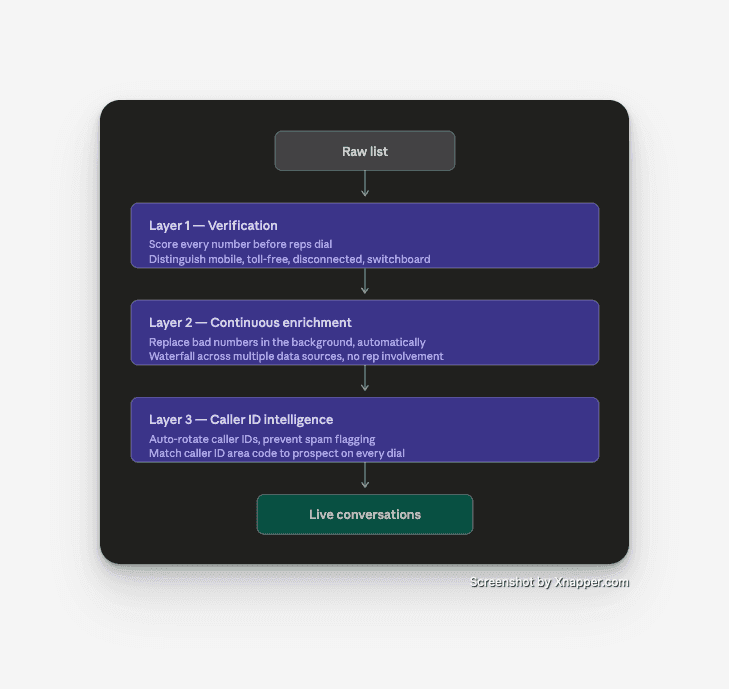
Layer 1 — Verification. Before reps ever dial, the dialer should score every number on the list and tell you which numbers are likely to ring versus which are bad. Not perfectly (you can't know if a specific person will answer a specific call), but at the level of "this is a working mobile line on a major carrier" vs. "this is a toll-free route to a disconnected switchboard." This information should appear in the dialer UI before a single dial is placed, so reps and managers can make informed decisions about which segments of the list to prioritize.
Layer 2 — Continuous enrichment. The dialer needs to know, in real time, when a dial result indicates a bad number — and it needs to automatically replace that number with a verified alternative from a waterfall of data sources. This should happen in the background, without rep involvement, without an admin touching anything. The output is a list that gets cleaner over time instead of degrading. This is the layer that doubles your addressable market, and it's the one almost no team has.
Layer 3 — Caller ID intelligence. The dialer should manage caller ID rotation, prevent any single number from being overused into spam-flag territory, and automatically match the caller ID's area code to the prospect's area code on every dial. Reps should never have to think about which number they're dialing from. The system handles it.
When all three layers are in place, the dialer stops being a tool that helps reps make more dials and becomes a system that produces consistent connect rates without management intervention.
A buyer's checklist for evaluating dialers
If you're evaluating a dialer right now — whether it's your first one or you're switching off something that isn't working — here are the questions that matter. Anything beyond this is mostly cosmetic.
Data verification:
Does the dialer score numbers for likelihood of pickup before reps dial them?
Can it distinguish mobile numbers from toll-free, switchboard, and disconnected lines?
Where does the score come from — a static database lookup or live carrier metadata?
Continuous enrichment:
When a dial fails because the number is bad, does the dialer automatically attempt to replace it from another source?
How many data providers are in the enrichment waterfall?
Does the replacement happen without rep intervention or admin involvement?
Does enrichment run continuously, or only at the moment of list import?
Caller ID hygiene:
Does the dialer automatically rotate caller IDs to prevent spam flagging?
Does it match the caller ID's area code to the prospect's area code on every outbound dial?
For international outbound, does it match country codes (German numbers for German prospects, UK numbers for UK prospects)?
Can administrators see, per dial, which caller ID was used and why?
Compliance and integrations:
Does it respect TCPA, DNC, and country-specific calling rules natively?
Does it integrate with your CRM (Salesforce, HubSpot) and sales engagement tools (Outreach, Salesloft) bidirectionally?
Does it have an open API and webhooks for the workflows your CRM doesn't cover?
Reporting:
Can you see connect rate broken down by rep, list segment, time of day, and caller ID?
Can you see, per rep, how much time was spent on dials that produced no connection?
Can you trace a low-performing rep's connect rate to a root cause — bad data, bad caller IDs, or bad pitch?
If a dialer can't answer most of these confidently, it's a tool, not a system. You'll be back in the connect-rate meeting in a quarter.
Why most teams don't do this
If the above is the right answer, why isn't every SDR org doing it?
Three reasons:
The verification, enrichment, and dialing layers were historically separate products from separate vendors. Stitching them together required a RevOps team, an integration project, and ongoing maintenance — most teams couldn't justify the lift, so they accepted low connect rates as the cost of doing outbound.
Data providers had no incentive to build the feedback loop. Their business model is selling more contacts, not improving the contacts they've already sold. The signal that a number is bad lives in the dialer, not the data provider — but the two systems didn't talk.
Power and parallel dialer vendors solved a different problem (dial throughput) and treated data quality as someone else's job. Most still do.
The orgs that have figured this out have either built it themselves (rare, expensive) or moved to a dialer that handles all three layers in one product (also rare, but increasingly available).
How we think about this at Salesfinity
We built Salesfinity because we were watching enterprise SDR teams lose 75% of every dial day to a problem that nobody owned. The product is built around the three-layer architecture above:
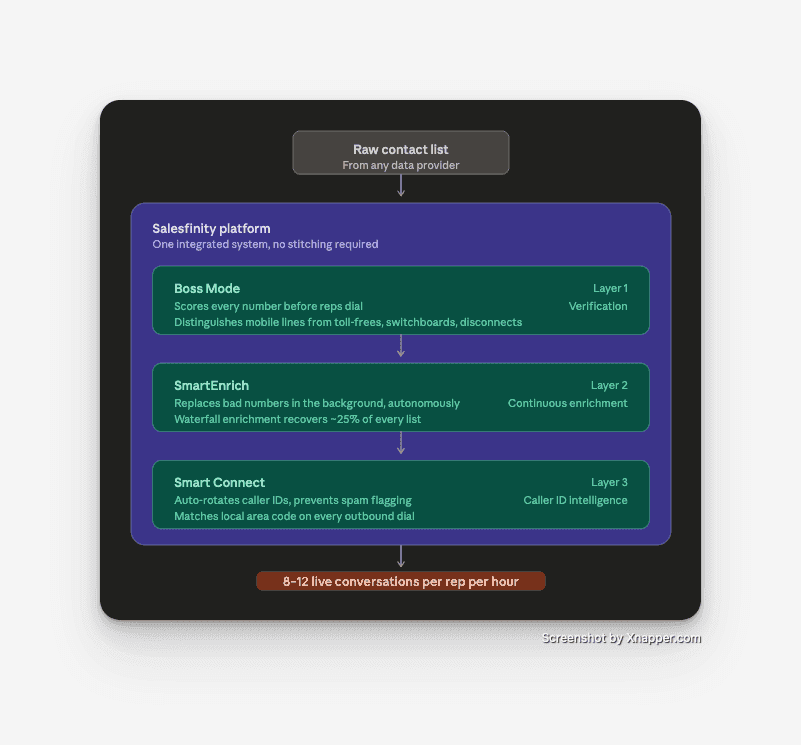
Boss Mode scores every number on your list before reps dial, so the dial queue is triaged.
SmartEnrich is a waterfall enrichment engine that automatically replaces bad numbers in the background, continuously, without rep involvement.
Smart Connect is our local area code matching algorithm — automatic on every dial, no setup, no rules.
We won't pretend this is a neutral observation, since we're the ones who built it. But the framework in this post is correct independent of which vendor you use to implement it. The point isn't that you should buy Salesfinity. The point is that connect rate is a system, and any dialer worth its line items should let you operate it as one.
If you want to see how the three layers work in practice, we're happy to show you. But you'd be better served evaluating any tool — including ours — against the buyer's checklist above. If the tool can answer those questions, it'll work. If it can't, it won't.
Frequently asked questions
Why are connect rates so low for outbound SDR teams? The primary cause is data quality. Roughly 50% of connect rate outcomes are determined by the underlying list — about 30% of any purchased list is bad numbers (voids, disconnects, toll-frees), 30–40% is real people who don't answer phones, and only 20–30% is actually phone-reachable. Adding more dialing capacity doesn't change this ratio. Fixing it requires a system that verifies, enriches, and manages caller ID hygiene continuously.
What's a typical connect rate for outbound SDR teams? Most teams running raw lists from data providers see connect rates in the 5–10% range. Teams running verified, continuously enriched lists with managed caller ID hygiene typically see 15–25%, and the best-performing teams run higher.
Will switching to a parallel dialer like Orum or Nooks fix my connect rate? A parallel dialer increases dial throughput, not connect rate. If you have a list quality problem, parallel dialing surfaces it faster but doesn't fix it. Long-term, connect rates plateau at the natural ceiling of the underlying list quality. Parallel dialing belongs inside a system that handles verification, enrichment, and caller ID management — not as a substitute for one.
What is data enrichment, and why should it happen inside the dialer? Data enrichment is the process of replacing bad or stale phone numbers with verified alternatives. It's traditionally done as a one-time process at list import. The problem is that data providers don't see dial outcomes — once a number is sold, the provider has no feedback loop to know whether it worked. The dialer does see dial outcomes, which makes the dialer the correct place for continuous enrichment. Numbers that fail get replaced automatically, and the list quality improves over time instead of degrading.
What is local presence dialing? Local presence dialing is the practice of matching the caller ID's area code to the prospect's area code on every outbound call. Buyers are roughly twice as likely to answer numbers that share their own area code, because the implicit signal is "this is local — probably someone I should answer." The best implementations are automatic and require no rep or admin involvement.
What's caller ID burn, and how do I prevent it? Caller ID burn happens when a single phone number is used for too many outbound dials, triggering carrier-level spam flags. Once flagged, the number shows up as "Spam Likely" or "Scam Likely" on prospects' screens, and connect rates from that number collapse. The fix is automatic caller ID rotation — the dialer should distribute outbound dials across many caller IDs and pull burned numbers out of rotation before they degrade.
How do I evaluate dialers when buying for my SDR team? Use the buyer's checklist above. The non-negotiables are: number verification before dialing, continuous in-dialer enrichment of bad numbers, automatic caller ID rotation, automatic local area code matching, and per-dial reporting that traces connect rate outcomes to root causes. A tool that can't do most of these is a dialer; a tool that can is a system.
How many live conversations per hour should an SDR team expect? Industry-standard single-line dialing produces about 1–2 live conversations per hour per rep. Power dialers move that to 2–4. Parallel dialers running on a verified, continuously enriched list with managed caller ID hygiene typically produce 8–12 live conversations per hour per rep.