What Top Cold Calling Teams Do Differently (We Analyzed 1.26M Calls)

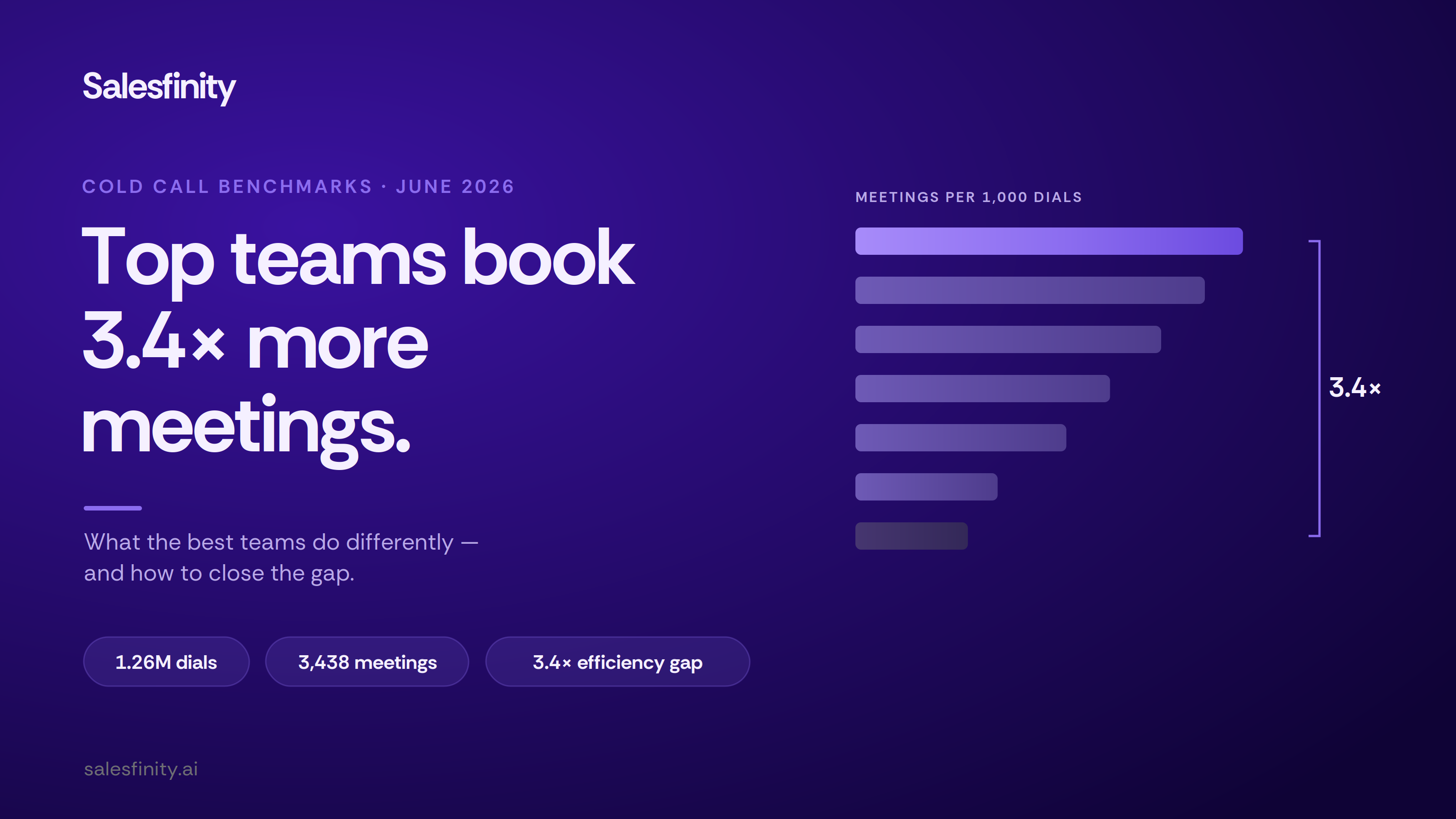
Two sales teams ran the exact same dialer for the exact same 30 days. One booked a meeting every 240 dials. The other needed 824 to book a single one.
Nobody on either team was lazy. Both showed up, both made their numbers, both worked the phones all month. The difference wasn't effort — it was everything that happens in the few seconds between the dial and the calendar invite.
We pulled aggregate, anonymized data across every team on the platform for the last 30 days — 1,257,329 dials in total — and lined every team up on one number: meetings booked per dial. The spread was brutal. And once you see what separates the top teams from the average ones, you can't unsee it.
Here's the whole picture.
The funnel: where 1.26M dials actually go
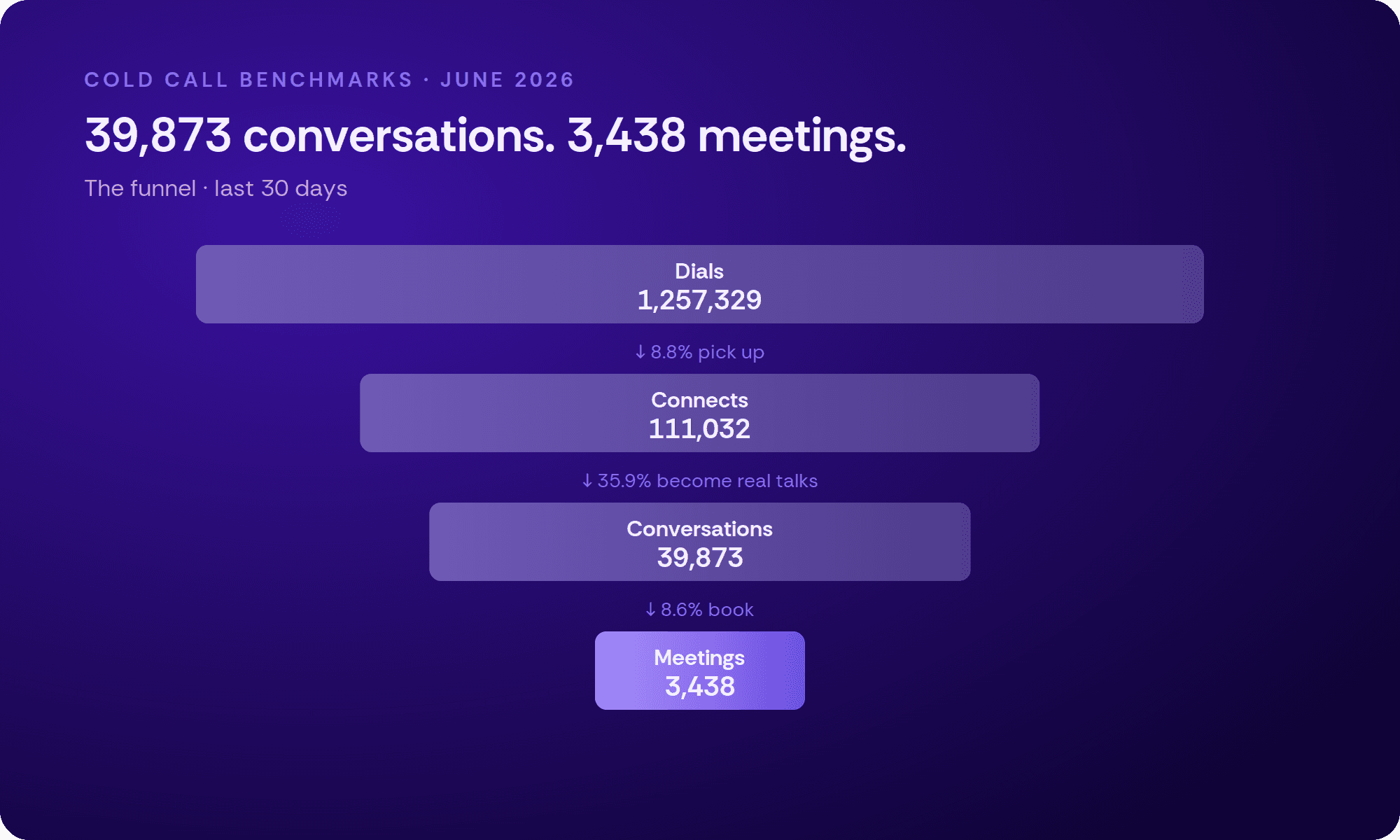
Across the full data set, the funnel looks like this:
1,257,329 dials →
111,032 connects (8.8% pick up) →
39,873 conversations (35.9% of connects became real talks) →
3,438 meetings booked (8.6% of conversations)
Two things jump out. First, the 8.8% connect rate is excellent — these teams are reaching live humans at a rate most outbound orgs only dream about. The top of the funnel is loud and healthy.
Second — and this is the important one — the leak isn't at the top. It's in the middle and bottom. Only 35.9% of connects turned into a real conversation, and only 8.6% of those conversations became a meeting. That second number means 36,435 real, live conversations happened last month and never produced a meeting.
That gap is where top teams and average teams part ways.
The 3.4× efficiency gap
When you normalize every team to meetings booked per 1,000 dials, the picture gets stark:
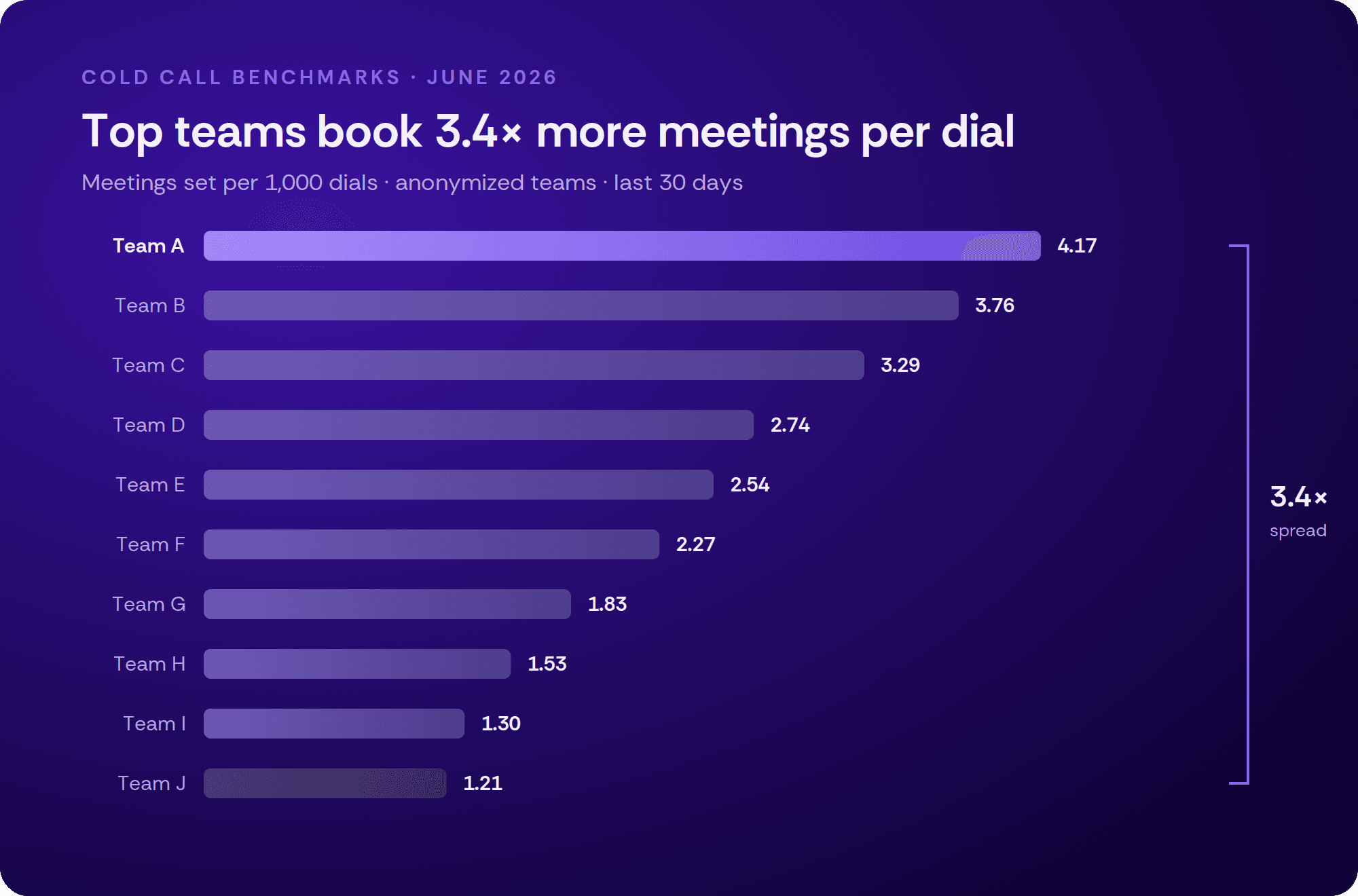
The most efficient team books 4.17 meetings per 1,000 dials. The least efficient books 1.21. Same tools, same month — a 3.4× efficiency gap.
This kills the most common myth in outbound: more dials = more meetings. The single highest-volume team in the data set — the one that made over 200,000 dials — was only an average converter. Several smaller teams quietly out-converted them per attempt by a wide margin. Volume is table stakes. Conversion is the moat.
So what are the top teams doing with those dials that the average teams aren't?
The whole job is four steps. Top teams just leak less at each one.
Cold calling, stripped to its bones, is a simple loop:
Build a great account list.
Find the relevant contacts.
Call them — book the obvious meetings, and salvage the conversations that don't convert yet.
Create follow-ups, then actually follow up.
That's it. Build, call, follow up. The thing is, cold calling is fundamentally a timing game. You can never predict whether a prospect needs your solution today, already has one, is in a budget freeze, or has priorities pointed somewhere else entirely. You can't control the timing. What you can control is how many at-bats you get and how few you waste.
Top teams don't have better luck on timing. They run the same four-step loop with far less leakage at every stage. Here's where that shows up in the data.
Lever 1: They clean the data before they dial
Go back to that funnel. The connect rate is elite, but only 35.9% of connects became real conversations. Where did the rest go?
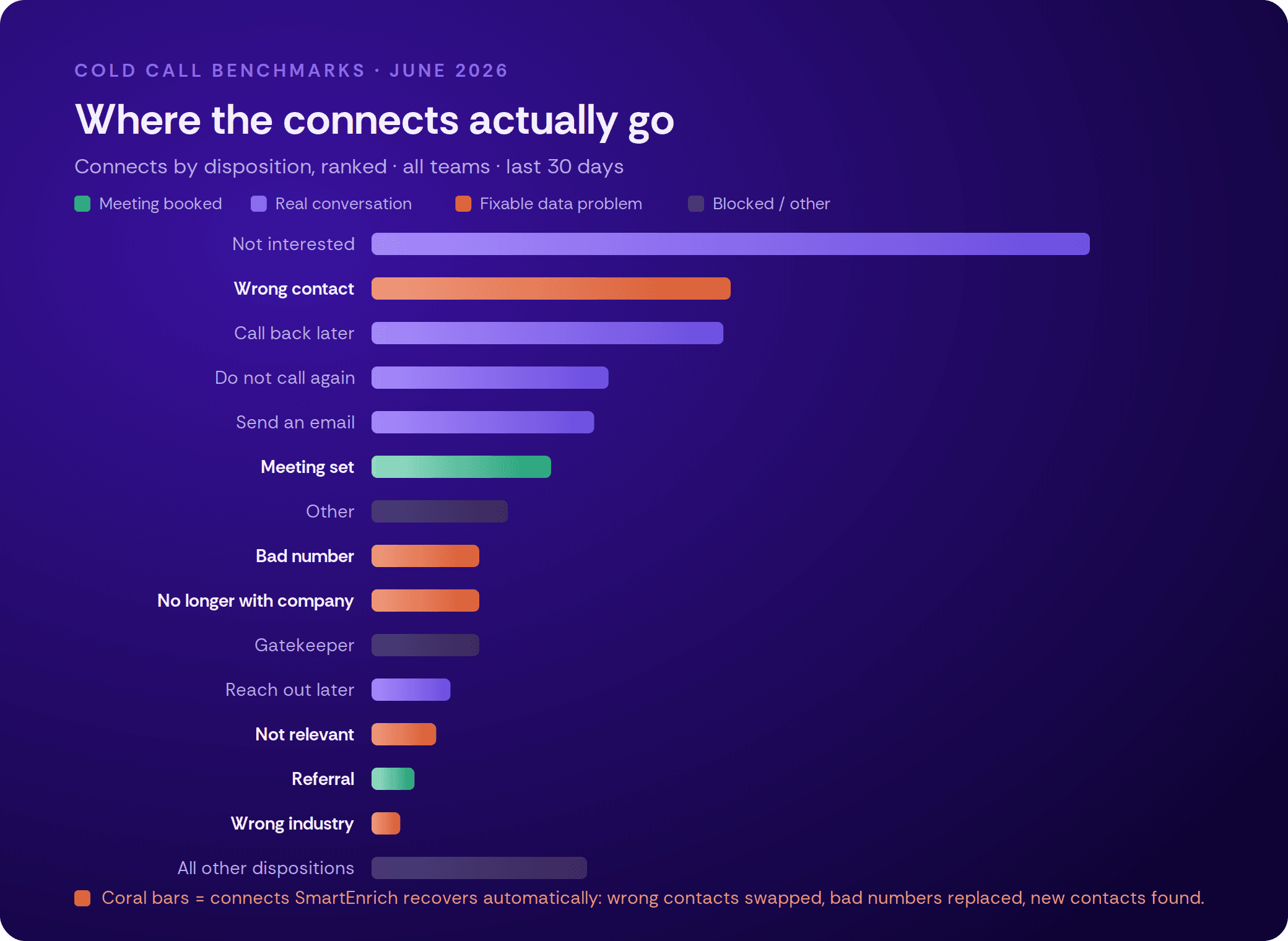
When you rank connects by disposition, a clear pattern emerges. Alongside the genuine outcomes — "not interested," "call back later," "send me an email," "meeting set" — sits a stack of dispositions that never had a chance: wrong contact, bad number, no longer with the company, wrong industry. Those are the coral bars above. They aren't rejection. They're connects that were doomed before the rep said a word, because the underlying data was wrong.
This is the most fixable number on the entire board, and top teams attack it two ways:
Validate numbers before dialing. Calling validated numbers means a higher share of dials reach a live human instead of a dead line — which lifts both connect quality and conversation rate. (On the platform, this is Boss Mode.)
Enrich and repair lists in real time. The best teams don't stop the motion to research a bad record. Their dialer automatically swaps wrong contacts, replaces bad numbers, and surfaces referrals inline. (On the platform, this is SmartEnrich.)
The compounding effect is bigger than it looks. A rep who spends 20% less time on dead numbers doesn't just dial more — they dial into more live conversations, which is the only input that produces meetings. And there's a human side, too: nothing erodes a rep's belief faster than a morning of "this isn't the right person." Clean, validated data changes the emotional texture of the shift, and momentum is what keeps people on the phone.
Lever 2: They treat follow-ups as inventory
Now the big one. Remember the 36,435 conversations that happened and never became a meeting? Most of those prospects didn't say no. They said "not right now."
"Not right now" is not "no." It's a follow-up waiting to be created.
Average teams have the conversation, hang up, and the lead quietly dies of neglect. Top teams treat every "call me later," "send me an email," and "wrong timing" as a scheduled next touch — a piece of inventory to be worked, not a dead end. The meeting that doesn't happen on call #1 happens on call #3, #5, or #8, if someone schedules the next touch.
If your conversation-to-meeting rate is sitting under ~10%, the problem almost certainly isn't your pitch. It's that there's no disciplined follow-up step in your workflow, and reps are folding a couple of touches too early — right before the timing finally lines up.
The rule top teams enforce: no conversation ends without a follow-up created.
Lever 3: They don't dial alone
There's one more pattern hiding in the activity data, and it's about environment, not technique.
Dialing happens in waves that track the team's rhythm — heavy midweek, near-zero on weekends — and the teams that dial together, on a shared sales floor, sustain those waves dramatically longer than reps grinding solo.
Solo dialing is where giving up happens. Nobody's watching, the morning's been rough, and the rep quietly stops at 11am. On a live sales floor, you feel the energy, you hear someone book a meeting two seats over, and you stay in the chair. Same talent, same scripts, completely different output. The reps most likely to quit early — right before the meeting that was about to happen — are almost always the ones dialing alone.
Bonus: timing within the week
One more nugget from the data, since cold calling is a timing game. Meetings cluster hard in the middle of the week:
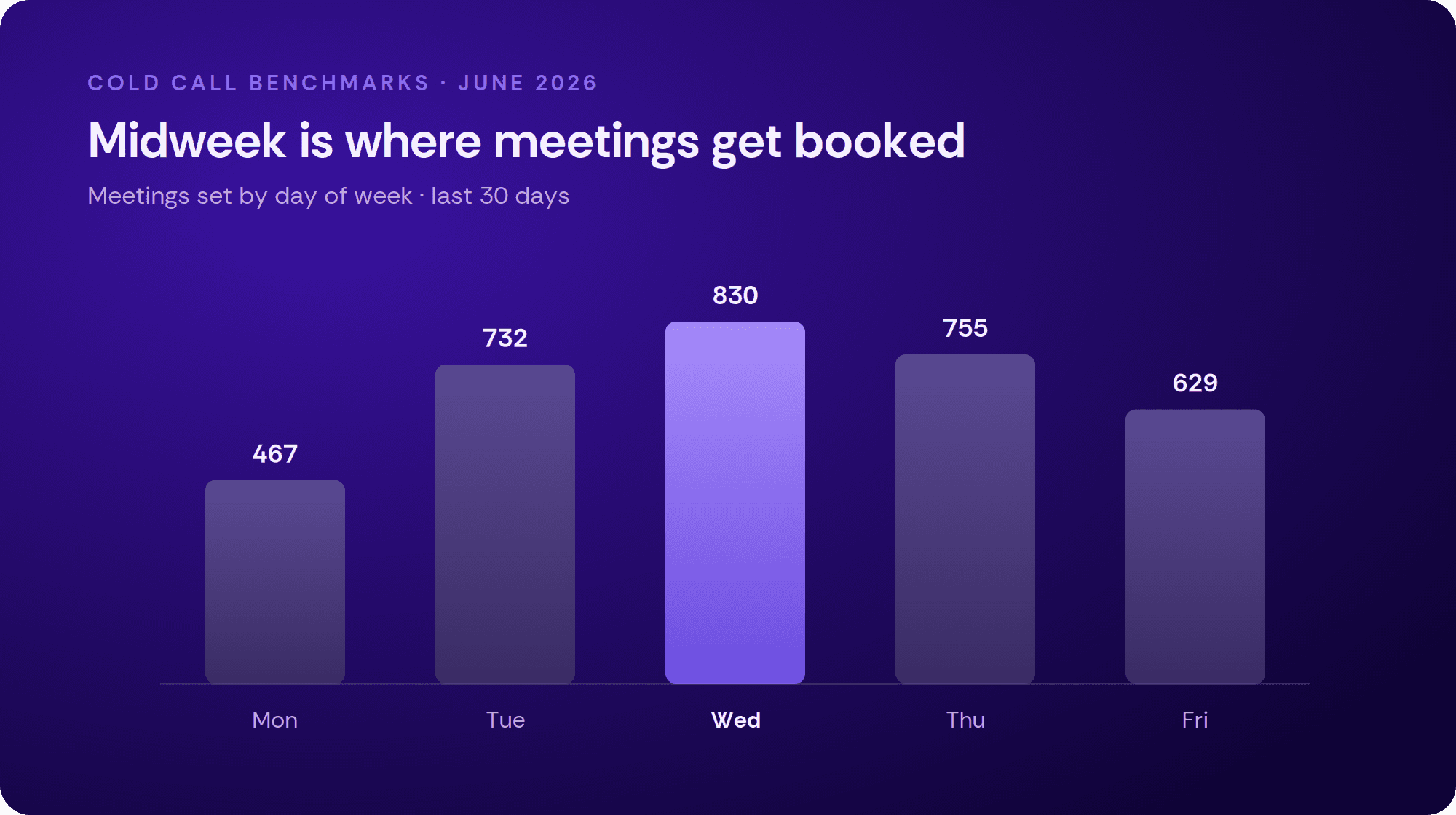
Wednesday, Thursday, and Tuesday do the heavy lifting; Monday lags and weekends are effectively dead. If you're deciding where to concentrate your best reps and your cleanest lists, midweek is where the meetings are.
How to turn an average team into a top team
You don't need a new script or a clever tactic. You need to run the loop with less leakage. Here's the two-week sprint we'd recommend to any team sitting on the wrong side of that 3.4× gap:
Validate and enrich every list before it hits the dialer. No exceptions. Move your connect-to-conversation rate off 35.9%.
Make "no conversation ends without a follow-up" a hard rule. Build a standing daily block for warm follow-ups — they convert far better than cold dials.
Get the team on the sales floor together. Persistence is contagious; isolation kills it.
Then change what you measure. Stop ranking reps on raw dial count and start ranking them on meetings per 1,000 dials. The leaderboard will reorder itself, the quiet converters will finally get credit, and the "grinders" dialing a thousand bad numbers a day get a reason to fix their inputs.
That single metric is the difference between a team that books 1.21 meetings per 1,000 dials and one that books 4.17. Move it, and everything downstream follows.
Frequently asked questions
What is a good cold call connect rate? In this data set of over 1.26M dials, the aggregate connect (pick-up) rate was 8.8%, which sits at the strong end of the range for B2B outbound. Many teams operate in the 3–8% band depending on data quality and dialing technology, so anything consistently above 8% is excellent. The bigger lever for most teams isn't the connect rate itself — it's what happens after the connect.
How many dials does it take to book a meeting? It varies enormously by team. In this analysis, the most efficient team booked a meeting roughly every 240 dials, while the least efficient needed around 824 — a 3.4× spread. Across all teams combined, the blended figure was about 366 dials per meeting. The number is driven less by raw effort and more by data quality, follow-up discipline, and dialing environment.
What is a good conversation-to-meeting rate on cold calls? In this data, only 8.6% of live conversations converted to a booked meeting, meaning over 36,000 conversations didn't result in a meeting in a single month. Most of those weren't rejections — they were "not right now." Teams that build a disciplined follow-up motion typically lift this rate well into the double digits, because the meeting often happens on a later touch rather than the first call.
Why are so many of my connects "wrong contact" or "bad number"? Because most lists degrade fast, and a meaningful share of any raw list contains outdated or incorrect records. These connects are doomed before the rep speaks. The fix is to validate numbers before dialing and to enrich lists in real time — automatically replacing bad numbers, swapping wrong contacts, and surfacing referrals — so reps spend their time on live, correct conversations instead of dead records.
What is the best day of the week to cold call? In this data set, meetings booked peaked midweek — Wednesday, Thursday, and Tuesday — with Monday noticeably lower and weekends effectively inactive. If you're concentrating effort, the middle of the week is where the meetings are.
Does dialing as a team actually book more meetings? The activity data strongly suggests yes. Reps who dial together on a shared sales floor sustain their dialing far longer than reps working solo, who tend to stop early on a tough morning. Since cold calling is a persistence game, staying in the chair longer directly translates into more conversations and more meetings.
What's the single biggest difference between top and average cold calling teams? Conversion efficiency, not volume. The highest-volume team in this analysis was only an average converter. The teams that win book more meetings from the same number of dials by doing three things consistently: dialing clean, validated data; following up on every conversation that didn't convert yet; and dialing together rather than alone.