

Why SDRs Waste Time Before Calls (And How to Fix It with Better Context)
Your SDRs Don’t Have a Calling Problem. They Have a Context Problem.
Most sales teams believe SDRs need to make more calls to book more meetings.
But that’s not the real issue.
The problem is what happens before the call even starts.
Why SDRs Waste Time Before Every Call
Before dialing, most SDRs go through the same routine:
Open Salesforce to check for open opportunities
Look up account ownership
Switch to Outreach to find contact details
Check Gong for past conversations
This process takes 2 to 5 minutes per call.
It may not seem like much, but across 100+ dials per day, that’s hours of lost productivity.
More importantly, it breaks something critical in outbound sales:
Momentum.
SDR Prospecting Is a Game of Speed and Focus
Top-performing SDRs don’t overthink every call.
They move quickly.
They stay in rhythm.
They learn and adapt in real time.
But when reps are forced to switch between multiple tools, that flow disappears.
Instead of dialing, they’re:
Waiting for pages to load
Searching for information
Trying to piece together account context
This slows down prospecting and reduces total activity.
But the bigger problem comes next.
What Happens When a Prospect Picks Up
Cold calling is about timing.
When a prospect answers, SDRs have seconds to engage.
They need instant answers to questions like:
Who is this person?
What does their company do?
Are they already in a deal cycle?
Have we spoken before?
Without clear context, SDRs hesitate.
They sound unsure.
They ask generic questions.
And the conversation loses impact.
This directly affects meeting conversion rates.
This Is Not a Training Problem
Many teams try to solve this by improving SDR training:
Better scripts
More research
Stronger discovery questions
But training doesn’t fix a broken workflow.
The real issue is that SDRs are working with fragmented data across multiple systems.
Salesforce, Outreach, and Gong each hold valuable information.
But none of them provide a complete picture in one place.
The Solution: Unified Context Before the Call
The most effective way to improve SDR performance is simple:
Give reps all the information they need, in one place, before they dial.
This includes:
Account ownership
Open opportunities
Contact and account data
Previous call history
When this context is instantly available, reps can:
Move faster between calls
Speak with confidence
Personalize conversations
Book more meetings
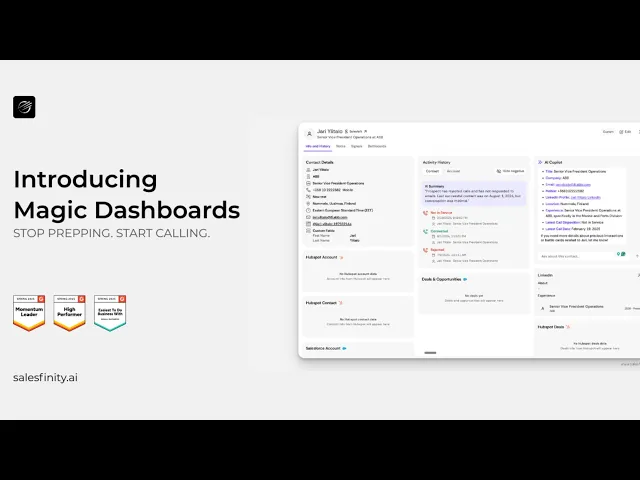
Introducing Magic Dashboards
Magic Dashboards is designed to solve this exact problem.
Instead of switching between tools, SDRs get a unified view that combines data from:
Salesforce (accounts, opportunities)
Outreach (contacts, engagement)
Gong (call history)
All in a single, customizable interface.
This allows reps to access everything they need without leaving their workflow.
How Magic Dashboards Improves SDR Performance
1. Reduces Call Prep Time
Reps no longer need to spend minutes gathering information.
Everything is available instantly.
This increases total call volume and keeps reps in flow.
2. Improves Cold Call Quality
With full context, SDRs can:
Reference past conversations
Understand account status
Ask more relevant questions
This leads to stronger conversations and higher engagement.
3. Increases Meetings Booked
Better conversations lead to better outcomes.
By removing friction and improving context, teams see:
Higher connect-to-meeting rates
More productive calls
Increased pipeline generation
The Shift from Fragmented to Unified Workflows
Traditional outbound workflow:
Open task
Switch between tools
Gather context
Make the call
With Magic Dashboards:
Open contact
See everything
Call
This reduces steps, saves time, and improves performance.
Why This Matters for Modern Sales Teams
Outbound sales is becoming more competitive.
Buyers are harder to reach.
Attention spans are shorter.
Expectations are higher.
In this environment, speed and relevance matter more than ever.
Teams that equip their SDRs with the right context will outperform those that rely on fragmented workflows.
Try It Before Your Next Call
If your SDRs are still switching between Salesforce, Outreach, and Gong before every call, they are losing valuable time and opportunities.
Magic Dashboards is now available in Salesfinity.
Set it up in minutes and use it on your next call.
The impact is immediate.
Frequently Asked Questions
What is SDR prospecting?
SDR prospecting is the process of identifying and reaching out to potential customers through outbound channels like cold calling and email to generate meetings and pipeline.
Why do SDRs struggle with cold calling?
SDRs often struggle due to lack of context, inefficient workflows, and time spent switching between multiple tools instead of focusing on conversations.
How can you improve SDR performance?
You can improve SDR performance by reducing friction in their workflow, providing full account context before calls, and enabling faster, more confident conversations.
What tools do SDRs typically use?
Most SDRs use a combination of Salesforce (CRM), Outreach or Salesloft (engagement), and Gong (call intelligence), which often leads to fragmented data across systems.
How do you reduce call prep time?
Call prep time can be reduced by consolidating all relevant data—contacts, accounts, deals, and call history—into a single view accessible before and during calls.