Best AI Parallel Dialer for EMEA: How to Actually Get Prospects to Pick Up Across Europe

There's a version of this article that ranks seven dialers in a table, gives each one a star rating, and tells you to "pick the one that fits your needs." You've read that article before. It didn't help.
This isn't that article.
This is the article for the sales leader who has already tried running outbound into Europe and hit a wall. The one whose team dialed 2,000 numbers across Germany, the UK, France, and the Nordics last quarter — and booked fewer meetings from all of EMEA combined than they did from a single week of US calling. The one who's been told "cold calling doesn't work in Europe" by reps who've never been given the right tools to actually test that claim.
Cold calling works in Europe. It works extremely well, in fact. But the mechanics are different. And the dialer you use either solves for those differences or ignores them — and the gap between those two outcomes is the difference between a thriving EMEA pipeline and a dead one.
The EMEA Problem Nobody Talks About on G2 Reviews
Every parallel dialer on the market will tell you they "support international calling." That's true in the same way that every car "supports driving in the rain" — technically accurate, operationally useless.
Here's what actually happens when a US-built parallel dialer tries to run a European campaign:
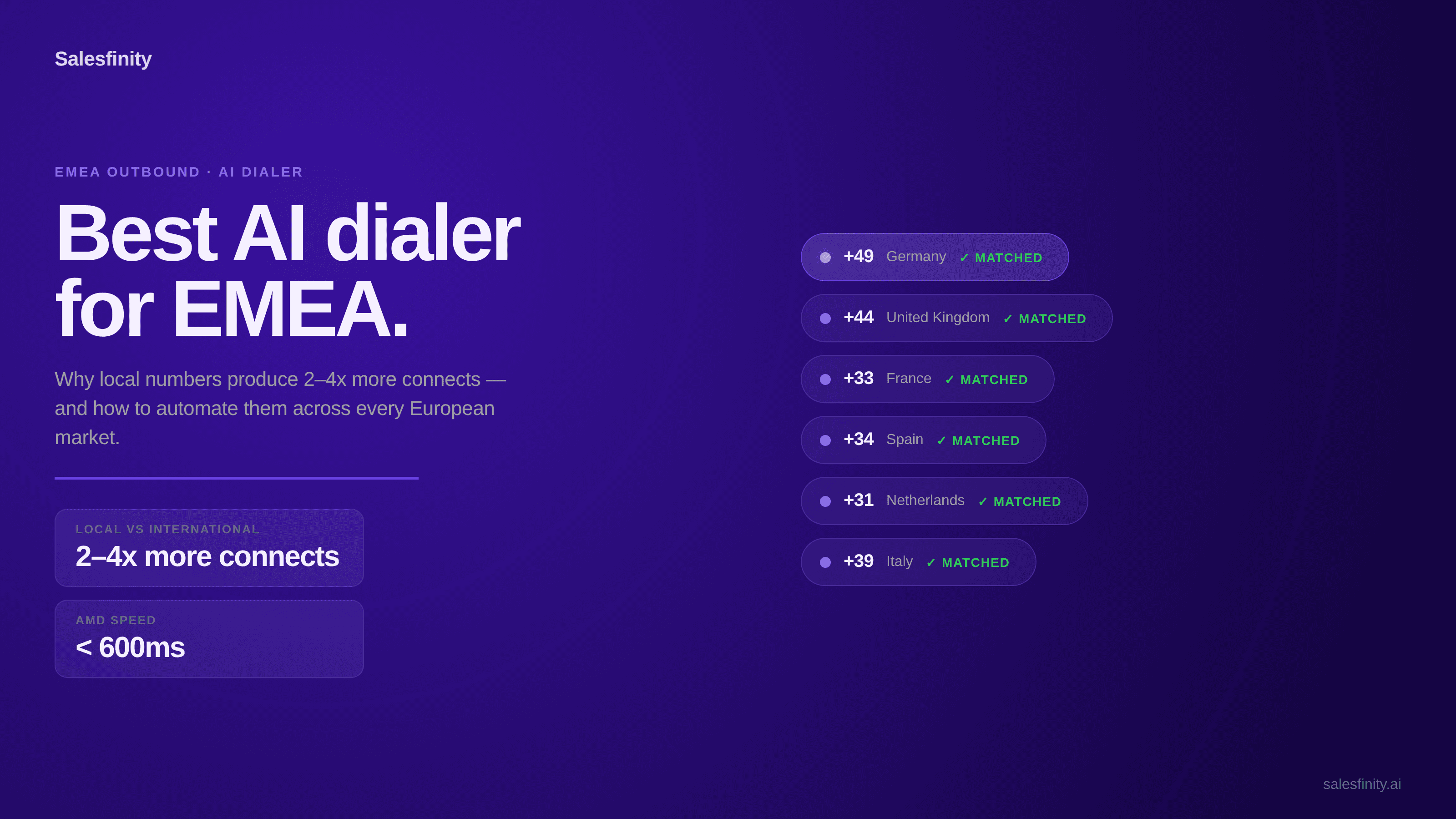
You need a different phone number for every country you call into. A German prospect sees a +49 number and might pick up. They see a +44 (UK) or +1 (US) number and ignore it. Same for France (+33), Spain (+34), the Netherlands (+31), Italy (+39), and every other market. This isn't a preference — it's a near-universal behavior. Across hundreds of Salesfinity customers running multi-country outbound, local numbers get picked up 2 to 4 times more than international ones.
Your lists are mixed. Nobody builds a call list that's 100% one country. Real EMEA lists have UK prospects next to German prospects next to French prospects next to Dutch prospects. They're sorted by account priority or buying stage, not by country code.
Most dialers force you to choose one number per session. So you either split your list into five separate campaigns (one per country), manually toggle your outbound number between every few calls, or accept that 70-80% of your dials are going out with the wrong country code. None of these options scale.
The result: teams that crush it in the US — 8%, 10%, 12% connect rates — drop to 3-4% the moment they expand into EMEA. Not because European prospects don't answer phones. Because the dialer is showing them a foreign number.
This is the single biggest reason EMEA outbound underperforms for most teams. Not the script. Not the list. Not the time zones. The country code.
What "EMEA-Ready" Actually Means in a Dialer
Let's be specific about what a parallel dialer needs to do — not claim, not support on paper, but actually do — to generate pipeline in Europe.
1. Automatic Country Code Matching
This is the table-stakes feature that separates dialers built for global selling from dialers that bolted on international calling as an afterthought.
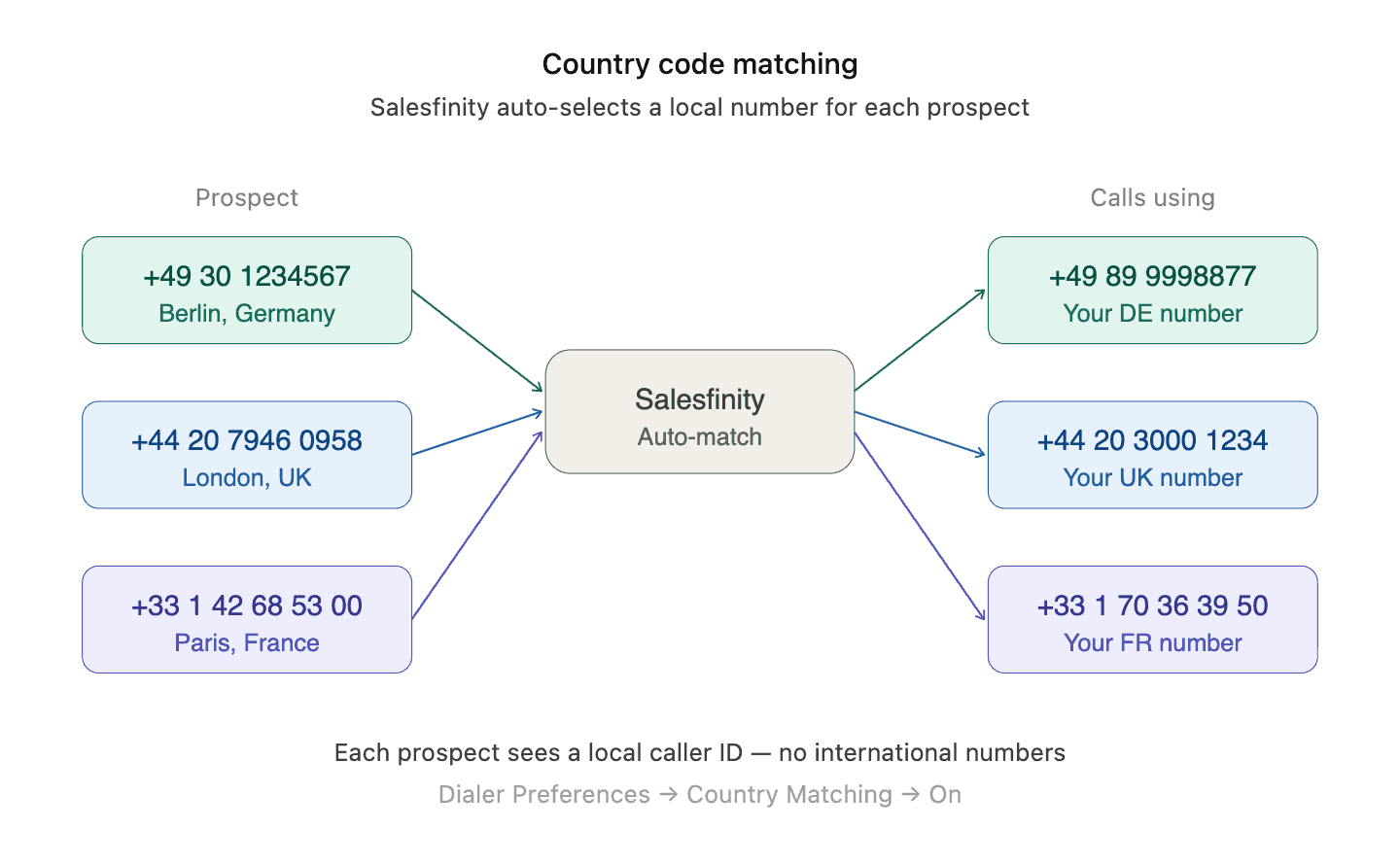
When a rep loads a mixed EMEA list and hits dial, the system needs to read each prospect's phone number, identify the country code, and automatically route the call through a matching local number. No toggling. No list segmentation. No manual number rotation. A UK prospect gets dialed from a +44 number. The next call to a German prospect goes out from a +49 number. The next one to Spain goes from a +34. The rep doesn't touch anything. They just talk.
Salesfinity's Country Code Matching does exactly this. You turn it on once in Dialer Preferences and it works on every dial, in every campaign, automatically. The system reads the prospect's number, matches it to a local number in your pool, and routes the call — all before the first ring.
Most other dialers either don't offer this at all, or offer it as a manual process that requires reps to segment lists or switch numbers between calls. The manual version doesn't work because reps forget, lists get messy, and the operational overhead kills velocity. Automation is the entire point.
2. Sub-Second Answering Machine Detection
Slow AMD kills EMEA connect rates even worse than it kills US ones.
Here's why: European mobile carriers are more aggressive about spam screening, and European prospects are more likely to let an unknown number ring through to voicemail. When they do pick up and hear 2-3 seconds of dead air (because your dialer is still figuring out if it reached a human or a machine), they assume it's a robocall and hang up.
Salesfinity's Lightning Mode classifies voicemails vs. humans in under 600 milliseconds. That's fast enough that the prospect experiences no delay — they pick up, hear the rep's voice immediately, and the conversation starts naturally. In a market where prospects are already more suspicious of unknown calls, eliminating dead air is the difference between a connect that converts and a connect that clicks.
3. Built for GDPR, Not Bolted On
If you're calling into Europe, GDPR isn't optional. You need lawful basis for processing, you need consent management, you need data retention controls, and you need audit trails. Most US-built dialers treat compliance as a checkbox on a feature page. European regulators treat it as a legal obligation with penalties up to 4% of global revenue.
Salesfinity is built for GDPR — data processing agreements, consent tracking, retention policies, and audit capabilities are built into the platform, not layered on as an afterthought. For any team selling into the EU, this isn't a nice-to-have. It's a prerequisite for operating. Our formal GDPR compliance is in progress; you can follow it in our trust center at trust.salesfinity.ai.
4. CRM Integration That Doesn't Create Double Work
EMEA campaigns are already operationally complex — multiple time zones, multiple country codes, multiple compliance frameworks. The last thing reps need is a dialer that forces them to manually sync call data back to their CRM.
Salesfinity integrates natively with Salesforce (including the Salesforce Sales Engagement platform), HubSpot, and the major CRM systems. Call outcomes, dispositions, recordings, and notes sync automatically. For teams running Salesforce Sales Engagement, Salesfinity pulls cadence tasks directly and completes them in real time — so reps can call through their Salesforce sequences without leaving the dialer.
This matters more in EMEA than in the US because multi-country campaigns generate more data points per call (country, compliance status, local number used, time zone) and teams need that data logged cleanly for reporting and compliance.
The Data Quality Layer Most Teams Miss
Here's a truth about EMEA outbound that's uncomfortable but important: even perfect dialer mechanics can't fix bad phone numbers.
European mobile number databases are less standardized than US ones. Prospects change numbers more frequently. Data providers have uneven coverage across countries — strong in the UK and Germany, weaker in the Nordics and Southern Europe. When we benchmark data providers, phone number accuracy ranges from 63% to 92% depending on the provider and the geography. That means up to 4 in 10 numbers could be wrong before your dialer even starts.
This is where most teams stop diagnosing. They blame the dialer for low connect rates when the real issue is upstream — the data feeding into it.
Salesfinity's SmartEnrich solves this with waterfall enrichment across eight data providers. Instead of relying on a single source, the system runs each contact through multiple providers sequentially and keeps the best result. For EMEA specifically, this matters enormously because different providers have different regional strengths. A provider that's 90% accurate in the UK might be 65% accurate in Germany. By waterfall-enriching across all of them, you get the highest possible accuracy for each individual contact regardless of geography.
The compound effect is significant: better numbers → more real connects → more conversations → more meetings. And you haven't changed your dialer settings, your list, or your script. You just stopped wasting dials on wrong numbers.
What Double-Digit EMEA Connect Rates Actually Look Like
Let's talk about what happens when all of these pieces work together.
ZipHQ, a Salesfinity customer running multi-country European outbound, is hitting double-digit connect rates across EMEA — consistently. Not on a single good day. Not on a cherry-picked list. As a sustained operating metric.
For context, the industry average connect rate for cold outbound in Europe is somewhere between 4-6%. Most teams running US-built dialers into EMEA see 3-5%. ZipHQ is running 2-3x above that baseline.
The components driving that result aren't secret. They're the same ones we've been discussing: automatic country code matching so every call lands as local, sub-600ms AMD so prospects hear a voice instead of silence, waterfall-enriched data so the numbers are actually right, and a dialer fast enough to let reps maintain cadence across a mixed multi-country list without operational overhead.
No single feature produces double-digit connect rates. The system produces them. Each layer compounds the one below it.
Beyond the Dialer: The Full Outbound Operating System
If you're evaluating AI parallel dialers for EMEA, it's worth understanding what sits around the dialer — because the teams producing the best results aren't using a dialer in isolation. They're running a system.
Data enrichment → Dialing → Coaching → Follow-up. That's the loop.
Data enrichment (SmartEnrich) ensures the numbers are accurate before a single call goes out. Waterfall enrichment across eight providers, automatic replacement of bad numbers, continuous re-enrichment as data ages.
Dialing (the parallel dialer with Lightning Mode, Country Code Matching, and SmartRotate) handles the mechanics of getting prospects on the phone with maximum speed and minimum friction.
Coaching (AI-scored calls, talk analytics, live coaching insights) helps reps improve conversation quality once they're connected. The system analyzes calls, identifies patterns, scores performance, and surfaces coaching moments so managers can develop reps based on data rather than gut feel.
Follow-up (Nurture AI) ensures no signal gets lost. When a prospect says "call me back in Q4" or "send me an email," the system tags that disposition, schedules the follow-up task with full call context, and reminds the rep when it's time to re-engage. Teams using Nurture AI see callback connect rates of 26-32% — 4-5x higher than cold dials — because the number is validated, the context exists, and the prospect already knows the rep's name.
This is what we mean when we say Salesfinity is an AI-accelerated outbound operating system, not just a dialer. The dialer is the engine, but the system around it — data, coaching, follow-up — is what turns dials into pipeline.
How to Evaluate an AI Parallel Dialer for EMEA
If you're comparing options, here are the questions that actually matter. Not "how many lines can it dial" — every parallel dialer dials multiple lines. The questions that separate tools that work in EMEA from tools that don't:
Does it automatically match country codes on every dial? Not "can you manually switch numbers." Automatically. On every call. Without list segmentation.
What's the AMD latency? Ask for the number. If they can't tell you, it's probably 2-3 seconds. That's too slow for European prospects.
Is it GDPR-compliant by design? Ask for the DPA. Ask about data retention controls. Ask about consent management. Then ask to see the vendor's trust center.
Does it handle data enrichment natively? Or do you need to buy enrichment from a separate vendor, export/import lists, and manage the data pipeline yourself? Every handoff point is a place where data degrades.
What CRM integrations are native? Specifically: does it work with Salesforce Sales Engagement? Does it pull cadence tasks and complete them automatically?
Does it have a follow-up system? Or does it just dial and forget? The teams with the best EMEA results are the ones that systematically re-engage every "not now" prospect.
The Bottom Line
EMEA is not a harder market. It's a more mechanically demanding one. The prospects are there. The pipeline is there. The budget is there. But the tooling has to match the complexity — multiple countries, multiple number pools, multiple compliance frameworks, variable data quality — and most dialers built for US-first teams simply don't.
The teams producing double-digit connect rates in Europe aren't doing anything exotic. They're using a dialer that automatically handles country code matching, eliminates dead air with sub-second AMD, enriches data across multiple providers, and feeds every call outcome into a follow-up system that compounds pipeline month over month.
That's not a feature list. That's a system. And the system is the edge.
Frequently Asked Questions
What is the best parallel dialer for EMEA cold calling?
The best parallel dialer for EMEA needs to automatically match the country code of each prospect's phone number and route the call through a local number from that country — without manual switching or list segmentation. It also needs sub-second answering machine detection, native GDPR compliance, and CRM integrations that handle multi-country campaign data cleanly. Salesfinity is the only AI parallel dialer that combines automatic country code matching, 600ms AMD via Lightning Mode, waterfall data enrichment across eight providers, and native Salesforce Sales Engagement integration in a single platform.
Why are my EMEA cold call connect rates so low?
The most common reason for low European connect rates is calling prospects with the wrong country code. A German prospect dialed from a UK (+44) or US (+1) number picks up roughly 3-4% of the time. The same prospect dialed from a German (+49) number picks up 12-15% of the time. Most dialers force you to use one number per session, meaning mixed EMEA lists get called almost entirely with the wrong country code.
How does country code matching improve EMEA connect rates?
Country code matching automatically detects the country code of each prospect's phone number and routes the outbound call through a local number from that same country. Instead of one default number for all calls, each prospect gets called from a matching local number — UK prospects from +44, German from +49, French from +33. This consistently produces 2-4x higher pickup rates compared to international number dialing.
Do I need different phone numbers for every European country?
Yes. To appear as a local call, you need at least one phone number registered in each country you dial into. Salesfinity lets you provision numbers for new countries directly from the dashboard — most countries provision in under five minutes. If you dial into a country where you don't have a local number, the system falls back to your default number and flags the gap.
Is cold calling legal in Europe under GDPR?
Cold calling is legal in most European countries under GDPR, provided you have a lawful basis for processing the prospect's data — typically "legitimate interest" for B2B outreach. However, regulations vary by country. Some markets (like Germany) have stricter rules around B2B cold calling than others (like the UK). Any dialer used for European outbound must support GDPR-compliant data processing, consent tracking, and audit trails.
What is answering machine detection (AMD) and why does speed matter?
AMD is the technology a parallel dialer uses to determine whether a human or voicemail answered the call. When a prospect picks up, the system has to classify the call and route it to a rep. Slow AMD (2-4 seconds) creates dead air — the prospect hears silence and hangs up. Fast AMD (under 600 milliseconds) means the prospect hears the rep's voice immediately, resulting in significantly higher conversation rates from the same number of connects.
How does Salesfinity compare to Orum and Nooks for EMEA?
Orum and Nooks both support international calling, but neither offers automatic country code matching that routes each call through a matching local number without manual intervention. Salesfinity automatically matches the prospect's country code to a local number on every dial, combines it with sub-600ms AMD via Lightning Mode, and includes waterfall data enrichment across eight providers — capabilities that are especially critical for multi-country European campaigns where data quality and local presence directly determine connect rates.
What CRM integrations does Salesfinity support for EMEA teams?
Salesfinity integrates natively with Salesforce (including Salesforce Sales Engagement), HubSpot, and other major CRM platforms. For EMEA teams specifically, the Salesforce Sales Engagement integration is significant because it allows reps to pull cadence tasks directly from Salesforce sequences, dial through them in Salesfinity, and have outcomes automatically synced back — eliminating the double-entry that slows down multi-country campaigns.
How does data quality affect EMEA cold calling performance?
Data quality has an outsized effect on European outbound because phone number databases are less standardized across countries and providers have uneven regional coverage. Accuracy ranges from 63% to 92% depending on the provider and geography. Salesfinity's SmartEnrich uses waterfall enrichment across eight providers to maximize accuracy for each contact regardless of country, automatically replacing wrong or outdated numbers.
What connect rates should I expect from EMEA cold calling?
The industry average cold call connect rate in Europe is 4-6%. Teams using international numbers without country code matching typically see 3-4%. Teams using a fully optimized system — automatic country matching, sub-second AMD, waterfall-enriched data, and systematic follow-up — can achieve sustained double-digit connect rates. The gap between average and top performance in EMEA is larger than in the US because the mechanical complexity amplifies every optimization.
Salesfinity is the AI-powered outbound operating system for teams selling into EMEA, North America, and APAC. Automatic country code matching, sub-600ms AMD, waterfall data enrichment, and AI coaching — in one platform. Get a demo →