Cold Calling Benchmarks 2026: What 1.3M Dials Reveal


The short version: across 1,315,034 cold calls placed in the last 30 days, the average connect rate was 10.1%, and it took 382 dials to book one meeting. But the best team on the platform books a meeting every 102 dials — and the weakest needs 690. Same tools, same month, a 6.8× gap.
Here's what the data says actually drives that gap, and what to do about it.
What is the average cold call connect rate?
The average cold call connect rate is 10.1%. Across 1,315,034 dials, 132,682 reached a live human being.
For context, most B2B teams operate in the 3–8% range. Anything sustained above 8% is strong; above 10% is elite territory — and it's typically the product of validated phone data and parallel dialing technology rather than rep effort.
Funnel stage | Volume | Conversion |
|---|---|---|
Dials | 1,315,034 | — |
Connects | 132,682 | 10.1% |
Conversations | 42,405 | 32.0% of connects |
Meetings booked | 3,445 | 8.1% of conversations |
The number most teams never calculate is the last one. Only 8.1% of live conversations became a meeting — meaning 38,960 real human conversations happened in 30 days and produced nothing on the calendar.
How many dials does it take to book a meeting?
It takes 382 dials to book one meeting on average. The median team needs 415. The best team needs 102.
That range is the entire story of cold calling in 2026. Effort is not the variable — the top team isn't dialing harder, it's dialing better.
What do top-performing teams look like?
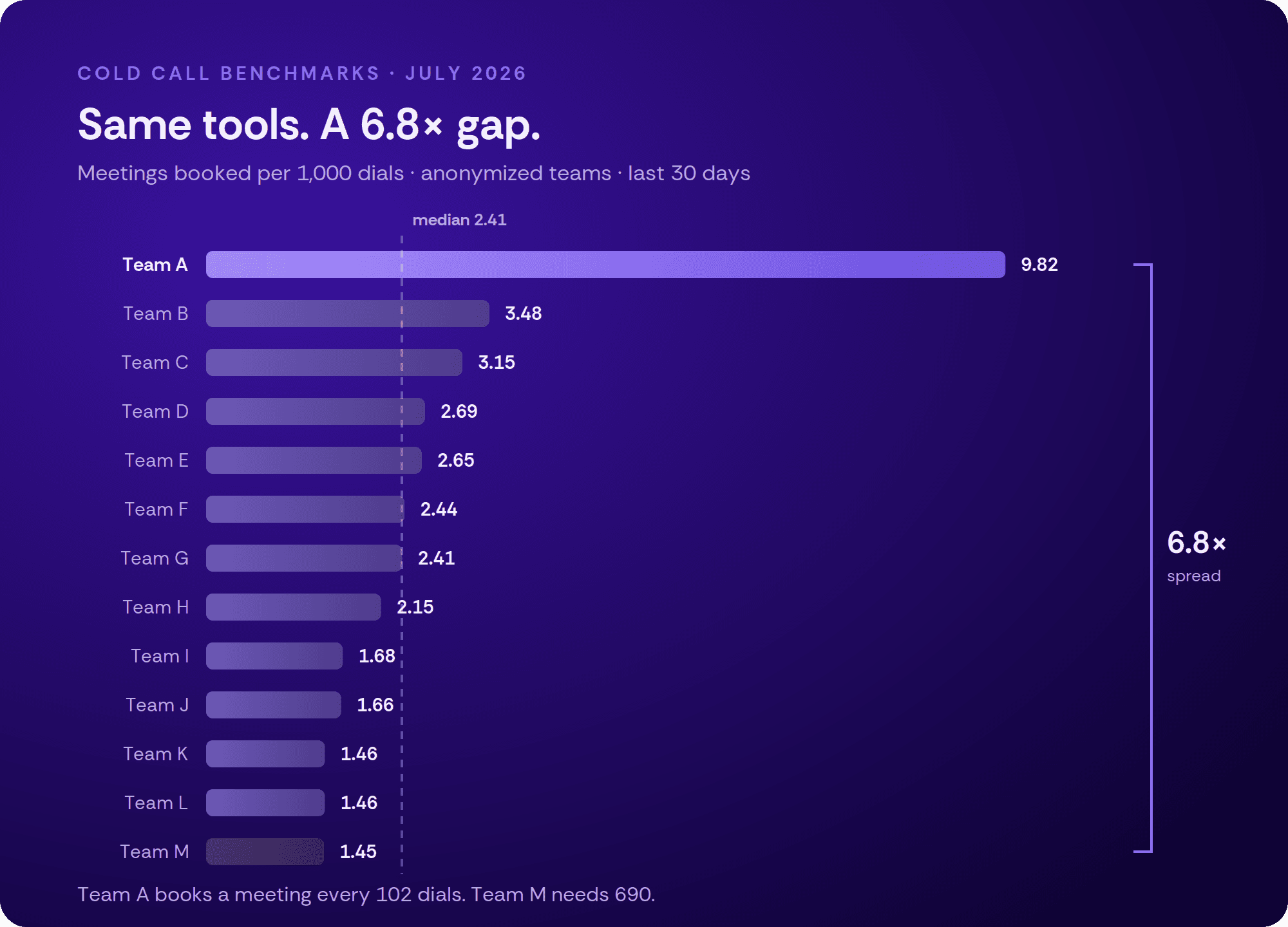
Normalize every team to meetings booked per 1,000 dials and the spread is brutal:
Meetings per 1,000 dials | Percentile | Dials per meeting |
|---|---|---|
1.66 | Bottom 25% | ~600 |
2.41 | Median | 415 |
2.69 | Top 25% | 372 |
3.42 | Top 10% | ~290 |
9.82 | Best on platform | 102 |
The most important detail: the highest-volume team on the entire platform — 189,425 dials in 30 days — converts at 2.15 per 1,000, which is below the median. More dialing did not produce more meetings.
What are top-performing reps actually seeing?
One rep booked 141 meetings in 30 days. That is more than 28 of the 32 teams on the platform booked in total, with entire rosters.
The top rep booked 2.2× more meetings than the #2 rep
The top 5 reps produced 11% of all meetings on the platform
They are not the highest-volume dialers
Elite reps aren't winning the dialing contest. They're winning the conversation contest — reaching the right person, and systematically working the "not right now" prospects that everyone else abandons.
What's working for teams — and what isn't
Two real teams, same 30 days, same dialer:
Dials | Meetings | Meetings per 1,000 dials | |
|---|---|---|---|
Team A | −2.6% | +35.3% | +38.8% |
Team B | +87.1% | −27.2% | −61.1% |
Team B nearly doubled its dial volume and booked 27% fewer meetings. Team A slightly reduced dials and booked 35% more.
What's working: validated phone data, enriched contact records, and disciplined follow-up on prospects who said "not now."
What isn't working: adding volume on top of bad data. When "wrong contact" is the #2 most common disposition on the entire platform — ahead of "call back later," ahead of every buying signal — doubling your dials just doubles your wrong numbers.
When is the best time to make cold calls?
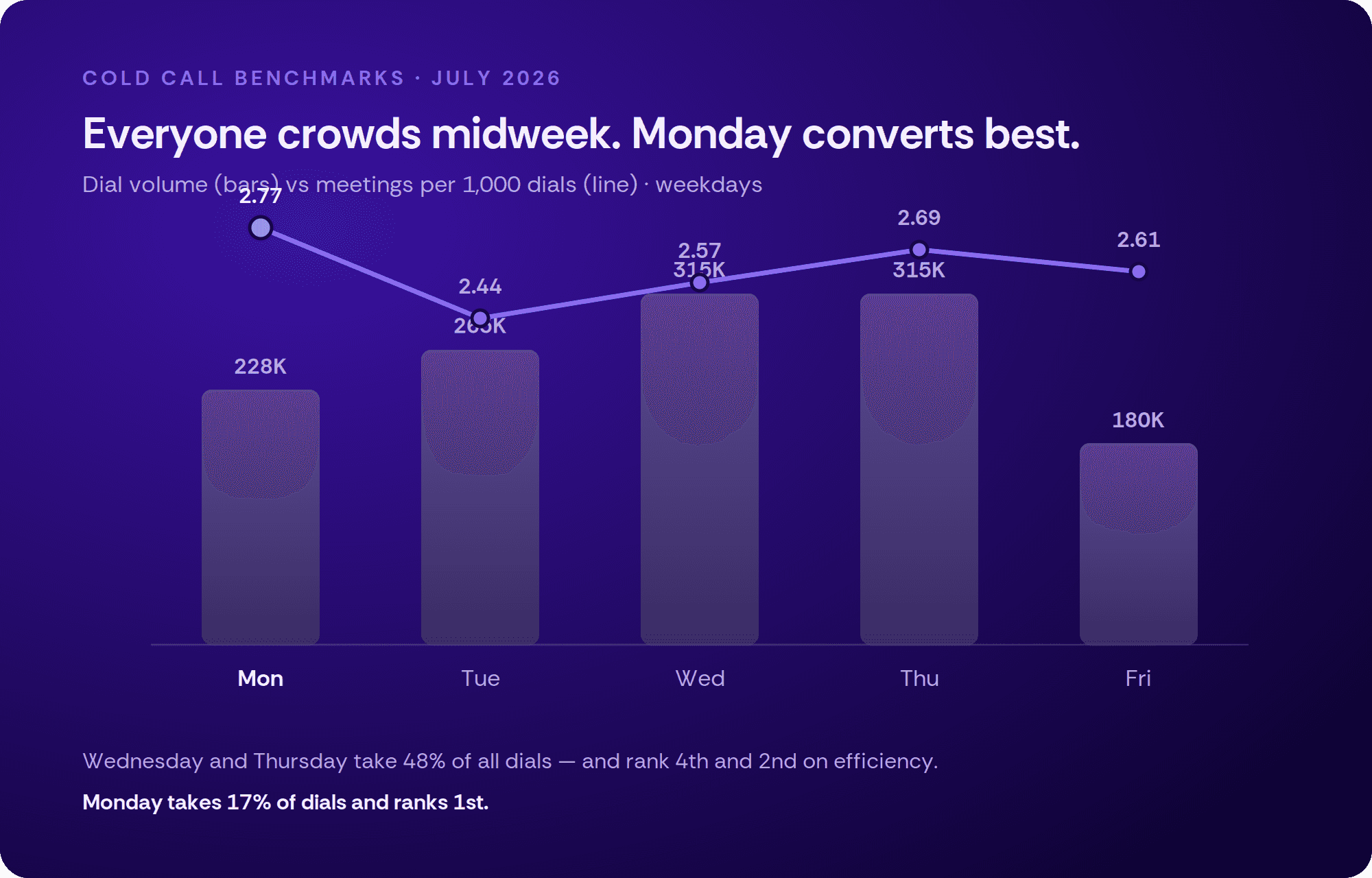
Monday is the best day to cold call, at 2.77 meetings per 1,000 dials — 14% better than Tuesday, the worst weekday.
Day | Meetings per 1,000 dials | Share of all dials |
|---|---|---|
Monday | 2.77 | 17.4% |
Thursday | 2.69 | 23.9% |
Friday | 2.61 | 13.7% |
Wednesday | 2.57 | 24.0% |
Tuesday | 2.44 | 20.1% |
Wednesday and Thursday absorb 48% of every cold call made — and rank 4th and 2nd on efficiency. Monday takes just 17.4% of dials and ranks 1st.
The surprise: it has nothing to do with pickups. Connect rate is essentially flat across the week (9.9%–10.2%). Monday doesn't get more people answering — it gets better conversations, converting 13% more meetings per conversation than Tuesday at an identical pickup rate.
How to improve your cold calling numbers
The benchmarks point at three levers, in order of impact:
1. Fix the data before you dial. "Wrong contact," "bad number," and "no longer with the company" collectively represent a punishing share of connects — calls that were dead before the rep spoke. Validating numbers before dialing raises the share of pickups that are real, relevant conversations.
2. Get to live conversations faster. A parallel dialer places multiple calls simultaneously and connects the rep only when a human answers, eliminating the dead air, voicemails, and ring time that consume most of a traditional dialing hour. This is the difference between 40 dials an hour and several hundred.
3. Work the "not now" pile. 38,960 conversations ended without a meeting last month. Most weren't rejections — they were timing. The teams at the top of that 6.8× spread treat every "call me back next quarter" as scheduled inventory, not a dead end.
Where Salesfinity fits
Salesfinity is an AI-native parallel dialer built around the finding above: reach isn't the constraint — relevance is.
Boss Mode validates every number before it's dialed, so pickups are real pickups and reps stop burning hours on dead lines.
SmartEnrich repairs lists mid-motion — automatically replacing bad numbers, swapping out wrong contacts for the right ones, and surfacing referrals inline, without the rep stopping to research.
Parallel dialing then compresses the time between dials, so reps spend their hour in live conversations instead of listening to ringing.
The result is the thing the data says actually matters: more conversations with the right person, and fewer of the 690-dials-per-meeting slog that defines the bottom quartile.
Frequently asked questions
What is a good cold call connect rate in 2026? The platform average across 1.3M dials is 10.1%. Most B2B teams sit between 3% and 8%, so 8%+ is strong and 10%+ is elite. Connect rate is largely a function of phone-data quality and dialing technology, not rep skill.
How many cold calls does it take to book a meeting? 382 dials per meeting on average. The median team needs 415, top-quartile teams need 372, and the best team on the platform needs just 102. The 6.8× spread between best and worst is driven by data quality and follow-up discipline, not call volume.
What percentage of cold call conversations turn into meetings? 8.1%. Of 42,405 live conversations in 30 days, only 3,445 became meetings — leaving 38,960 conversations that produced nothing. Most were "not right now" rather than "no," which makes follow-up the single largest recoverable source of pipeline.
What is the best day of the week to cold call? Monday, at 2.77 meetings per 1,000 dials — 14% better than Tuesday, the weakest weekday. Notably, connect rates are nearly identical every weekday (9.9%–10.2%), so Monday's advantage comes from conversation quality, not pickup rate. Most teams dial the opposite way: Wednesday and Thursday take 48% of all calls.
What is a parallel dialer? A parallel dialer places several outbound calls at once and connects the rep only when a real person answers, skipping voicemails, ring time, and dead numbers. Compared with manual dialing, it dramatically increases live conversations per hour — which is why parallel dialing teams post connect rates near 10% while manual teams often sit in the low single digits.
Does calling more improve results? Not on its own. The highest-volume team in this data set — 189,425 dials in 30 days — converts below the median. One team in the sample increased dials 87% and booked 27% fewer meetings. Volume amplifies whatever your data quality already is.
All figures are aggregate, anonymized platform data from the trailing 30 days across 1,315,034 dials. No customer, team, or individual is identifiable.