Compound Prospecting: The Pipeline Strategy That Books 2-4x More Meetings (Without More Cold Dials)


What is Compound Prospecting?
Compound Prospecting is a B2B outbound sales strategy where every conversation — including the 9 out of 10 that don't convert into a meeting today — gets systematically nurtured until it does. Instead of treating each cold call as a one-shot attempt, Compound Prospecting treats every answered phone call as an asset that accrues value over time.
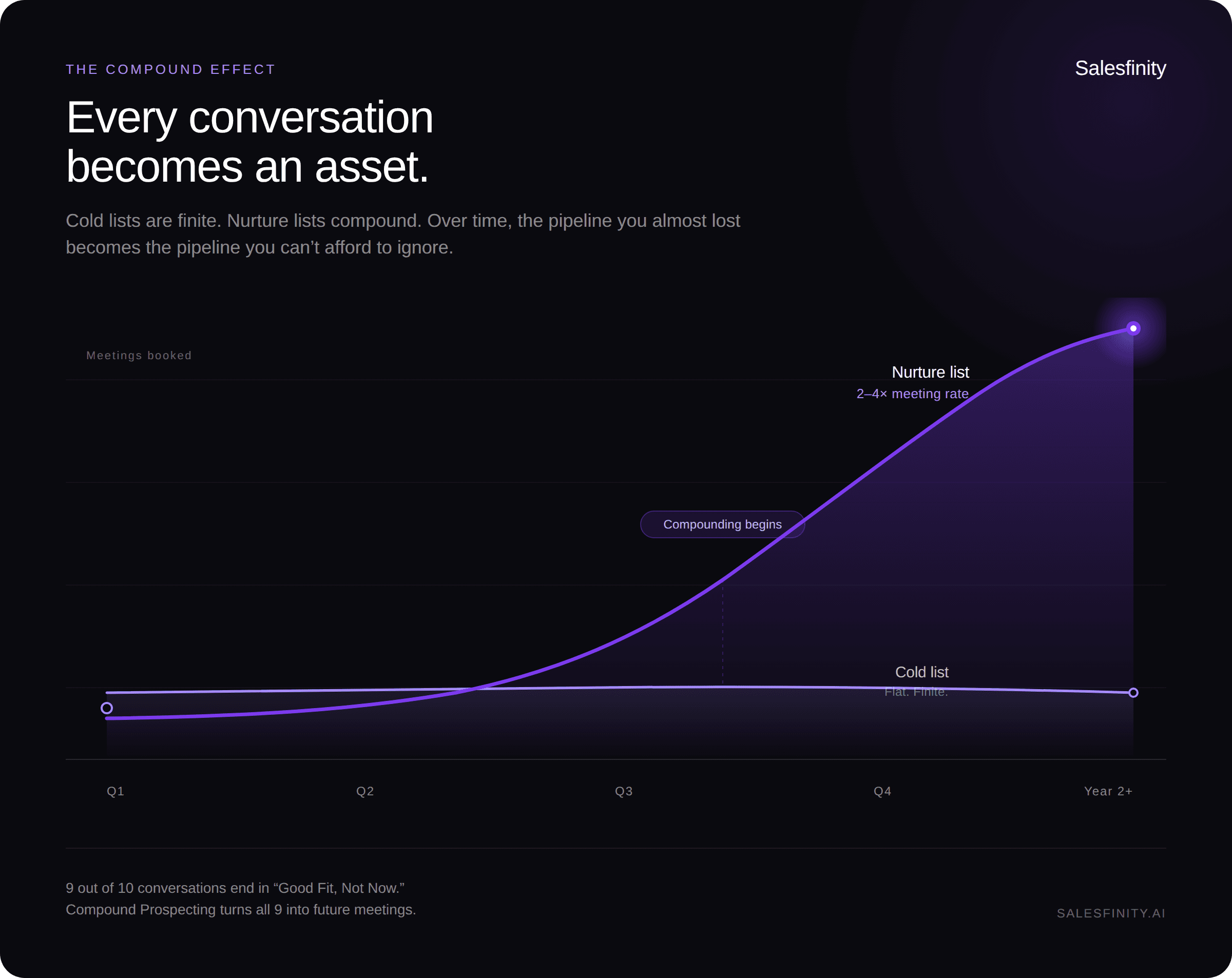
The name is deliberate. Like compound interest, the returns aren't linear. Reps who run this strategy book 2-4x more meetings from their nurture list than they do from any cold list they dial. And the longer they run it, the wider that gap gets.
This post explains the full framework, the four pillars required to run it, why most outbound teams leave 90% of their pipeline on the table, and the data from Salesfinity customers who used it to book 275% more meetings this Q1 versus last Q1.
The Problem: Most SDR Teams Throw Away 90% of Their Pipeline
Here is the uncomfortable math of outbound.
On a good day, an SDR gets 1 meeting booked for every 10 real conversations. The industry calls this a strong conversation-to-meeting rate. What nobody talks about is the other 9.
Those 9 conversations are not failures. They are real humans who answered a real phone call, engaged in a real conversation, and for one specific reason on one specific day, said "not right now." They have a budget cycle, a competing priority, an incumbent contract, a hiring freeze, a new VP who just started. The reason is almost never "your product is irrelevant to me forever." The reason is almost always timing.
We call these prospects Good Fit, Not Now.
In a traditional outbound motion, those 9 conversations vanish. The SDR disposition-codes the call, sets a vague task for "next quarter," and the prospect falls into the CRM void. Three months later, the SDR has churned out, the task has expired, the notes are lost, and the whole conversation never happened.
That is the pipeline equivalent of throwing away 90% of your manufactured product because you don't have a warehouse.
Compound Prospecting is the warehouse.
Why "More Dials" Isn't the Answer
The reflexive industry response to a weak pipeline is "dial more." Buy more numbers, run more sequences, hire more SDRs, switch to a parallel dialer. All of these scale the top of the funnel.
None of them fix the leak in the middle.
If your team is losing 9 Good Fit, Not Now prospects for every meeting they book, doubling your dial volume doubles the loss. You are not building pipeline — you are running a conveyor belt that drops inventory off the end. The math gets worse the more you spend.
The highest-leverage move in outbound is not dialing harder. It is catching the conversations you already had.
The Four Pillars of Compound Prospecting
Compound Prospecting only works if four things are in place. Miss any one of them and the flywheel stalls.
1. Data
The phone numbers you dial matter more than the dialer you use.
No follow-up system in the world saves you if half your records have wrong numbers attached. The inputs determine the ceiling. The best B2B data strategies aggregate across multiple sources — each provider has gaps in different industries, geographies, and company sizes, and the only way to approach full coverage is to waterfall them and cross-validate.
At Salesfinity this is built into the product via SmartEnrich, which aggregates 8 different data providers and cross-validates phone numbers before they ever hit a dial list. Whatever tool you use, the principle is the same: single-source data is a data disadvantage.
2. Dialer
A conversation that doesn't happen can't compound.
The dialer is the instrument that converts list into conversations, and its only job is to maximize live connects per hour with minimum friction. That means power or parallel dialing, clean caller ID rotation and spam flag management, and native integration into the CRM and sequencer so reps don't live in three tools at once.
If your reps spend half their "call block" clicking through Salesforce or waiting for rings, you are rate-limited before the strategy ever kicks in.
3. Skills
More conversations don't compound if the conversations are bad.
The output of a dial is a conversation. The output of a good conversation is one of two things: a meeting booked, or a correctly-classified Good Fit, Not Now with accurate context captured for the nurture system to act on. Both outcomes require rep skill.
This is where most outbound teams break down at scale. One SDR manager cannot listen to 500 calls a week per rep across a team of 10. So they don't — and the quality of conversations drifts, and the follow-up notes get thinner, and the nurture list fills with garbage.
The fix is systematic call coaching: AI-generated scoring against your ICP criteria, surfaced weakest-moments-first to the manager, and training loops built directly into the rep's daily workflow. When coaching is a weekly review meeting, it doesn't happen. When coaching is embedded into the tool, it does.
4. Follow-up
This is the pillar that makes the whole system "compound."
For every Good Fit, Not Now conversation, three things need to be captured automatically: who they are (decision-maker, seat, title), what the objection was (wrong timing, wrong quarter, wrong budget cycle, incumbent contract ending in month X), and when the natural trigger is to re-engage.
Then the system needs to act on that trigger without human intervention. When the prospect's incumbent contract is 60 days from renewal, the sequence fires. When the prospect posts about a new hire or a round of funding, the sequence fires. When the quarter they said "next quarter" about arrives, the sequence fires.
No SDR can hold this in their head. No CRM task can reliably surface it. It has to be a system.
The Compound Effect: What the Data Shows
Here is what happens when all four pillars are running together.
The cold list your SDRs work from is roughly constant in quality. The nurture list grows every single week — every new conversation that lands as Good Fit, Not Now adds inventory. After a few quarters, the nurture list is larger than the cold list. After a year, it isn't even close.
Meetings booked from the nurture list convert at 2-4x the rate of meetings booked from cold. This is not surprising — these are prospects who already had a conversation, already acknowledged the problem, and are being re-engaged at a moment when the timing finally matches.
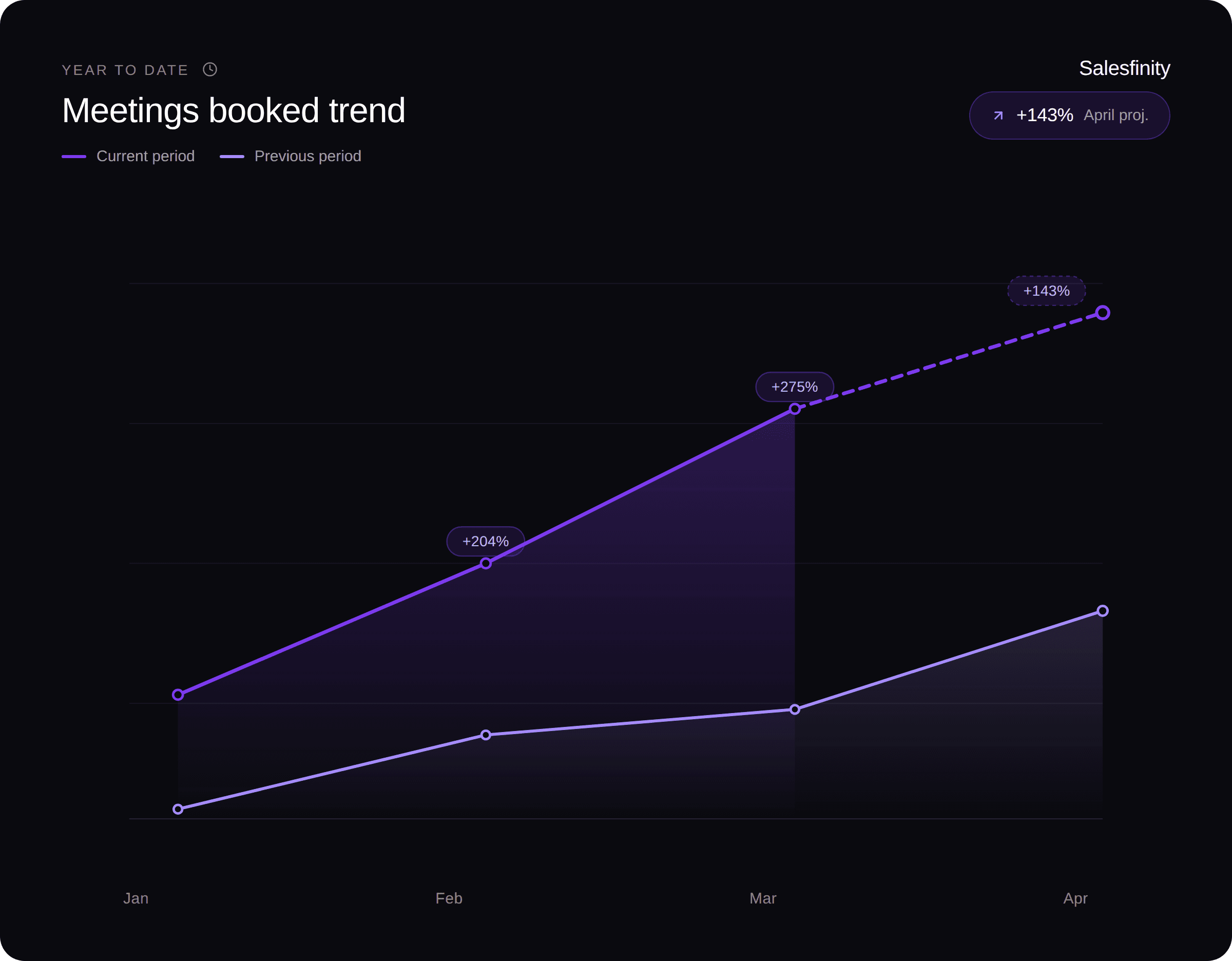
On the Salesfinity platform, customers running the full Compound Prospecting framework booked 275% more meetings in Q1 2026 versus previous period. Not 27%. Not 75%. 275%. The YTD trajectory through April is pacing at +143% versus the same period last year, even after normalizing for customer growth.
The compounding doesn't stop. Every quarter the nurture list is bigger, better-segmented, and more accurately timed. The cost per meeting drops. The SDR's output-per-hour climbs. The rep who looked average in Q1 looks exceptional by Q4, not because they got better — because the system they're running is compounding underneath them.
Compound Prospecting vs. Traditional Outbound
Dimension | Traditional Outbound | Compound Prospecting |
|---|---|---|
Primary input | Cold list | Cold list + nurture list |
Meeting source | 100% cold | Roughly 40% cold / 60% nurture (mature) |
Cost per meeting | Rises with list fatigue | Falls over time |
Rep output curve | Flat or declining | Compounding quarter over quarter |
Tenure impact | Senior reps = slightly better scripts | Senior reps = massive nurture-list equity |
Churn cost | Severe (rep takes pipeline context with them) | Manageable |
The bottom row is the one most sales leaders under-price. In a Compound Prospecting motion, an SDR is not just producing meetings — they are building a pipeline asset that lives in the system. When the system is built right, the asset survives the rep turnover. When it isn't, every SDR departure is a pipeline extinction event.
How to Start Running Compound Prospecting This Quarter
You don't need to rebuild your stack to get started. You need to fix the four leaks in this order:
First, fix the disposition. Every rep, on every call that doesn't convert, must capture three fields: the decision-maker detail, the specific timing objection, and the re-engagement trigger. If your current disposition flow doesn't force these, change it this week.
Second, fix the follow-up trigger. Audit your sequencer. For a random sample of 20 Good Fit, Not Now dispositions from the last 90 days, trace what actually happened. If fewer than 15 of them got re-engaged at the right moment, your follow-up system is broken regardless of what the dashboard says.
Third, fix the dialer math. Measure conversations-per-rep-hour. If it is under 8-10, your reps are rate-limited by the dialer, not the list. Parallel dialing and better caller ID management are the fastest wins.
Fourth, fix the data. This is last on the list, not because it doesn't matter, but because single-source data gets you to "okay" and that is enough to start the flywheel. Upgrade to multi-source waterfall enrichment once the first three are running.
Once all four are live, the compound starts. You will feel it in month two. You will see it in the dashboard in month three. By quarter three, the nurture list will be pulling its weight against the cold list, and by quarter four, the conversation will stop being "how do we generate more pipeline" and start being "how do we handle all the meetings we're booking."
Frequently Asked Questions
Is Compound Prospecting the same as lead nurturing? No. Lead nurturing typically refers to marketing-led email campaigns to top-of-funnel leads who raised their hand. Compound Prospecting is specifically a sales-owned motion that re-engages prospects who had a real outbound conversation and explicitly classified as Good Fit, Not Now. The input is a two-way conversation, not a form fill.
How long before Compound Prospecting shows ROI? Most Salesfinity customers see measurable nurture-list meetings within 60-90 days and see the full compound effect at the 6-9 month mark, when the nurture list reaches parity with the cold list in meetings-generated volume.
Does Compound Prospecting work for SMB outbound, or only enterprise? It works for both, but the re-engagement triggers differ. SMB triggers are usually event-based (funding rounds, new hires, job changes). Enterprise triggers are usually cycle-based (contract renewals, fiscal year boundaries, leadership transitions). The framework is the same; the signal sources differ.
What's the single biggest mistake teams make trying to run this? Treating the follow-up as a rep task instead of a system. Humans forget. Systems don't. If your nurture trigger depends on an SDR remembering a conversation from four months ago, it will fail.
Who owns Compound Prospecting in a revenue org — the SDR or the AE? The SDR, with the system doing the heavy lifting. The AE owns the meeting once it's booked. The SDR owns the asset (the conversation, the classification, the nurture trigger). In a mature org, this is explicit in comp — SDRs are measured on both net-new meetings and nurture-sourced meetings.
The Bottom Line
Outbound sales has spent the last decade optimizing the top of the funnel — better data, faster dialers, more sequences. The top of the funnel is now largely solved.
The pipeline teams have been leaking is in the middle: the 9 out of 10 conversations that end in "not right now" and never get re-engaged at the right moment.
Compound Prospecting closes that leak. Every conversation becomes an asset. Every asset compounds. And the teams that run it full-stack start to pull away from the teams that don't, not by 10% or 20%, but by multiples.
If you want to see how Salesfinity operationalizes all four pillars — SmartEnrich data, parallel dialer, built-in call coaching and scoring, and the nurture engine that makes the whole thing compound — the fastest way is to watch it run on your own ICP.