How to Get Past Call Screening on Cold Calls: What 2,468 Screened Calls Show


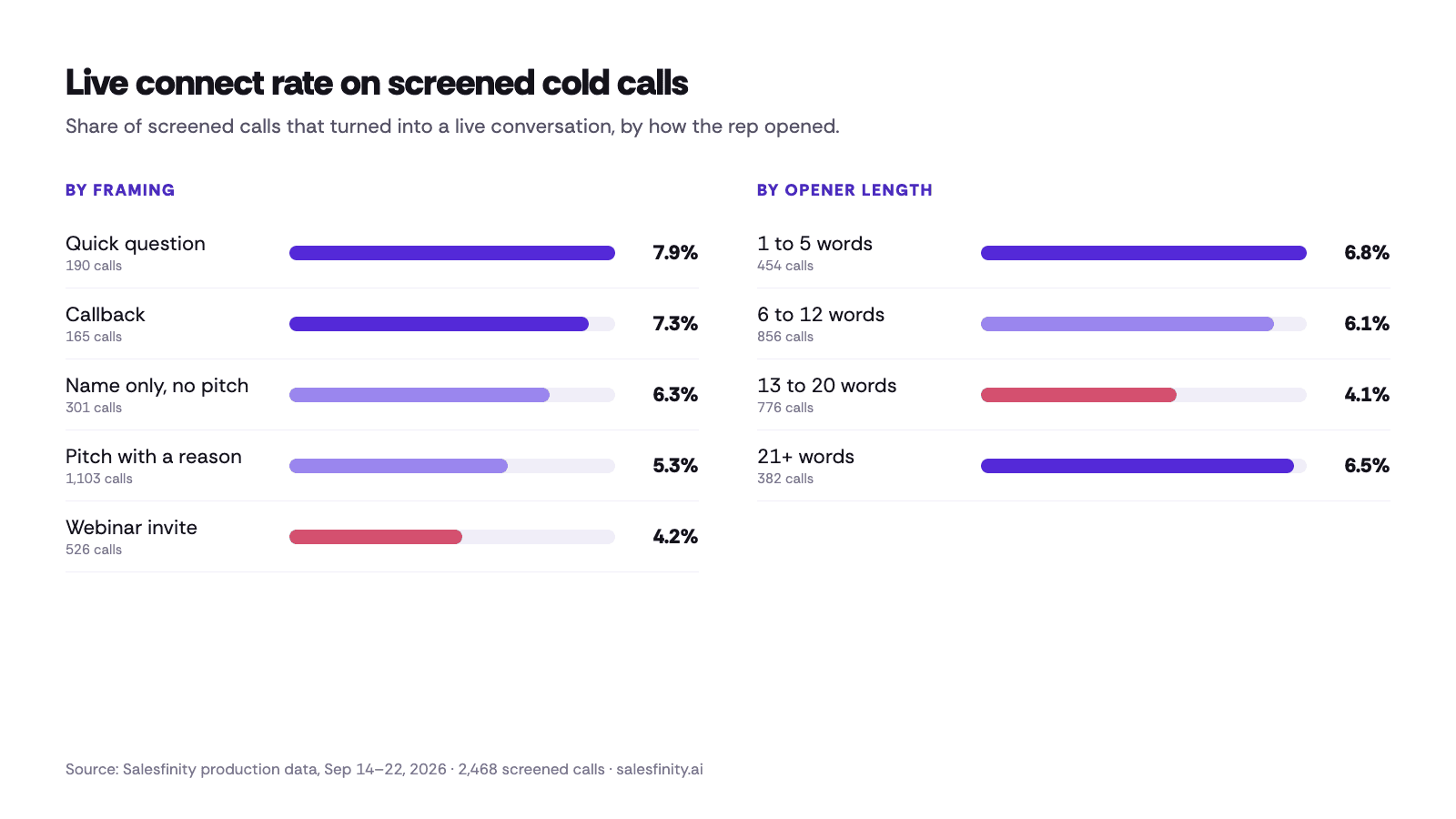
The short version: when a cold call hits call screening, like iPhone Call Screening, the first few words you say decide whether the owner picks up. Across 2,468 screened calls placed through Salesfinity, openers framed as a quick question turned into a live conversation 7.9% of the time, versus 4.2% for webinar invites. Length matters too, and not in a straight line: 1 to 5 words (6.8%) and 21+ words (6.5%) both beat the 13 to 20 word middle (4.1%). Naming your company or giving a reason for the call did not help on its own.
This study picks up where our 34,000-dial call screener study left off. That analysis showed call screeners cost you connects mostly on the first dial, and that screened prospects who pick up convert better. The next question is the practical one: what should you actually say to the screener?
The numbers at a glance
Metric | Result |
|---|---|
Screened calls analyzed | 2,468 |
Rep's name and reason relayed to the owner | 84% |
Owner accepted the call | 7.8% |
Became a live conversation | 5.7% |
Source: Salesfinity production data, September 14–22, 2026.
The takeaway from the top line: getting relayed is easy. Almost every rep who spoke to the screener had their intro passed along. The hard part is what happens next, when the prospect reads or hears your intro and decides in a second whether you're worth picking up for. That decision is where the opener matters.
What is call screening, and what happens to a cold call?
Call screening is a phone feature that answers calls from unknown numbers for the owner. On iPhone, Call Screening (expanded in iOS 26) asks the caller for their name and reason for calling, then shows the owner a live transcript so they can decide whether to pick up. Google's Call Screen does something similar on Android. For a cold caller, that means your first sentence is no longer heard by a person. It's read as a line of text, often at a glance, before anyone decides to answer.
Finding 1: How you frame the call matters more than what you pitch
Opener framing | Calls | Relayed | Accepted | Live connect |
|---|---|---|---|---|
Quick question | 190 | 89% | 10.5% | 7.9% |
Callback | 165 | 91% | 9.1% | 7.3% |
Name only, no pitch | 301 | 87% | 9.6% | 6.3% |
Pitch with a reason | 1,103 | 83% | 7.3% | 5.3% |
Webinar invite | 526 | 78% | 6.1% | 4.2% |
Source: Salesfinity production data, September 14–22, 2026 · 2,468 screened calls.
The most common opener in the data, a pitch with a reason (1,103 calls), was also one of the weakest. Reps explained who they were and why they were calling, and the prospect declined. Openers that promised something small and specific, a quick question, did best. Webinar invites did worst on every measure: they were relayed least often, accepted least often, and connected least often.
Why? A screened call turns your opener into a notification. A notification that reads like a question feels like it needs an answer. One that reads like an invitation or a pitch can safely be ignored.
Finding 2: Go very short, or commit to a full explanation
Opener length | Calls | Relayed | Accepted | Live connect |
|---|---|---|---|---|
1 to 5 words | 454 | 88% | 9.7% | 6.8% |
6 to 12 words | 856 | 85% | 8.2% | 6.1% |
13 to 20 words | 776 | 79% | 6.6% | 4.1% |
21+ words | 382 | 87% | 7.3% | 6.5% |
Source: Salesfinity production data, September 14–22, 2026 · 2,468 screened calls.
This is the finding most reps get wrong. The relationship between length and success is U-shaped, not a straight line. Very short intros (1 to 5 words) did best, and full explanations of 21 words or more held up well. The 13 to 20 word middle was the weak spot: long enough to sound like a pitch, too short to earn the pick-up with real substance.
If your current intro is a single sentence with your name, company and a vague value statement, you are probably sitting right in that 13 to 20 word zone.
The openers that worked, and the ones that didn't
These are real openers from the data, machine-transcribed from the recordings, with company names removed. Individual openers are small samples, so read them as illustrations of the patterns above, not as scripts to copy.
Highest live connect rate
14.3%: “Taylor returning this call.”
13.5%: “Hey it's Dan, just had a quick customer question, thanks, it'll be brief.”
8.6%: “Hey this is James.”
Lowest live connect rate
3.0%: “Joe, responding to your application.”
0.0%: “Matthew, calling about effective top-of-funnel spend on your revenue.”
0.0%: “This is Pearson, my CEO wanted me to reach out to you.”
One caution on the top of that list. A callback opener works because it signals an existing conversation. Only use it when that's true: they called you, replied to an email, or asked you to follow up. Claiming a callback that never happened might get one pick-up, but it burns trust on the very first second of the relationship, and prospects remember.
How to get past call screening: a playbook for SDRs
Lead with a quick question. “It's Sam, quick question for Dana.” A question reads like something that needs an answer.
Keep it to 1 to 5 words when you can. “Hey, it's Sam.” Short intros did best in this data and leave the prospect curious enough to pick up.
If you explain, go all the way. Past 20 words, a specific reason held up: “Hi Dana, it's Sam at Salesfinity. I work with sales leaders at fintech companies on cold call connect rates and had a quick question about how your SDR team handles screened calls.”
Use a callback only when it's real. “Sam, following up on Dana's email from Tuesday” is honest and still signals an existing thread.
Drop the webinar invite and the 13 to 20 word pitch. Both underperformed across every stage of the funnel.
Keep calling screened numbers. Our 34,000-dial study found the connect gap for screened numbers mostly closes by the second dial, and screened prospects who do connect convert better.
How the data was collected
Dataset: 2,468 cold calls that reached a call screener, placed through Salesfinity between September 14 and 22, 2026.
Openers: what the rep said to the screener, taken from machine transcripts of the call recordings. Company names are removed from the examples.
Relayed: the rep's name and reason were passed on to the phone's owner. Accepted: the owner picked up. Live connect: the call became a live conversation with the owner.
Framing and length: each opener was grouped by how it was framed (quick question, callback, name only, pitch with a reason, webinar invite) and by word count.
Limits: nine days of data, and some groups are under 200 calls, so treat small differences as directional. The individual opener examples are especially small samples.
Every call in this dataset was placed and transcribed through Salesfinity's AI Parallel Dialer, which is what made it possible to see exactly what reps said to the screener and what happened next.
FAQ
How do you get past call screening on a cold call? Keep your intro short and framed as a quick question. In an analysis of 2,468 screened cold calls, quick-question openers reached a live conversation 7.9% of the time, versus 4.2% for webinar invites, and intros of 1 to 5 words (6.8%) beat intros of 13 to 20 words (4.1%).
What should I say when iPhone Call Screening answers? State your name and a short, honest reason, framed as a question: “It's Sam, quick question for Dana.” Avoid long pitch sentences and event or webinar invitations, which had the lowest connect rates in the data.
What is iOS 26 call screening? iOS 26 expanded iPhone Call Screening, which answers calls from unknown numbers, asks the caller for their name and reason, and shows the owner a live transcript before they decide whether to pick up. For cold callers, the first sentence becomes a text preview the prospect reads before answering.
Does saying your company name help get through call screening? Not on its own. In this dataset, naming the company or stating a reason for the call did not improve connect rates by itself. How the opener was framed and how long it was mattered more.
How long should a cold call opener be for a call screener? Either very short (1 to 5 words) or a full explanation of 21 words or more. The 13 to 20 word range had the lowest live connect rate, 4.1%.
Should I leave a callback-style message to a call screener? Only if there really is something to call back about. Callback openers connected at 7.3% in this data, but claiming a callback that never happened damages trust with the prospect from the first second.
How often do cold calls get screened? In our earlier analysis of 782,728 dials, about 2.5% were screened. Screened calls are a minority of dials, which is exactly why the opener matters so much on the ones that do hit a screener.
Should SDRs skip numbers with call screening? No. A separate 34,000-dial analysis found that screened numbers connect less often on the first dial, but the gap nearly disappears by the second, and screened contacts who connect give a positive response more often (30.9% vs 25.8%).