Parallel vs Exa - AI Search Prospecting Benchmark


The short version: we ran Parallel and Exa head-to-head across 16 prospecting queries and 592 results. Exa won ten queries, Parallel won one, three were ties — and on two, neither engine could answer at all. But the number that actually changed our conclusion was this: across eight identical people searches, the two engines returned 13 of the same 152 people. Barely 8%.
Neither index contains your market. Here is the full data.
How we tested
Every go-to-market team is quietly rebuilding its prospecting stack on AI search. The pitch is irresistible: skip the rigid filter forms, describe your buyer in a sentence, get a list. Two of the strongest entrants are Parallel's Entity Search and Exa's people and company search.
We tested them on the kind of request an SDR manager actually makes on a Monday — not demo queries. Sixteen natural-language searches, eight for companies and eight for people, twenty results each, identical wording sent to both engines, no per-vendor tuning, plus depth probes at a hundred results. Then we read all 892 results and graded every one.
Four of the eight people queries were anchored to a named employer across a deliberate spread of company sizes — Snowflake, Datadog, Klaviyo, Vanta — because "find me the AEs at this account" is the single most common request in outbound.
Scoring is precision: the share of results that satisfy every constraint in the query, not just the topic. Ask for Texas and get Ohio, that's a miss. Ask for 50–200 employees and get a 12-person shop, that's a miss. Where an engine cannot express a constraint at all, the misses still count against it — a constraint you can't enforce is one your reps discover the hard way.
The scoreboard
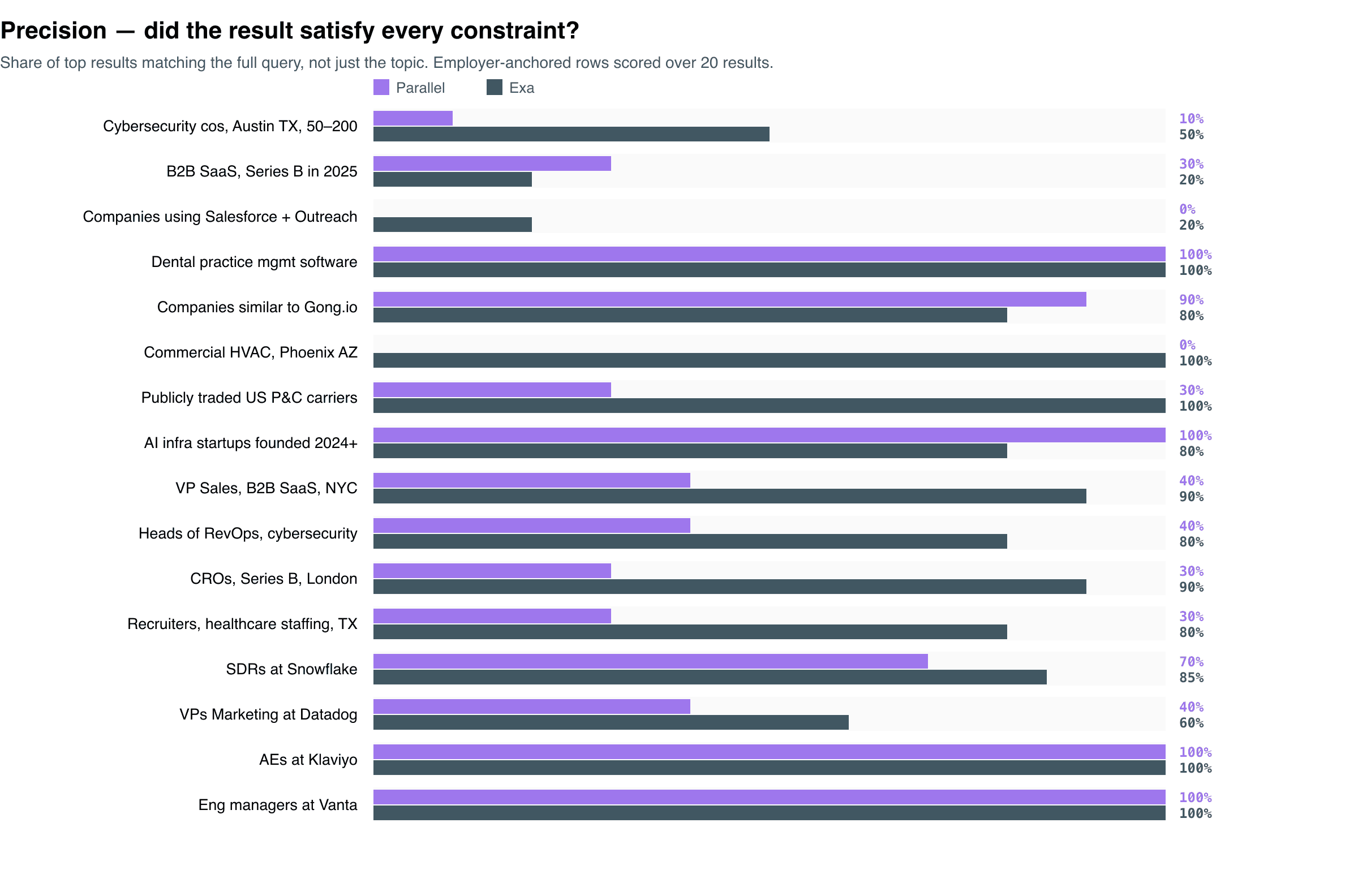
The same sixteen queries with timings and the constraint each engine dropped:
Query | Parallel | Exa | Par ms | Exa ms | Winner |
|---|---|---|---|---|---|
Cybersecurity cos, Austin TX, 50–200 staff | 1/10 | 5/10 | 964 | 106 | Exa |
B2B SaaS that raised a Series B in 2025 | 3/10 | 2/10 | 675 | 69 | both fail |
Companies using Salesforce + Outreach | 0 rows | 2/10 | 172 | 75 | both fail |
Dental practice management software | 10/10 | 10/10 | 646 | 70 | tie |
Companies similar to Gong.io | 9/10 | 8/10 | 537 | 54 | tie |
Commercial HVAC contractors, Phoenix AZ | 0 rows | 10/10 | 173 | 61 | Exa |
Publicly traded US P&C carriers | 3/10 | 10/10 | 677 | 74 | Exa |
AI infrastructure startups founded 2024+ | 10/10 | 8/10 | 484 | 113 | Parallel |
VP Sales at B2B SaaS in NYC | 4/10 | 9/10 | 2,165 | 61 | Exa |
Heads of RevOps at cybersecurity cos | 4/10 | 8/10 | 1,172 | 84 | Exa |
CROs at Series B startups in London | 3/10 | 9/10 | 2,194 | 64 | Exa |
Recruiters at healthcare staffing, Texas | 3/10 | 8/10 | 1,297 | 72 | Exa |
SDRs at Snowflake | 14/20 | 17/20 | 1,169 | 55 | Exa |
VPs of Marketing at Datadog | 4/10 | 6/10 | 863 | 1,506 | Exa |
Account executives at Klaviyo | 10/10 | 10/10 | 3,188 | 1,251 | tie |
Engineering managers at Vanta | 10/10 | 10/10 | 845 | 1,226 | tie |
Median latency: company search — Parallel 646ms, Exa 74ms. People search — Parallel 1,297ms, Exa 84ms.
The pattern behind the scoreboard
Parallel wins exactly where the request maps onto a label it already holds. Ask for AI infrastructure startups founded in 2024 and every row comes back stamped with a founded year and a sector — a clean 10 out of 10, beating Exa. Ask for dental practice management software and it is flawless, and stays flawless a hundred rows deep.
It loses wherever the constraint has to be checked against the world rather than looked up on a label. Publicly traded property and casualty carriers returned mutual insurers, an acquired brand, and one company its own data marked as deadpooled. Exa returned Progressive, Travelers, Hanover, AIG, The Hartford, Selective, RLI, Markel and Erie — with revenue figures attached.
Exa is the inverse: weaker at taxonomy, much stronger at grounding a result in a real place, a real size and a real current job.
The comma that deleted a market
One query in our set was "commercial HVAC contractors in Phoenix, Arizona." Parallel returned nothing. Not an error — a clean 200 OK with an empty list. Assuming we had malformed something, we started shortening it.
Objective sent | Results | Response time |
|---|---|---|
HVAC contractors in Phoenix | 20 | 801ms |
HVAC contractors in Phoenix, Arizona | 0 | 260ms |
commercial HVAC contractors in Phoenix | 20 | 650ms |
commercial HVAC contractors in Phoenix, Arizona | 0 | 418ms |
Four repeats of each, perfectly deterministic. And look at the timings: every empty response returned in under 450ms while every populated one took more than 600ms. The zeros are not an exhaustive search that found nothing. They are an early exit.
Add a state name, lose a market. Nothing in the response distinguishes "this market does not exist" from "your phrasing missed the index." A rep asks for Phoenix contractors, sees an empty screen, and moves on. There are hundreds of them.
An empty list is the most expensive result a prospecting tool can return, because it looks exactly like the truth.
"Works at" is doing a lot of load-bearing work
The employer-anchored searches are where a prospecting tool earns its keep, so we graded them hardest: does the person actually work there right now? Exa was held to its structured current-employer field. Parallel has no employer field at all, so we credited it whenever the company appeared explicitly as the row's employer in its text.
Anchor account | Parallel: employer stated | Exa: currently there | Exa: past employee | Exa: different employer |
|---|---|---|---|---|
Snowflake | 14/20 | 17/20 | 3 | 0 |
Datadog | 16/20 | 16/20 | 1 | 3 |
Klaviyo | 20/20 | 20/20 | 0 | 0 |
Vanta | 19/20 | 20/20 | 0 | 0 |
At mid-size and smaller accounts the two engines are indistinguishable — both return effectively perfect rosters. The gap opens at the top of the market, where the roster is large enough that matching on text alone starts pulling in the wrong people.
Which brings us to the most instructive row in the entire test. We asked both engines for VPs of Marketing at Datadog. Parallel returned a marketing leader whose own profile headline reads "VP Product Marketing ¦ Ex Datadog ¦ Ex JFrog."
Exa returned the same person, and listed their current employer as Fastly.
One engine matched a substring. The other knew where they work now. That is not a rounding error in a list — it is a rep opening a call with "I saw you're leading marketing at Datadog" to someone who left months ago.
Geography failed the same way. Asked for recruiters at healthcare staffing agencies in Texas, Parallel returned genuine healthcare staffing recruiters — with no location field anywhere in the payload, several of them at agencies headquartered in other states. Exa returned Dallas, Austin, Irving and Fort Worth, city attached to every row.
What actually comes back in the payload
This is the difference that never shows up in a demo. Parallel's response schema is three fields: name, url, description. Everything else — headcount, founding year, funding stage — arrives as unparsed prose inside the description, and only sometimes.
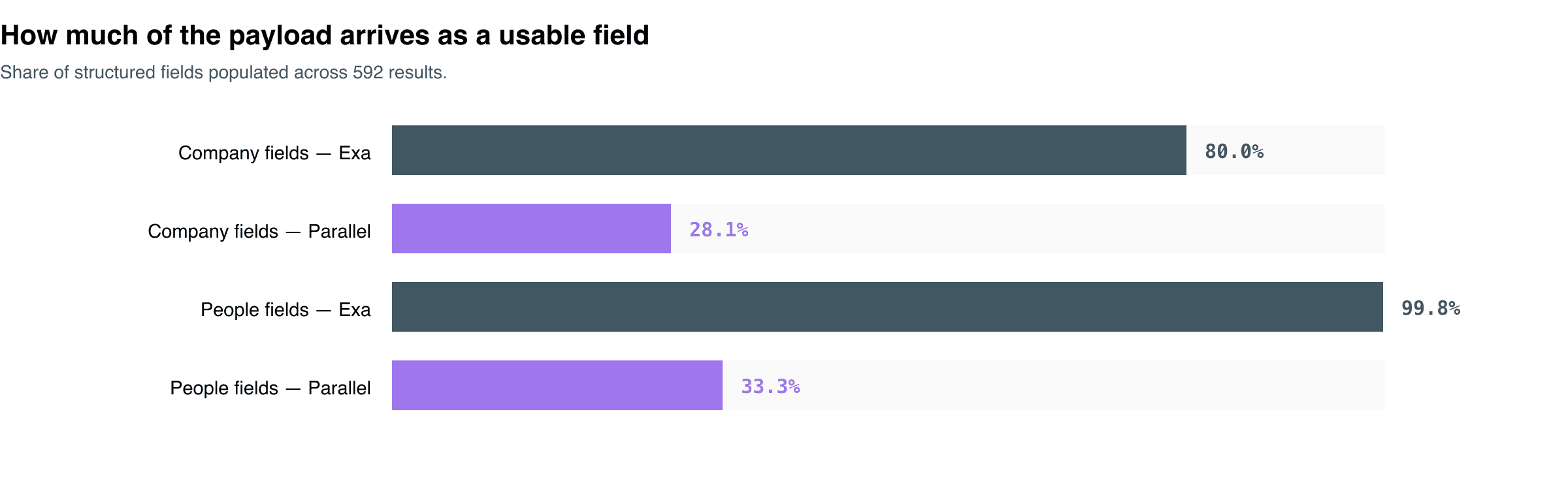
Structured field | Exa | Parallel |
|---|---|---|
Company — headcount | 151/160 | 0 (27/120 in prose) |
Company — founded year | 129/160 | 0 (65/120 in prose) |
Company — HQ location | 157/160 | 0 |
Company — annual revenue | 58/160 | 0 |
Company — total funding | 56/160 | 0 |
Company — monthly web traffic | 107/160 | 0 |
Person — current title | 160/160 | 0 |
Person — current employer | 160/160 | 0 |
Person — location | 160/160 | 0 |
Person — role start date | 158/160 | 0 |
Person — full work history | 157/160 | 0 |
Parallel's prose is not worthless — it often contains the fact you wanted. But using it means running an extraction pass on every row, which is a cost of its own.
The domain problem
Here is one that sounds technical and is entirely operational. Ask Parallel for companies and you get a professional-network page or a startup-database entry. You do not get the company's website.
Company results | Own website | Professional network | Startup database |
|---|---|---|---|
Parallel | 0 / 120 | 99 | 21 |
Exa | 145 / 160 | 15 | 0 |
Zero out of 120 is not a sampling artifact — the depth probes at a hundred results returned zero own-domain URLs too. For people, both engines return profile URLs, which is the right answer.
A company domain is how a list gets deduplicated against your CRM, matched to an existing account, suppressed if it is already an open opportunity, and routed to the right rep. A list of a thousand companies with no domains is not a list — it is a thousand lookups you now owe somebody.
Freshness, and whether you can even tell
Exa timestamps its records. Parallel exposes no date field of any kind — no crawl date, no role dates — so a consumer cannot age out a stale row or detect that someone changed jobs.
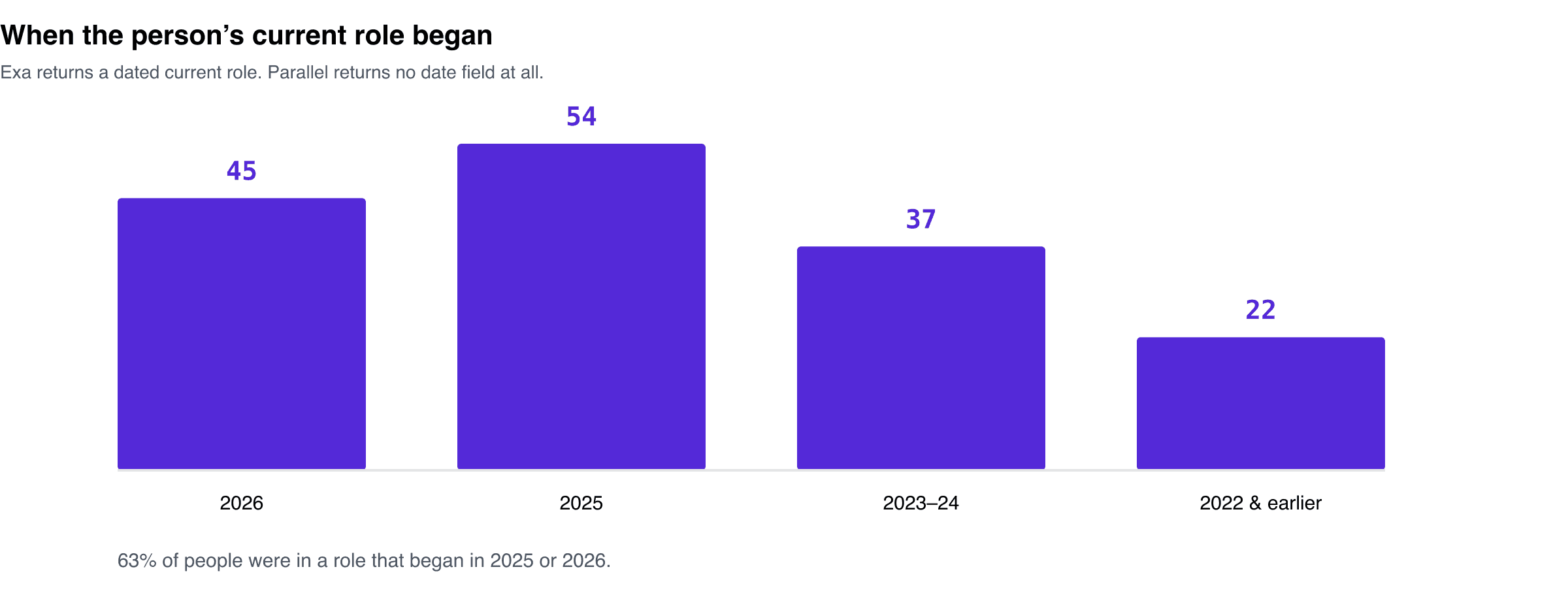
Company records carried a crawl date on 157 of 160 rows and a monthly web-traffic series current to within about two months. The newest people record was crawled two days before the test. And the currency flag is load-bearing, not cosmetic: Exa correctly marked four of eighty employer-anchored people as past employees rather than silently presenting them as current.
Everything that broke
No technology-usage search
Every phrasing of a tech-stack query returned zero results from Parallel. Exa answered, but returned vendors of sales-engagement software rather than companies using it — 2 of 10.
Headcount bands ignored
Asked for Austin cybersecurity companies with 50–200 staff, half of Exa's results fell outside the band. Parallel returned firms its own text marked as having 11–50 employees.
Entity-type drift
Asked for companies that raised a Series B, Parallel's top result was a venture firm rather than a portfolio company. Exa's list included a media outlet covering SaaS news, plus companies in Japan, Korea, Serbia and China.
Precision decays with depth
Parallel's hundred-row lists hold up on clean taxonomy queries — dental software was still on-target at row 100. On constraint-heavy queries the tail collapsed into adjacent businesses: insurance agencies and brokers instead of publicly traded carriers.
Neither engine enforces a filter
Both are retrieval engines with a language model in front, not databases with constraints. Nothing in either API guarantees a returned row satisfies what you asked for — which is fine, as long as something downstream is checking.
What it costs
Parallel is dramatically cheaper, and the gap widens with depth because its price includes the first hundred results.
Per request | 20 results | 100 results | Per result at 100 | Rate limit |
|---|---|---|---|---|
Parallel Entity Search | $0.0050 | $0.0050 | $0.00005 | 600/min |
Exa search + contents | $0.0370 | $0.1970 | $0.00197 | — |
Difference | 7.4× | 39× | 39× | — |
For the narrow set of questions Parallel answers well, it answers them at a price that makes running the query on every account in your territory a rounding error. A hundred account executives at one company cost half a cent from one engine and twenty cents from the other.
And then the number that changed our conclusion
We ran the same eight people searches through both engines and checked how many of the same humans came back.
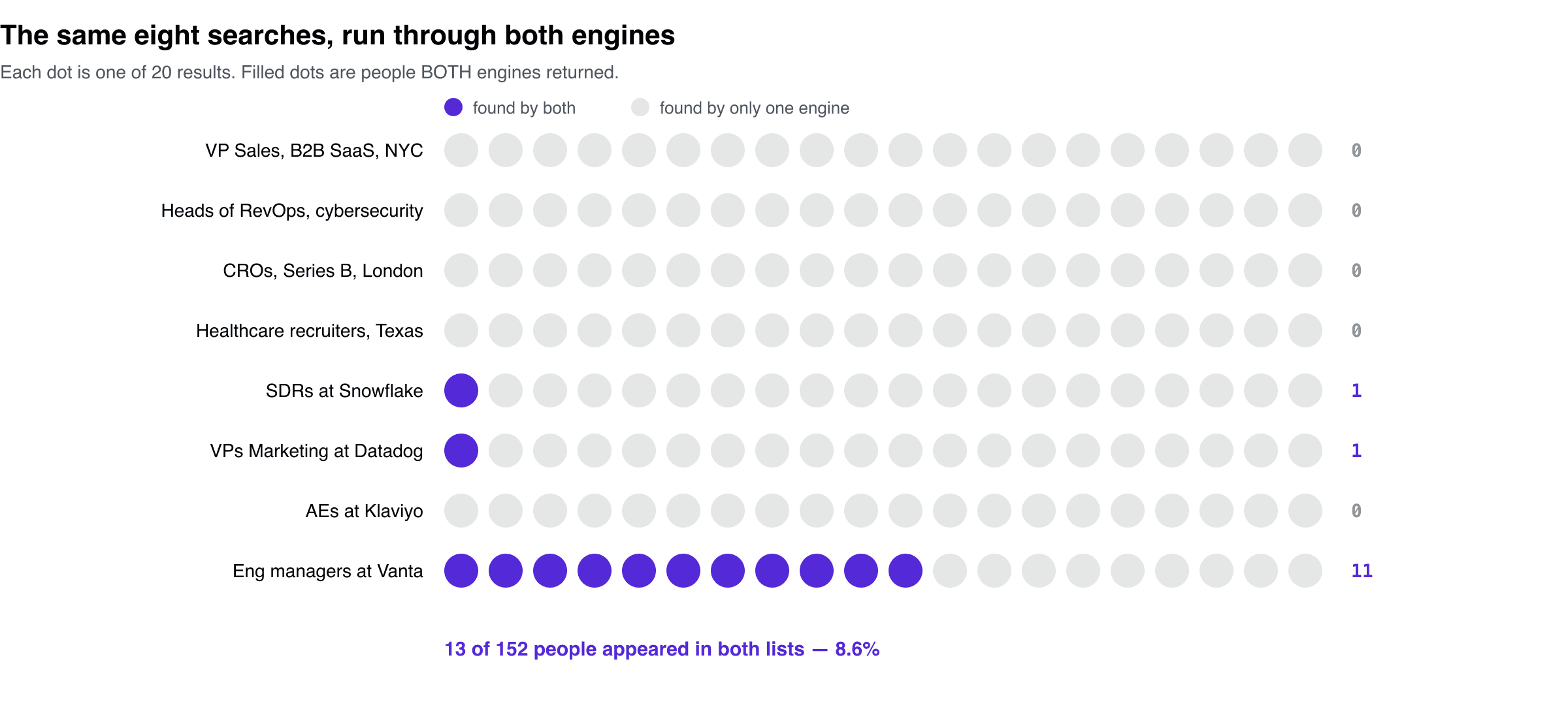
On six of eight searches, two of the best AI search engines available returned zero or one of the same people. They converged only on the narrowest possible question — engineering managers at a 900-person company, where the true answer is a short, finite list, and even there they agreed on barely half.
Read that carefully, because it is not a knock on either vendor. It means neither index contains your market. Each holds a slice. When you run a query and get twenty names, you are not seeing the twenty best people who match — you are seeing the twenty best that index happens to know about. The other engine, same query, same instant, found nineteen or twenty completely different humans who matched just as well.
If you build your go-to-market on a single provider, you are not prospecting your market. You are prospecting one vendor’s copy of it.
What this means for how you buy
The instinct after a test like this is to pick the winner. That instinct is the mistake. Look at what actually happened across sixteen queries:
When the request is… | The right engine is… | Margin |
|---|---|---|
A deep roster at one named account | Parallel | $0.005 for 100, on-target |
Anything with a place in it | Exa | structured geo vs none |
Companies you'll match to your CRM | Exa | 145/160 vs 0/120 domains |
A recency-and-sector list | Parallel | 10/10 vs 8/10 |
Proof someone still works there | Exa | dated current role |
A niche vertical by what they build | either | 10/10 both |
Companies by the technology they run | neither | 0 results / wrong entities |
Headcount or funding-stage bands | neither | constraint ignored by both |
There is no row in that table where one engine answers everything, and two rows where the answer is neither. A single go-to-market motion crosses all of them in one afternoon: build the account list, find the buyers at those accounts, confirm they still work there, filter to the right region, then narrow to the ones running the software you integrate with.
Doing that well is not a data-vendor decision. It is a routing decision, made per query, at the moment the question is asked — recognizing that this ask is employer-anchored and cheap depth wins; that this one has a state in it and needs structured geography; that this one is technographic and needs a specialized source neither general engine can serve; and that when a source comes back thin, the answer is to try the next one rather than show a rep an empty screen.
That is a system, and it has to keep working when a vendor changes its index, reprices, or quietly starts returning zero for queries with a comma in them.
This is exactly what we built
Salesfinity's AI Companion runs list building as an agentic harness across many data providers rather than a search box in front of one. It reads the intent behind the request, routes each part of it to the sources that can actually honor it, waterfalls to the next provider when one comes back thin, gates every contact against the company it claims to work for, and re-verifies employment before a rep ever dials.
No single index has your market. The engine that finds it has to know which door to knock on for each question — and to keep knocking.
Build your list on all of it, not one slice of it. Describe your buyer once. Salesfinity's AI Companion works the full data network to build the list, verifies who is still there, and hands your reps a queue they can dial today.
Method
16 natural-language queries — 8 company, 8 people — run against Parallel Entity Search and Exa search-with-contents in August 2026. 20 results per query per engine (592 results), plus depth probes at 100 results (a further 300), for 892 reviewed in total. Identical wording to both engines, no per-vendor tuning, one run per query except where repeat runs are reported.
Relevance was graded by our team reading every result list against the constraints in the query; latency, structured-field coverage, URL type, employer attribution, duplication and cross-engine overlap were measured programmatically. Pricing is each vendor's published rate card as of the test date. Both products are actively developed and improving — these results are a snapshot, not a permanent verdict, and we would encourage you to run the same test yourself before making a decision.