How to Turn More Cold Calls Into Meetings (Without More Dials)


The short version: with today's dialers, volume is solved. Conversion is not. On the Salesfinity platform, 8.1% of cold call conversations turned into meetings in the 30 days to July 17, 2026, and most teams sit between 5% and 10%. Move it from 10% to 15% or 20% and you get 50% to 100% more pipeline from the calls you already make. The way there is relevance on every call: a talk track for each persona, coaching in the moment, and call scores that tell you whether to fix the process or the rep.
The Salesfinity platform, 30 days to July 17, 2026. Source: Cold Call Benchmarks.
Conversations aren't the problem anymore
With any of today's dialers, you can hit the volume. Parallel dialing and validated numbers put reps in front of more people than ever.
So getting people on the phone is no longer the hard part. The hard part is what happens after they pick up. Our own data shows it plainly. In the 30 days to July 17, 2026, connects on the Salesfinity platform rose 19.5% over the month before: 21,650 more people picked up the phone. Meetings rose by 7.
The bottleneck moved inside the conversation. So the question every sales leader should be asking now is simple: how do we turn more of these conversations into meetings?
What is a good cold call conversation-to-meeting rate?
A good conversation-to-meeting rate is about 10%: one meeting for every 10 real conversations. Most teams sit between 5% and 10%. Across the Salesfinity platform in the 30 days to July 17, 2026, it was 8.1% (Cold Call Benchmarks, July 2026).
Funnel stage | Volume | Conversion |
|---|---|---|
Dials | 1,315,034 | |
Connects | 132,682 | 10.1% of dials |
Conversations | 42,405 | 32.0% of connects |
Meetings booked | 3,445 | 8.1% of conversations |
That last row is the one to watch. 38,960 real conversations, with people who picked up and talked, ended with nothing on the calendar. The month before, the rate was 8.6% (Cold Call Benchmarks, June 2026).
To find your own rate, divide the meetings booked by the conversations held in the same period. Count a conversation only when the rep actually talked with the person: not a voicemail, a wrong number or a gatekeeper. For the full benchmark set, including dials per meeting by percentile, see Cold Calling Benchmarks 2026: What 1.3M Dials Reveal.
The math: 15 to 20% conversion means 50 to 100% more pipeline
Now picture a team at 10% turning 15% or 20% of its conversations into meetings instead. Same list, same dials, same connect rate. Only the last step changes.
Conversations that become meetings | Meetings from 1,000 conversations | Meetings compared with 10% |
|---|---|---|
10% | 100 | Baseline |
15% | 150 | +50% |
20% | 200 | +100% |
Illustration. That is 50 to 100 more meetings for every 1,000 conversations, without buying another list, hiring another rep or making another dial.
There is plenty of room to grow. On the same dialer, in the same 30 days, the best team on the platform booked a meeting every 102 dials and the weakest needed 690. Volume is not what separates them. What happens inside the conversation is.
Why conversion is so hard to move
To convert more conversations, reps have to be relevant in the first minute. Getting there takes rigorous coaching, and selling into enterprises makes it harder in three ways.
Every persona cares about something different
When you sell into enterprises, you are never talking to just one buyer. Managers, directors and VPs each care about different things, and what lands with one falls flat with the next.
Who picks up | What they care about | What lands |
|---|---|---|
Manager | Their team's week: workload, tools, this month's number | A problem their team hits every day, and how it goes away |
Director | Moving the team's number, and proving it | A result from a team like theirs |
VP | This year's priorities and the risks to them | Why it matters now, at the company level |
Add industries on top, each with its own language and its own objections, and the talk track a rep needs changes from one call to the next.
New reps take months to get there
A new SDR has to learn the problem you solve, each persona, each industry and your product, plus the answers to the objections each one raises. Until they do, they struggle on exactly the calls that matter most. That takes months.
Managers don't have the hours
If your reps are coachable and your managers can spend real time on the floor, they will get there. But if you are growing fast, managers can't sit in on every call or coach every rep on every persona. Ramp slips even further, and every call a rep isn't ready for is a meeting you don't book.
How to turn more cold calls into meetings
Six things move this number. None of them need more dials.
1. Chase completions, not only meetings
Not every good cold call ends in a meeting. With the wrong person, the right outcome is a referral. With the right person at the wrong time, it is a follow-up. A rep who pushes for a meeting on every call kills the conversation before the pain comes out. Define a good outcome for each situation instead. We call these completions:
Meeting booked: the right person, with a real pain and some interest.
Qualified: the right person with a real pain, not ready to meet yet.
Referral: not the right person. Get the name of who is, and call them right away.
Follow-up set: the right person at the wrong time. If they say "call me in a month", call back in two weeks.
Info gathered: they won't engage now, but they'll tell you what they use and when it renews.
Disqualified: not a fit, or firmly not interested. Ask for the quick reason and end politely.
The meetings come from the calls where they are earned, and the rest of the calls still move the account forward.
2. Follow a call flow that earns the meeting
The cold calls that convert follow the same arc: get permission, earn a little trust, confirm you have the right person, make it relevant, then ask. This is the call flow Live Assist starts every team with, and you can change any step.
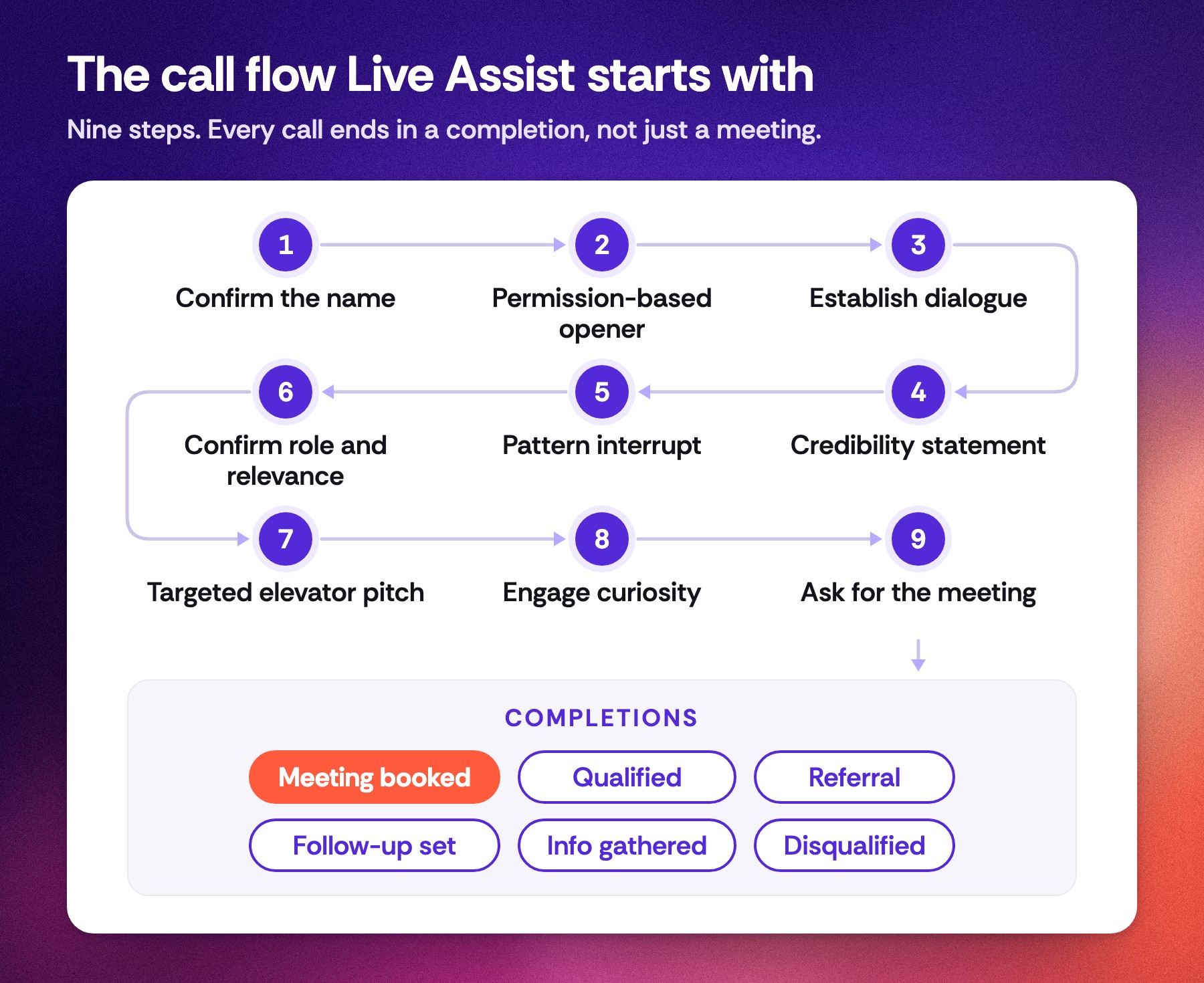
The ask comes last, only once the role, the relevance and a real pain are clear. Make it easy to say yes: "Would you be opposed to a quick 15-minute chat, say Tuesday at 10 or Wednesday at 2?"
3. Write a talk track for each persona
One generic pitch can't serve a manager, a director and a VP. For each persona, write down the problem they feel, the outcome they want, and one line that connects the two. Keep the pitch to one breath: problem to outcome.
4. Bring proof that fits the person on the line
"We work with teams like yours" only lands when the rep can name a customer the prospect recognizes, in their industry, with a result they care about. Keep your case studies and customer stories where reps can use them in the middle of a call, not in a folder nobody opens.
5. Prepare for the objections you hear most
Many calls are lost in the few seconds after "not interested", "we already have something" or "send me an email". Your best rep has an answer ready. Write those answers down as rebuttals and battle cards so every rep has them. There is more on this in Overcoming Objections in Cold Calling.
6. Score every call against the same scorecard
You can't improve what you can't see. Score every call against one scorecard, the one that describes your process, so you know who follows it and whether it works.
Live Assist: a coach on every call
All six of those work when a manager has the time to coach every rep on every persona. Most don't. We built Live Assist to close that gap.
Salesfinity gives your reps the conversations. Live Assist helps them win more of those conversations. You build your playbook once: how to talk to each persona and what matters to them. Then you add what your best reps already rely on:
Case studies and customer stories
Rebuttals for the objections you hear most
Battle cards
Talk tracks and your call flow
A real call on our own account. Our founder plays the prospect: "We are all set with our current dialer." This is what the rep's screen does next.
During the call, Live Assist listens to both sides. When the prospect pushes back, names a competitor, asks a question or shows a buying signal, the rep gets one short line to say, with a follow-up for what to ask next. When the rep starts answering, it steps back.
It coaches reps toward completions, even when no manager is on the sales floor. The coach works in the background on every call, so reps stop going quiet when they don't know what to say. The first time you see it, it feels like magic.
Another real call. The prospect is not the right person and has no budget. Live Assist gives the rep the line from the team's battle card, the prospect names the team that owns the problem, and the call ends as a Referral.
The lines come from your own material: your team's own plays first (when they say this, you say that), then battle cards, then your call framework. If nothing fits, it falls back to general guidance and labels it. It does not make up customers or numbers. For the full tour, see Introducing Live Assist.
Process problem or behavior problem? Now you can tell
Live Assist and call scoring do two things together.
1. Your process reaches every rep
When you set up a process you believe in, Live Assist makes it the default on every rep's calls, not only your best reps'. The call flow, your answers to objections and your must-do checklist show up live, and the checklist ticks itself off as the rep covers each item.
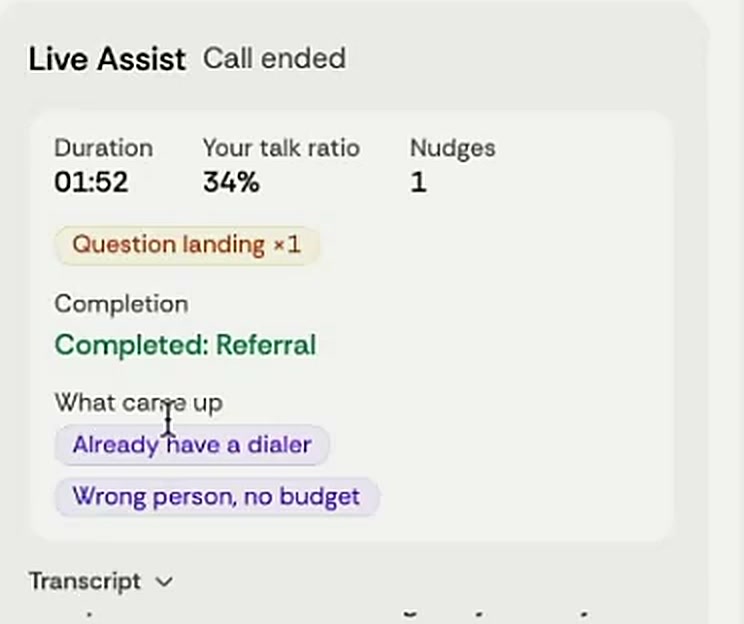
When the call ends, the rep sees a recap: the talk ratio, the nudges, the completion they reached and the must-dos they covered.
2. You see whether it works
After each call, Salesfinity scores it against your own scorecard. You decide what it grades and how much each part counts (Score calls your way). Then you see, rep by rep, who is following your process and whether it books meetings.
Put those scores next to meetings booked, and every rep lands in one of four places:
Following the process and booking meetings: the process works. You have a repeatable way to book meetings, so you can hire more reps and scale it.
Following the process and still not booking: it's a process problem, not a people problem. Change the playbook, then check the next month's scores.
Not following the process: it's a behavior problem. Coach the rep, or make the hard call.
Booking without the process: find out what they do differently, and add it to the playbook.
No more black box. Conversion stops being an art and becomes a science: instead of guessing why meetings are down, you know whether to fix the playbook or coach the rep.
Get started this week
Find your rate. Divide last month's meetings by last month's conversations. Under 10% means there is pipeline on the table.
Write the playbook. Pick your top three personas. For each, write the talk track, the proof and the answers to the top objections.
Put it on every call. Load the playbook into Live Assist so every rep has it, live.
Review the scores every week. Place each rep in one of the four boxes above, then scale, fix the process or coach.
Try Live Assist
Turn more of the conversations you already have into meetings, and know whether to fix the process or coach the rep.
Not using Salesfinity yet? Book a demo with our sales team and we'll show you Live Assist on a real call. Already a customer? Ask your CSM to turn it on for your team.
Frequently asked questions
What is a good cold call conversation-to-meeting rate?
About 10%, or one meeting for every 10 real conversations. Most teams land between 5% and 10%. Across 42,405 conversations on the Salesfinity platform in the 30 days to July 17, 2026, the rate was 8.1%.
How many cold calls does it take to book a meeting?
On the Salesfinity platform in the 30 days to July 17, 2026, it took 382 dials on average. The best team needed 102 dials per meeting and the weakest needed 690.
How much more pipeline does a higher conversion rate give me?
Meetings grow in step with the rate. Going from 10% to 15% of conversations means 50% more meetings from the same calls. Going to 20% doubles them.
Why don't more dials fix it?
Because the leak is inside the conversation, not before it. Month over month, connects on the platform rose 19.5% while meetings rose 0.2%.
How long does it take a new SDR to ramp?
Months. A new rep has to learn your problem, your personas, your industries and your product, plus the objections each one raises. Live Assist gives them your best answers on their first call while they learn.
What does Live Assist do?
Live Assist is a real-time sales coach inside the Salesfinity dialer. It listens to a live call and, when the prospect pushes back or shows interest, shows the rep one short line to say from your own playbook. When the call ends, the rep gets a recap, and call scoring grades the call against your scorecard.
How do I get Live Assist?
Live Assist is an add-on for Salesfinity customers: ask your CSM to turn it on. New to Salesfinity? Book a demo.
Sources: Cold Call Benchmarks, The Call Report, July 2026 and June 2026, Salesfinity platform data. Live Assist call flow and completions are the product defaults; every team can edit them.